| Question | Short Answer |
|---|---|
| Is Senecio 'Angel Wings' a true succulent? | No. |
| How large does Senecio 'Angel Wings' grow? | Mature plants form clumps about 30–45 cm tall and wide. |
| Can Senecio 'Angel Wings' grow indoors? | It is often sold as a houseplant, but warm dry indoor air usually causes lower-leaf loss. |
| How do you propagate Senecio 'Angel Wings'? | Division is the standard method. |
Senecio candicans 'Angel Wings' is a commercial cultivar selected from the wild Senecio candicans DC., a sub-Antarctic coastal species from southern Patagonia. 'Angel Wings' was introduced to the European market around 2015 and has since been sold widely as a striking silver-leaved patio plant. Strictly, it is semi-succulent rather than truly succulent; the leaves are thick and water-storing but less so than Echeveria or Curio.
Part of the Complete Senecio Guide.
Identification
- Clumping semi-succulent shrub, 30–45 cm tall and wide at maturity.
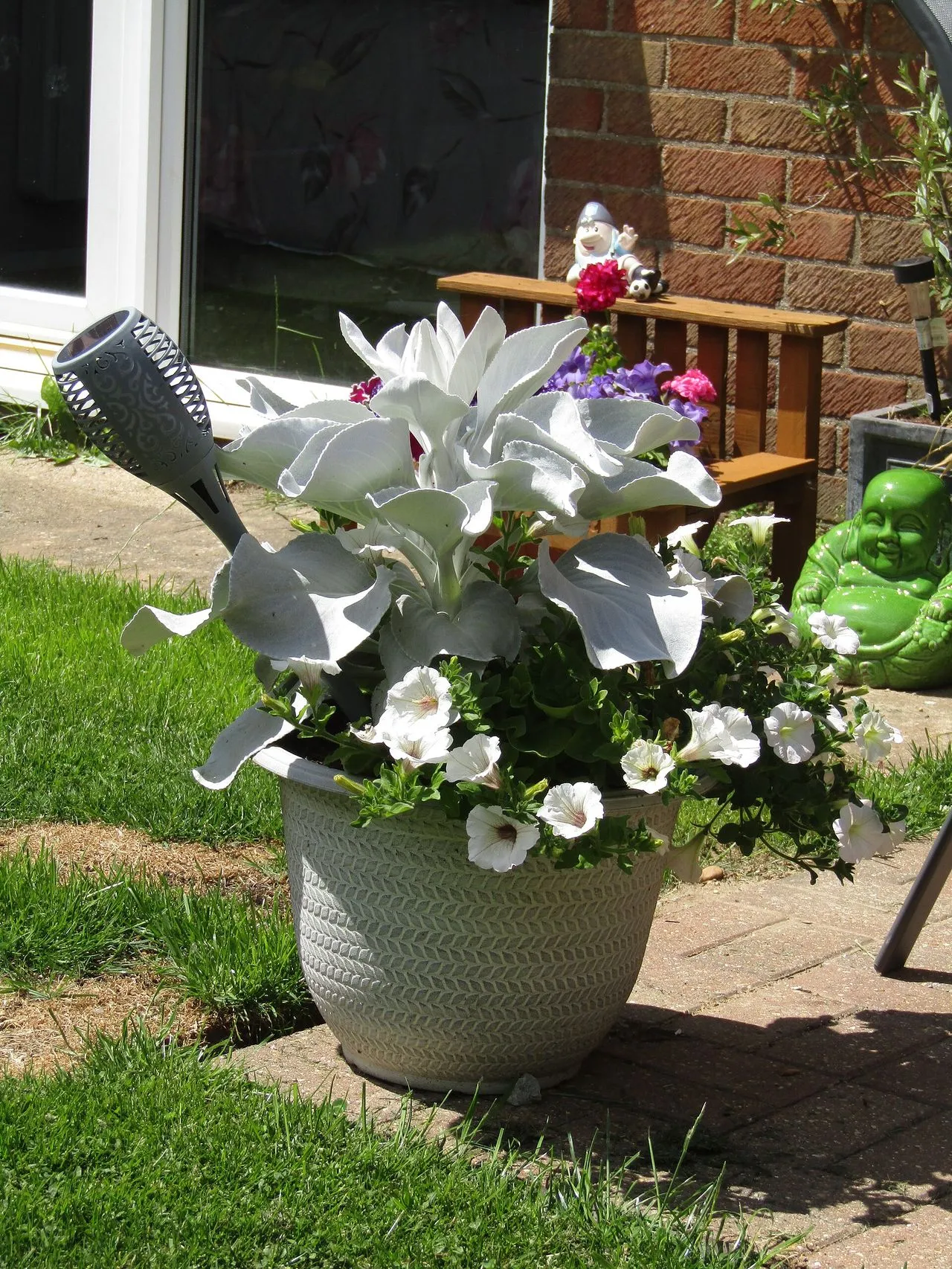
- Leaves large, broad, cordate to oblong, 15–20 cm long, covered in dense pure-white tomentum on both surfaces.
- Leaf margin smooth to slightly undulate; basal rosette habit with leaves radiating outward.
- Flower heads cream to pale yellow, in branched corymbs; flowering is sparse in cultivation.
The broad silver-white leaf is diagnostic. Senecio cineraria (dusty miller) has smaller, deeply cut, fern-like silver leaves; Senecio haworthii has cylindrical finger-leaves. 'Angel Wings' has flat broad leaves the size of a human palm.
Cultivation
Where this cultivar diverges from the standard Senecio / Curio regime:
- Light. Full sun to bright partial shade. The tomentum functions as a reflective layer; the plant expects exposure.
- Water. Significantly more than the pillar default. The leaves are only modestly succulent, and the species comes from a cool coastal habitat with reliable moisture. Water when the top 3 cm of substrate dries, typically weekly in summer. Do not let the root zone go bone dry for extended periods.
- Substrate. More organic than the pillar default. 40% loam / 30% grit / 30% pumice works well. Straight cactus mix leaves the plant chronically thirsty.
- Cold. One of the most cold-tolerant members of the trade; hardy to around −7 °C briefly, which makes it useful as a silver accent in cool-temperate gardens.
- Overhead water. Avoid. Water pools in the tomentum and causes rot, as with S. haworthii. Water at the substrate surface.
The plant is often sold as a houseplant but performs much better as a sheltered outdoor patio plant in cool summers. Indoor specimens in warm dry heating frequently lose lower leaves and rarely thrive long-term.
Propagation
Division of clumps at the root crown is the standard route for 'Angel Wings'. Lift a mature plant in early spring, separate sections each with a growing rosette and attached roots, and replant into gritty but organic-rich substrate.
Leaf cuttings fail. Stem cuttings are possible but slow because the plant has a short, partially buried caudex rather than an elongate stem.
Notes and quirks
'Angel Wings' is propagated under plant breeder's rights in several jurisdictions and is vegetatively produced by licensed growers. The result is a very uniform product across the market, but also a plant that can be more expensive than comparable silver-leaved species.
As with other Senecio, the tomentum does not regenerate on damaged leaves; handle minimally and avoid brushing against the plant in a walkway.
Mildly toxic to pets and livestock.
See also
- Senecio candicans — the wild-type parent species.
- Senecio cineraria — silver ragwort, a related silver garden plant.
- Senecio haworthii — cocoon plant, a woolly cylindrical-leaved succulent.
Frequently Asked Questions
Is Senecio 'Angel Wings' a true succulent?
No. It is semi-succulent: the leaves store some water, but less than Echeveria or Curio species. It needs steadier moisture than most succulent Senecio.
How large does Senecio 'Angel Wings' grow?
Mature plants form clumps about 30–45 cm tall and wide. Individual leaves can reach 15–20 cm long.
Can Senecio 'Angel Wings' grow indoors?
It is often sold as a houseplant, but warm dry indoor air usually causes lower-leaf loss. It performs better outdoors in sheltered cool-summer conditions.
How do you propagate Senecio 'Angel Wings'?
Division is the standard method. Separate rooted rosettes from a mature clump in early spring and replant into gritty, organic-rich substrate.