Stretching in Senecio and Curio is among the clearest examples of light-driven plant behaviour: the plant extends toward the brightest available source, spacing its leaves or pearls farther apart to expose more surface area to the limited light. The result is a plant that looks nothing like the compact nursery form that attracted the buyer. String of pearls trails become thin, widely-pearled strands. Upright types become leggy towers with leaves visible only at the tips.
The fix is simple in principle but requires patience: correct the light, then prune. Part of the Complete Senecio Guide.
The mechanism — etiolation in low light
Etiolation is a phytochrome-mediated response to light deprivation. When photoreceptors detect insufficient red-wavelength radiation, the plant increases auxin production in growing cells, promoting elongation. In most Senecio and Curio species, this manifests as longer internodes — the sections of stem between each leaf or pearl — because the cells can elongate but cannot divide fast enough to fill the space with correctly-formed leaves.
The result is visually distinctive: a trailing string of pearls where each pearl is separated from the next by 1–3 cm of visible greenish stem, rather than the tight succession of touching pearls characteristic of compact healthy growth. An upright Curio where the lower 15 cm of stem is completely bare and the leaves cluster only at the tips. A Senecio haworthii (cocoon plant) with elongated, widely-spaced white-felted leaves rather than a tight columnar form. The same low-light mechanics also explain stretched sedum growth, especially in trailing stonecrops.
The stretching is directional: the plant leans toward the brightest point in the room, and the most elongated growth is on the side facing away from the light source. The characteristic posture of a severely etiolated hanging basket plant is trails that grow horizontally toward a window rather than cascading vertically.
Trailing types — string of pearls and string of bananas
Curio rowleyanus (string of pearls) and C. radicans (string of bananas) are both highly sensitive to light deficiency. In good light — bright indirect east or south window — the strands produce pearls or banana-shaped leaves in dense succession with almost no visible stem between leaves. This creates the characteristic beaded-cord appearance that defines the genus in cultivation.
In insufficient light, the internodal distance increases rapidly. Within 4–6 weeks in deep shade, a previously compact strand can become a loose, widely-pearled string with 1–2 cm of bare stem between each pearl or banana. The plant looks diseased, though it is physiologically healthy — just badly positioned. New pearls or leaves that emerge are slightly smaller and paler than pre-stretching leaves.
The trailing habit of these plants often creates the light problem: they are placed high on shelves or in hanging baskets where they look visually striking, but the positions are far from windows and the light is insufficient. The plant then faces both a light deficit and the difficulty of being disturbed to move (which dislodges leaves on species that attach loosely).
Upright types — blue chalksticks, pencil plant, cocoon plant
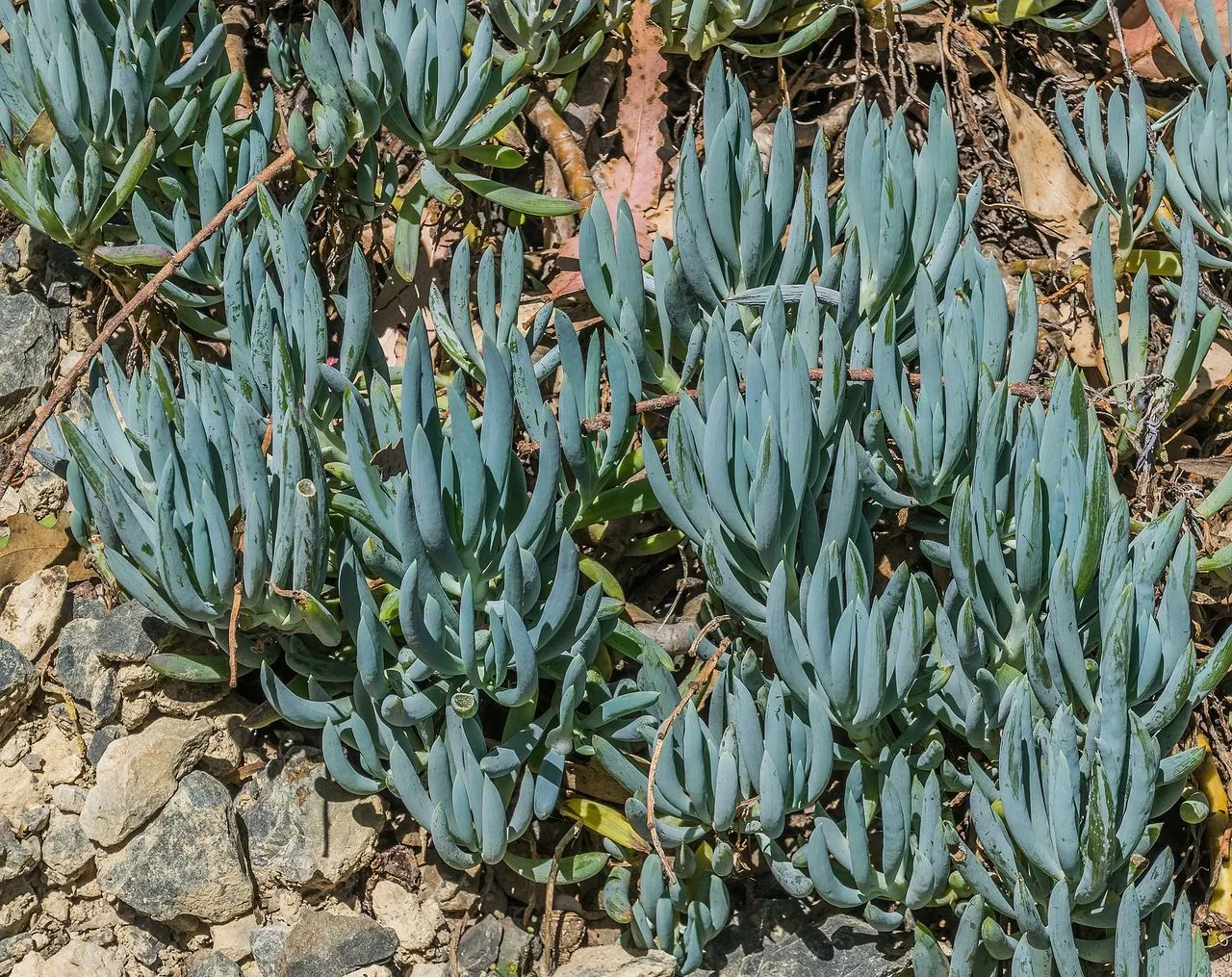
Upright Curio species (C. mandraliscae — blue chalksticks, C. serpens, S. crassissimus — vertical leaf senecio, S. haworthii — cocoon plant) stretch by producing elongated internodes between leaf insertions on the main stem. A compact, correctly-lit specimen of S. crassissimus presents with leaves closely packed and the stem barely visible. In low light, the same plant stretches to twice the height with each leaf widely spaced and the stem visible between them.
S. haworthii is particularly dramatic when etiolated: the normally dense white column becomes an open, thinly-felted plant with obvious bare stem between the wool-covered leaves. Move to full sun or very bright indirect light. Full recovery of compact form on the existing stem is not possible, but new growth from pruned nodes will be compact in correct light.
How to fix stretching
Step 1 — Correct the light position first. Every pruning effort is wasted if the plant goes back into insufficient light after the cut. Move to the brightest available indirect position, or install a full-spectrum LED grow light at 150–250 µmol/m²/s PAR for 12–14 hours per day. Acclimatise gradually — one week of moderate indirect light before moving to the final bright position — to prevent sunburn on shade-adapted tissue; this is the same sequence used for an Echeveria that has stretched and gone leggy.
Step 2 — Take stem tip cuttings. Identify the compact portions of the strands or stems (usually the terminal 10–15 cm, where pearl spacing is still relatively tight). Cut these off, allow the cut end to dry and callus for 24–48 hours, then place in a small container of dry mineral mix. Begin light watering after 7 days. In correct light, rooted cuttings produce compact growth from the start.
Step 3 — Cut back the mother plant. After removing cuttings, cut the stretched stems back to a node (a point where a leaf or pearl attaches). In C. rowleyanus, these nodes are viable even on very bare sections of stem. New growth emerges from these nodes within 2–4 weeks in bright light. A cut-back string of pearls can look alarming — a pot of bare green sticks — but usually regrows vigorously from the cut points.
Step 4 — Maintain the correct position. A plant that was compact at purchase and stretched in 6 weeks was simply in the wrong position. Match light levels to the species requirement from the start.
How to assess etiolation severity
| Observation | Degree | Action |
|---|---|---|
| Plant leaning toward window, normal pearl spacing | Very early | Rotate pot; move closer to window |
| Pearl spacing slightly wider than nursery form | Mild | Move to brighter position; no pruning yet |
| Visible 1–2 cm stem gaps between pearls | Moderate | Correct light; take cuttings from compact tips |
| Mostly bare stems, pearls only at tips | Severe | Hard prune; root multiple cuttings |
| Upright types: bare lower half of stem | Moderate to severe | Cut back to lowest viable node; root cuttings |
Prevention
Hang trailing senecio near a window — within 60–80 cm of east or south glass — or on a plant stand adjacent to a window rather than in a distant corner. Use grow light supplementation for any position more than 1 m from the nearest window. Rotate hanging baskets quarterly so all sides receive equal light. Accept that a very high ceiling hook position may look beautiful but will produce an etiolated plant within months. Visit the cactus etiolation fix guide for the re-rooting procedure, which applies directly to senecio stem cuttings.
See also
- Cactus etiolation fix — beheading, callusing, and re-rooting the compact top; the procedure applies directly to Senecio and Curio stem cuttings.
- Indoor succulent care — managing light levels, grow lights, and window position for trailing and upright senecio species.
- Senecio rowleyanus — string of pearls care, including the light requirements for maintaining compact bead-to-bead density.
Frequently Asked Questions
Why is my string of pearls not growing dense trails?
Insufficient light causes pearls to space out on the strand — the internodal distance (distance between pearls) increases as the plant stretches. In good bright indirect light, a healthy Curio rowleyanus produces pearls in tight succession with minimal visible stem between them.
Can a leggy Senecio recover?
The already-stretched stem will not compact. Take stem tip cuttings from the compact upper portions, root them in bright light, and the cuttings will produce compact growth from the start. The bare-stemmed lower portion can also be pruned back hard to encourage new side shoots.
How much light does string of pearls need to stay compact?
Bright indirect light for 10–12 hours per day — an east-facing windowsill or a south window set back 60–80 cm from the glass, or a full-spectrum grow light at 150–250 µmol/m²/s PAR. Direct summer midday sun causes sunburn; the goal is bright, not harsh.
Why is my upright Senecio (blue chalksticks, pencil plant) growing tall and thin?
Etiolation from insufficient light. Upright Curio species should be compact with tightly spaced leaves. Tall, thin, widely-leaved growth indicates the plant is stretching toward the light source. Move outdoors in summer or supplement with a grow light.