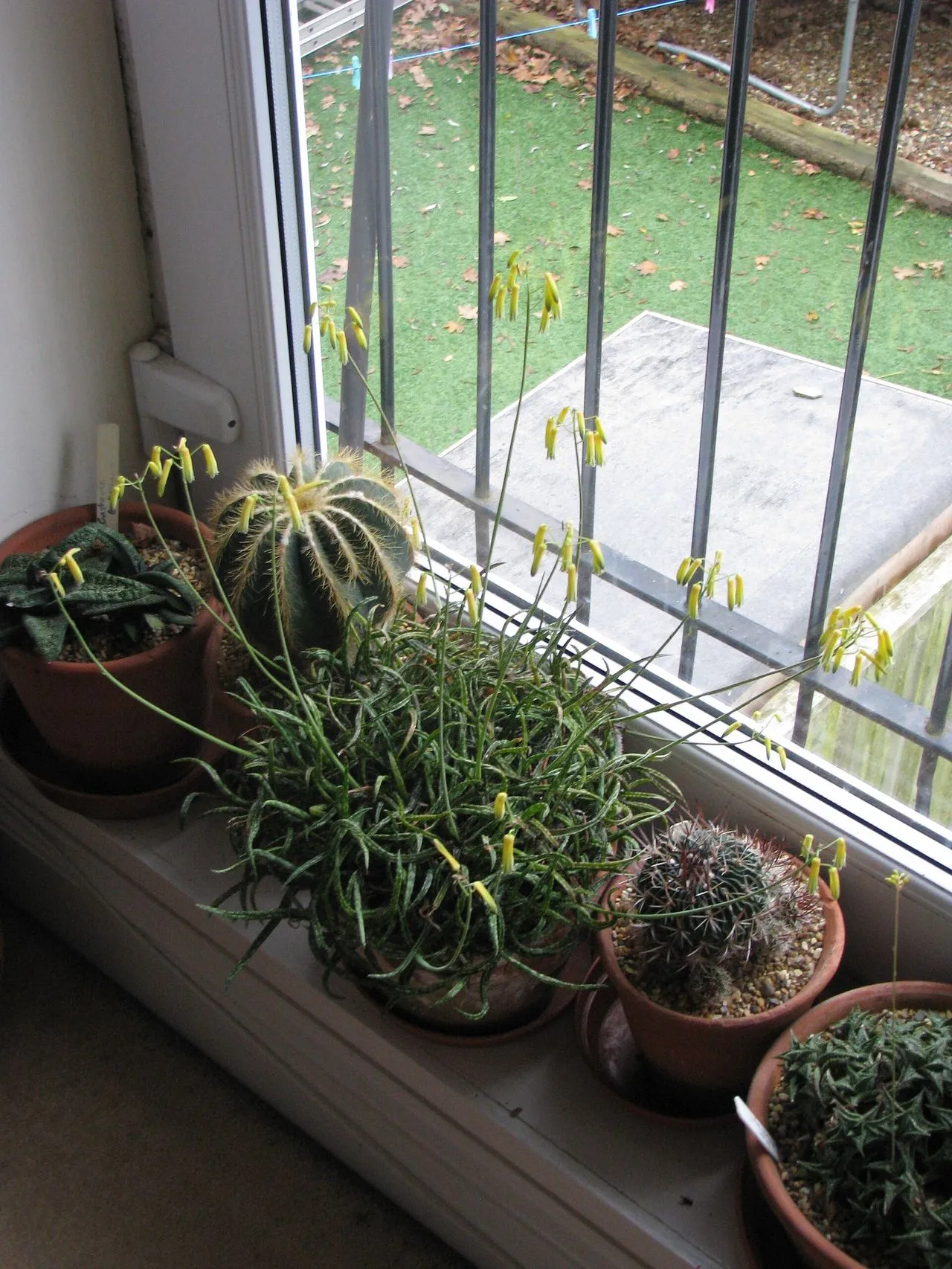
Most indoor succulents do not die of thirst. They die of darkness. When a hobbyist asks me why their Echeveria is pale, stretched, and dropping leaves, the honest answer is usually the same: there is not enough light in that room, and no watering schedule will fix it. Water gets the blame because it is the variable you control daily. Light is the one that decides whether your plant survives the next six months.
Quick Answer
- Light is the limiting factor for indoor succulents - aim for 250+ µmol/m²/s or several hours of direct window sun.
- Water only when soil is completely dry. Indoor succulents dry slower than outdoor ones.
- Improve airflow with a small fan. Watch for mealybugs and fungus gnats which thrive indoors.
I'm Dr. Elena Martín, a Certified Advanced Cactus & Succulent Horticulturist. This guide covers what is actually different about growing succulents indoors. Light is scarce, humidity is steady, airflow is poor, and pest pressure skews toward mealybug and fungus gnats. Get the indoor-specific variables right and the rest of succulent care follows easily.
Light is the limiting factor
Outdoors on a clear summer day you have roughly 100,000 lux at midday. A "bright" spot in a typical living room, one that feels comfortably lit, usually measures between 800 and 1,500 lux. Human vision adapts logarithmically, so a spot that feels 30% as bright as outdoors is often delivering less than 2% of the irradiance. Most succulents want at least 10,000 lux (around 1,000 foot-candles) at the leaf surface for 6+ hours a day to maintain compact form. That is the threshold where genuine photomorphogenic growth happens. Below it, you are keeping the plant alive, not growing it.
Window orientation in the northern hemisphere
- South-facing, unobstructed: the only window in a typical home that reliably exceeds 10,000 lux for several hours. Aim to place light-hungry species here.
- East or west-facing: 3–5 hours of direct sun per day, peaking at 20,000–40,000 lux at the glass. Workable for many species if the plant sits within 30 cm of the window.
- North-facing: rarely exceeds 2,000 lux at the glass even at midday. Without supplemental lighting, restrict yourself to Haworthia, Haworthiopsis, Gasteria, and shade-tolerant Crassula.
For readers in the southern hemisphere, mirror the above: north-facing windows become the bright option, south-facing the dim one.
Measuring what you actually have
You do not need specialist equipment. Free phone apps using the ambient-light sensor are accurate to within 10–15% of a calibrated meter, which is plenty. Take readings at the leaf surface, not on the window ledge a metre away, and take them at multiple times of day. A spot that reads 15,000 lux at noon but 1,200 lux by 3 p.m. averages to a mediocre grow location.
Irradiance falls with the inverse square of distance. Doubling the distance from a window quarters the light. A plant 30 cm inside a south window may receive 25,000 lux; the same plant at 120 cm receives roughly 1,500 lux. Furniture placement is cultivation.
Etiolation — the diagnostic telltale
When a succulent does not receive enough light, it produces a specific, repeatable response: internodes lengthen, new leaves emerge smaller and paler, and the rosette loses symmetry. This is etiolation. It is driven by elevated auxin transport to shaded tissues and is completely reversible in prognosis but not in form. The stretched stem will never compact again. You can behead the rosette and reroot it (see the complete Echeveria guide), but the old growth stays stretched.
If you notice etiolation, the fix is not "water less". The fix is more light, applied within days, not months.
Grow lights
For any room without a bright unobstructed window, a grow light is the difference between growing succulents and watching them decline. Modern full-spectrum LEDs are the only sensible choice. Targets worth knowing:
- Daily Light Integral (DLI): 12–20 mol/m²/day suits most mesembs and Echeveria; 6–10 mol/m²/day is enough for Haworthia and Gasteria.
- Practical wattage: budget 20–40 actual watts of LED per square foot of shelf, hung 20–40 cm above the canopy. Wattage labels on cheap fixtures are often inflated; look for reputable horticultural brands that publish PPFD maps.
- Photoperiod: 12–14 hours per day. A cheap mechanical timer pays for itself within a week.
If the meter at leaf level reads 15,000 lux for 12 hours a day, the plant does not care whether the photons came from the sun or a diode.
Window-sill placement
Pressed close to the glass is usually correct. Most home windows, even double-glazed low-E coatings, transmit 70–85% of incident PAR, and the inverse-square rule makes 10 cm versus 50 cm matter more than people expect.
Two caveats. Single-glazed glass in old houses can reach 40°C in summer sun; leaves touching it burn at the contact line, so leave 2–3 cm of clearance. In winter, single-glazed glass can drop to near-freezing overnight, and leaves touching it may develop soft, translucent, water-soaked patches that turn brown within 24 hours.
Rotate pots a quarter-turn every two weeks. Phototropism is strong in Echeveria and Crassula. A rosette facing the window for months develops a permanent lean that is hard to correct without beheading.
The winter problem
At 50° N latitude, day length shrinks from 16 hours in summer to 7 in December, and the sun sits much lower in the sky. Even a south-facing window that is excellent in June becomes marginal between November and February. If you see pale new growth, slight etiolation, or flower-bud abortion in midwinter, that is the photoperiod collapse. A supplemental LED running 6–8 hours a day through the darkest three months rescues form for almost nothing in running cost.
Substrate
The same free-draining mineral mix that suits outdoor succulents works indoors, but substrate dries more slowly without airflow, so lean further toward grit. A workable baseline is 60% pumice, perlite, or lava grit, 20% coarse sand, and 20% peat-free loam-based compost. Avoid pre-packaged "cactus mix" from general garden centres; most are peat-dominated and hold water far longer than the label suggests. For mix ratios, pH, and amendments in detail, see the succulent soil guide.
Water
Indoors, the dry-down rate is the hinge variable. Three factors control it:
- Ambient humidity. At 30–50% RH (typical for a heated home), evaporation from a terracotta pot is brisk. At 65%+ (damp bathroom, unvented kitchen), it can take twice as long.
- Airflow. Still rooms evaporate water slower; a fan or open window speeds dry-down considerably.
- Pot material. Unglazed terracotta wicks moisture through its walls and dries a substrate 30–50% faster than a glazed ceramic or plastic pot of the same size. For indoor growing, I recommend unglazed terracotta for any species prone to rot, which is most of them.
Bottom watering versus top watering
Both work. Top watering (pouring through the substrate until it exits the drainage holes) is the simpler method and flushes accumulated mineral salts, which matters if your tap water is hard. Bottom watering (standing the pot in 2–3 cm of water for 15–20 minutes) keeps rosette foliage dry and reduces fungus gnat attraction because the surface stays dry. For indoor plants with tight rosettes (Echeveria, Sempervivum, most Aeonium), bottom watering is the better default. Top-water every third or fourth watering to flush salts.
The winter rhythm
Indoors, most succulents do not enter the true dormancy they would outdoors because temperatures stay mild. Growth slows but does not stop. Water roughly every 3–4 weeks in cool, low-light winters, and only after verifying the substrate is dry 4–5 cm down. In a well-lit, centrally heated room, the interval may be closer to 10–14 days. Schedule-based watering fails precisely because these variables swing across the year.
Temperature and humidity
Typical home conditions (18–24°C, 30–50% RH) suit most cultivated succulents. Two specific failure modes:
- Heating vents and radiators. A plant directly above a forced-air vent experiences 30°C+ air with near-zero humidity for hours at a time; leaves desiccate unevenly. Move the plant or baffle the vent.
- Cold-draft windows in winter. A 10°C draft along a window sill creates a localised zone where roots stay chilled while foliage stays warm. This is the most common cause of sudden mid-winter leaf drop in indoor Kalanchoe.
Humidity below 30% rarely harms succulents themselves, though it can worsen spider mite outbreaks. Humidifiers marketed for tropical plants are not useful here and may harm farina-coated species.
Ventilation
Ventilation is the variable most often ignored, and the one that turns a survivable indoor setup into a thriving one. Stagnant air does three things:
- It leaves persistent moisture films on leaves after watering, inviting fungal pathogens such as Botrytis and Alternaria.
- It lets mealybug populations reach damaging densities before detection; crawlers settle on the nearest leaf rather than being blown off.
- It weakens cell-wall lignification in new growth, producing soft tissue prone to rot and breakage.
A small oscillating desk fan on its lowest setting, 3–6 hours per day, is a trivial fix. In my own collection, mealybug incidence dropped by more than half after introducing fans.
Best species for indoor conditions
The following species tolerate the reduced light and stable conditions of a typical home with reasonable grace. For a dim room without grow lights, start here.
- Haworthia and Haworthiopsis. The best genus for indoor growing, full stop. Many species evolved under the shade of rocks and shrubs in the South African Cape and are adapted to lower light. A 2,000 lux north window suits them.
- Crassula ovata (jade plant). Exceptionally forgiving, tolerates household conditions, and will flower under 10,000 lux with a cool winter rest. The classic indoor succulent for a reason.
- Echeveria. Suitable only on your brightest window. If the window does not deliver 10,000+ lux for at least 5 hours daily, Echeveria will etiolate within weeks.
- Kalanchoe blossfeldiana. The florist's indoor staple, sold in bloom. Reblooming requires short-day photoperiod treatment: 14 hours of uninterrupted darkness per day for 6 weeks in autumn to initiate flower buds.
- Gasteria. Close relative of Haworthia with similar low-light tolerance. Distichous leaf arrangement makes it the better choice for narrow sills.
What not to grow indoors without grow lights
Some genera are simply incompatible with typical home lighting. Without a full-spectrum LED delivering 15,000+ lux at the leaf surface, these will etiolate within weeks and decline over months:
- Agave. Almost without exception a full-sun outdoor genus. Indoors it stretches rapidly and loses its architectural form.
- Aloe (most species). Aloe vera survives indoors but rarely thrives; pigmented species like A. dichotoma need direct sun. Gasteria-hybrids (×Gasteraloe) are a workable compromise.
- Sempervivum. Evolved for full-sun alpine conditions. Indoors they etiolate badly and lose their characteristic colour.
- Adenium, Pachypodium, and most caudiciforms. Require intense light and seasonal water cycling that household conditions rarely provide without dedicated setup.
If you love these genera, that is an excellent reason to invest in a dedicated grow shelf. It is not a reason to keep fighting your north-facing living room.
Common indoor problems
| Symptom | Likely cause | Fix |
|---|---|---|
| Stretched internodes, small pale leaves | Etiolation from insufficient light | More light or behead and reroot |
| White cottony tufts in axils | Mealybug (poor airflow) | 70% isopropyl alcohol on cotton swab; introduce fan |
| Small flying insects around soil | Fungus gnats (wet substrate) | Let substrate dry completely; top with 1 cm grit |
| Lower leaves yellow and mushy | Root rot from over-watering | Unpot, inspect roots, trim blackened tissue, replant dry |
| Brown scorched patches on sun-facing leaves | Windowburn from glass-magnified UV in summer | Move 10 cm back from glass; shade cloth if severe |
| Sudden leaf drop in winter | Cold draft or abrupt temperature swing | Relocate away from sill or vent |
| Translucent soft patch on leaves pressed against glass | Winter cold damage | Leave 2–3 cm clearance from glass |
A quick decision checklist
Before buying a new succulent for indoor display, walk through this:
- Stand at the spot where the plant will live. Can you comfortably read small print without turning on any lamps? If no, that spot is under 1,500 lux. It gets Haworthia or Gasteria, not Echeveria.
- Measure with a lux app at midday. Below 2,000 lux, use grow lights or stick to shade-tolerant species. Between 2,000 and 10,000 lux, expect slow survival rather than active growth for most species. Above 10,000 lux, proceed.
- Check for drafts and heat sources. If the spot is within 50 cm of a radiator, vent, or single-glazed winter window, choose differently.
- Confirm air can move. If the plant will sit in a still corner, budget for a small fan.
Indoor succulent growing is not difficult. It is unforgiving of one specific mistake: treating a room that feels bright as if it is bright. Measure once, choose species accordingly, and the rest of the care routine looks like any other succulent cultivation.
FAQ
Which succulents grow best indoors without grow lights?Haworthia, Gasteria, and some Aloe species tolerate lower light. They can survive in brightness that would cause etiolation in Echeveria or Crassula.
My indoor succulent is stretching - what's wrong?It's not getting enough light.stretched growth (etiolation) is a light problem, not a watering one. Move closer to a window or add a grow light.
How often should I water indoor succulents?Water only when the soil is completely dry - indoor succulents typically need watering every 2-3 weeks, less in winter.
Frequently Asked Questions
Which succulents grow best indoors without grow lights?
Haworthia, Gasteria, and some Aloe species tolerate lower light. They can survive in brightness that would cause etiolation in Echeveria or Crassula.
My indoor succulent is stretching - what's wrong?
It's not getting enough light.stretched growth (etiolation) is a light problem, not a watering one. Move closer to a window or add a grow light.
How often should I water indoor succulents?
Water only when the soil is completely dry - indoor succulents typically need watering every 2-3 weeks, less in winter.
What is the first step for indoor succulents: a practical guide to keeping them alive at home?
Water only when soil is completely dry. Indoor succulents dry slower than outdoor ones.