Quick Answer
The short answer: Grafting attaches a scion (desired plant) onto a rootstock (vigorous base) so the rootstock supplies water/nutrients. Used for: slow seedlings (speeds growth), chlorophyll-free cultivars (can't survive alone), or rescue.
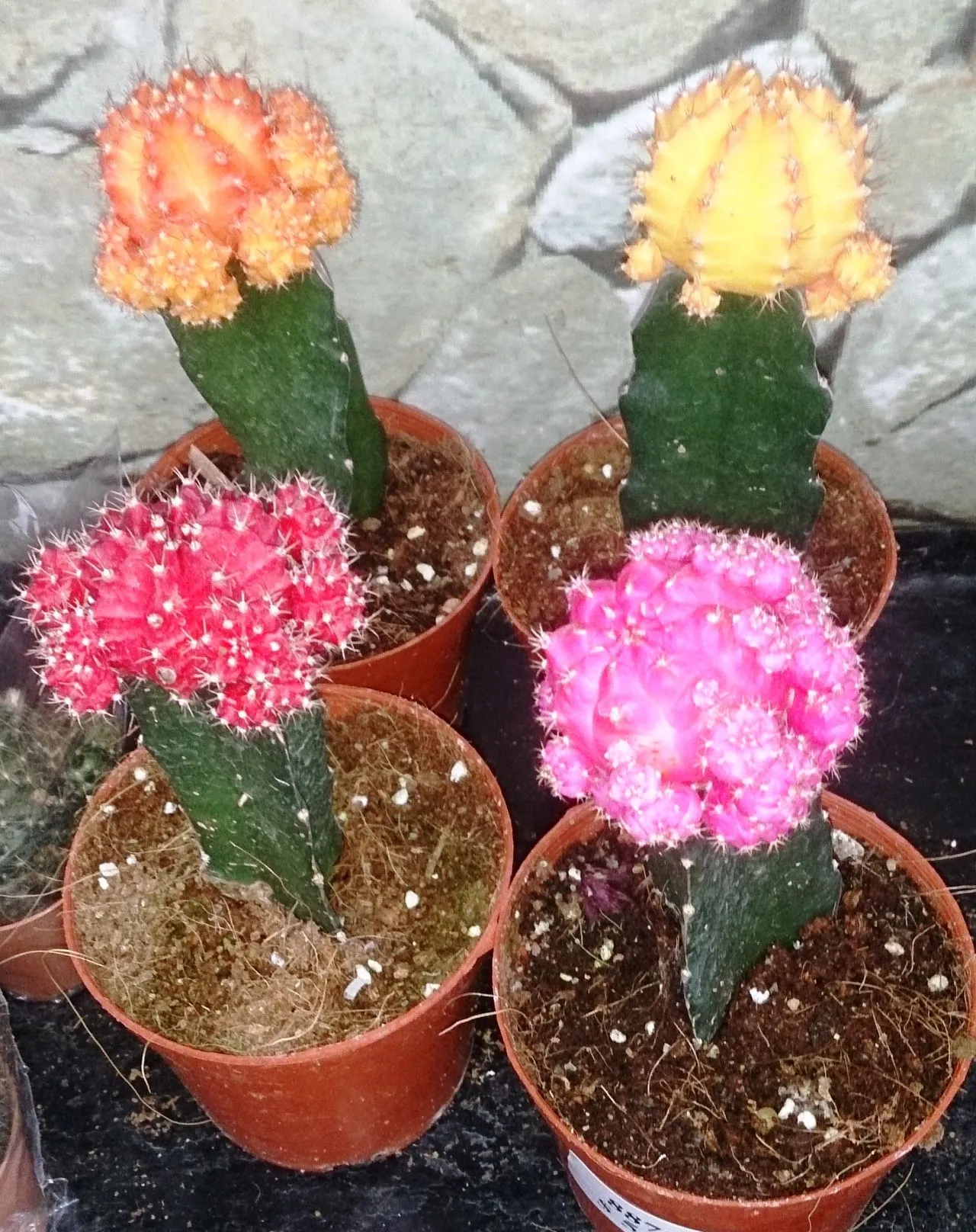
Best first step: Start with moon cactus (Gymnocalycium mihanovichii) on Hylocereus rootstock - this is the supermarket standard and the easiest graft to practice.
Avoid: Grafting Echeveria or other Crassulaceae - they don't graft successfully. Only use for cacti.
Grafting joins two cacti into a single functional plant. The top piece, the scion, is the species you want to display: a slow seedling, a chlorophyll-deficient colour cultivar, or a rare clone with a failing root system. The base, the rootstock, is a fast, vigorous species whose root system pumps water and sugars into the scion. The combination looks tidy in a pot, but it is a manual skill with measurable failure rates, and the resulting plant has a finite lifespan. Here is the rest of the picture.
Part of the Beginner's Guide to Succulents.
When grafting makes sense
Three situations justify the work.
The first is a chlorophyll-deficient cultivar that cannot survive on its own roots. The classic example is Gymnocalycium mihanovichii (Frič ex Gürke) Britton & Rose 'Hibotan', the pink, red, orange, or yellow "moon cactus" sold in supermarket gift wrap. These cultivars carry a mutation that prevents chlorophyll production, so the body itself cannot photosynthesise. Mounted onto a green rootstock, the rootstock supplies the sugars and the scion contributes only its colour and shape. Detach the scion from the rootstock and it dies within weeks.
The second use is speed. A Turbinicarpus or Aztekium seedling 5 mm across can take 6 to 10 years to reach flowering size on its own roots. The same seedling grafted onto a fast rootstock at 6 to 8 weeks old can flower in 18 to 24 months. Specialist growers use this routinely for the slowest cactus genera and for rare seed lots where each survivor matters.
The third is rescue. A cactus with terminal basal rot or severe root mealybug damage may still have a healthy crown. Cut the crown off above the damage, callus the wound briefly, and graft it onto a clean rootstock. The original root system is gone, but the genetics survive on borrowed roots.
If you only want more of a common species that already roots well from offsets or seed, grafting is more trouble than it is worth. Use a stem cutting or a seed pan instead.
Common rootstock species
Four species cover most amateur and commercial grafting work.
Hylocereus undatus (Haw.) Britton & Rose, the dragon fruit cactus, is the rootstock under almost every supermarket moon cactus. It grows fast, accepts a wide range of scions, and is cheap to produce from cuttings. Its weakness is cold tolerance: below 5 °C (41 °F) it sustains tissue damage, and below 0 °C the rootstock often fails outright. It also tends toward corky basal decline after 4 to 6 years even in good conditions.
Pereskiopsis spinulosa (F.A.C.Weber) Britton & Rose is the rootstock of choice for very tiny seedlings. It produces leafy, fast shoots that elongate dramatically with light and warmth, and a millimetre-wide seedling pushed onto a fresh tip can establish in 24 hours. Pereskiopsis grafts are deliberately temporary; once the scion is large enough, the grower regrafts it onto a more durable rootstock or down-grafts it onto its own roots.
Trichocereus pachanoi Britton & Rose, the San Pedro cactus, is the workhorse for medium and long-term grafts. It grows briskly, tolerates 0 to −4 °C without significant damage when dry, and supports scions for 8 to 15 years. Its diameter (4 to 8 cm in mature stock) accepts scions up to that size cleanly. The downsides are a slower start than Hylocereus and a more expensive rootstock to source.
Eriocereus jusbertii (Rebut) Riccob. is the slowest-growing of the four but the most durable. Grafts on Eriocereus often outlast grafts on any other rootstock and are favoured by collectors of rare Astrophytum, Ariocarpus, and Obregonia. The slow growth means you wait longer for the scion to plump up, but the bond is unusually stable over time.
What can be grafted onto what
Compatibility within Cactaceae is broad but not universal. Most cactus genera accept most cactus rootstocks, with vascular tissue closing across the interface within days. The factors that decide success are vascular ring diameter (the two rings should overlap at least partially) and the absence of sap chemistry that interferes with cell fusion.
Crassulaceae (Echeveria, Sedum, Crassula, Aeonium, Kalanchoe) generally do not graft. Their callus tissue forms differently, the wound chemistry does not bond cleanly, and the rare reported successes do not last. Treat grafting as a Cactaceae technique.
Within cacti, a few combinations are reliable enough to recommend to beginners:
| Scion | Compatible rootstocks |
|---|---|
| Gymnocalycium mihanovichii (moon cactus) | Hylocereus undatus, Trichocereus pachanoi |
| Astrophytum | Trichocereus pachanoi, Eriocereus jusbertii |
| Ariocarpus, Obregonia | Eriocereus jusbertii, Trichocereus pachanoi |
| Tiny seedlings (any genus) | Pereskiopsis spinulosa |
| Lophophora | Trichocereus pachanoi, Pereskiopsis spinulosa |
Do not graft anything irreplaceable until you have completed at least 5 to 10 practice grafts on common scions. Beginner success rates run 20 to 40% on first attempts and rise to 70 to 85% with practice. The skill is real and learnable, but it will cost you scions while you learn it.
Tools and conditions
You need very little equipment, but every piece must be clean.
- A new single-edge razor blade. Replace it after every two or three grafts; a dulled blade tears tissue and ruins the cut surface.
- 70% isopropyl alcohol for sterilising the blade between cuts.
- A clean, dry working surface. Avoid working over open substrate; airborne fungal spores ruin grafts.
- Rubber bands or a small soft weight (a clean stone, a small bag of dry rice) to apply gentle pressure across the union.
- Both plants in active growth. A dormant rootstock in winter does not bond.
- Air temperature between 22 and 26 °C (72 to 79 °F) during the bonding period. Below 18 °C the bond forms too slowly and risks failure; above 30 °C the cut surfaces dehydrate before contact closes.
Bright indirect light is correct for the bonding window. Direct sun cooks the fresh union and can dehydrate the scion before vascular continuity forms.
The step-by-step procedure
The whole graft takes 5 to 10 minutes once both plants are in front of you. Speed matters because the cut surfaces dry quickly and a dry cut bonds poorly.
- Decapitate the rootstock with a horizontal cut 1 to 2 cm below the growing tip. The cut must be perpendicular to the stem axis, in one clean stroke. A sloped cut will not bond evenly.
- Bevel the rim of the rootstock cut at about 30°. As the rootstock dries over the next 24 hours, a flat-cut rim shrinks inward and lifts the scion off the central vascular ring. The bevel keeps the central area dominant during contraction.
- Cut the scion with a perpendicular slice 1 to 2 cm above its base. Use the same fresh blade after wiping it with isopropanol.
- Look at both cut surfaces. Each shows a paler central ring of vascular tissue inside the green or pale flesh. Align the two so the rings overlap at least partially. Full concentric alignment is ideal, but partial overlap of the rings on one side is enough for a working graft.
- Press the scion gently down onto the rootstock and rotate slightly to expel any trapped air bubble. Hold for 10 seconds.
- Apply tension with two crossed rubber bands running from the rootstock pot, over the top of the scion, and back to the pot on the opposite side. The pressure should be enough to keep the scion from sliding but not so much that it crushes the scion tissue. Alternatively, set a small soft weight (5 to 30 g for a small scion) directly on top.
- Place the grafted plant in bright indirect light at 22 to 26 °C, dry, undisturbed, for 7 to 10 days. The vascular bond forms across this window.
- After 7 to 10 days, remove the rubber bands or weight. Do not water yet.
The graft is visibly successful at 14 to 21 days, when the scion plumps and resumes growth. A scion that shrivels, browns, or remains flat at three weeks has failed; remove it, recut both surfaces fresh, and try again.
Aftercare
Do not water the rootstock during the first 7 to 10 days. The cut surfaces need to bond, not to absorb water through wound tissue. From day 10 onward, return to normal cactus watering for the rootstock species. Hylocereus prefers more water than Trichocereus or Eriocereus; treat the rootstock, not the scion, as the species when scheduling water.
Keep the new graft out of direct midday sun for the first month. The scion's photosynthetic load is light during bonding, and a sudden full-sun exposure can scorch the freshly bonded tissue. After about 30 days, harden it off in stages over a fortnight, much as you would a freshly potted seedling.
Many rootstocks send up offsets below the graft point. Remove these as soon as you spot them; they steal water and sugars from the rootstock that should be feeding the scion. A clean snap with a sterile blade is enough.
Repot the grafted plant only after 6 to 12 months, once the scion is clearly established and growing. Earlier disturbance breaks the rootstock's root system and stresses the union before it has fully matured.
Why grafted plants don't last forever
A grafted plant is a temporary biological compromise. The vascular bond between scion and rootstock ages and weakens over years. Three failure modes dominate.
The first is bond senescence. Vascular continuity at the graft point slowly degrades as the scion expands and the rootstock corks at the union. After 5 to 15 years, water and sugar transport across the bond becomes inadequate even when both partners are otherwise healthy.
The second is rootstock decline. Hylocereus undatus in particular develops basal corking and rot in its lower stem after 4 to 6 years even in ideal conditions. Trichocereus and Eriocereus last longer, often 8 to 15 years, but no rootstock is permanent.
The third is geometric mismatch. The scion grows, and as it expands, its base eventually overhangs the rootstock and topples or breaks at the union. This is most visible in the supermarket moon cactus on a thin Hylocereus stem: the scion plumps faster than the rootstock thickens, and the lever arm at the union grows yearly.
A pink "moon cactus" on Hylocereus rarely survives beyond 3 to 5 years in a typical home. A Trichocereus-rooted Astrophytum may last 10 to 15. An Eriocereus-rooted Ariocarpus can last longer still. None lasts forever.
Two practical responses follow. First, if you value a particular scion long-term, plan to regraft it onto a fresh rootstock every 5 to 10 years; this is routine in collector circles. Second, where the species allows, root the scion back onto its own roots once it is large enough to survive: cut it off the rootstock, callus the base, and treat it as a stem cutting. The success rate is lower than grafting, but a self-rooted plant lasts as long as the species naturally would.
See also
- A Beginner's Guide to Succulents: the underlying light, water, and substrate decisions that keep both rootstock and scion healthy through the bonding period and beyond
- Growing Succulents from Seed: An Honest Introduction: the route that produces the seedlings worth grafting, and the only legal way to obtain many rare cactus genera in quantity
- The Complete Cactus Guide: cultivation across the family that supplies most rootstocks and almost every interesting scion candidate
- Beheading and root reset: the decapitation technique that feeds flat-grafting with fresh scion material
FAQ
How long does a grafted cactus live?
Moon cactus on Hylocereus lasts 3-5 years. On Trichocereus rootstock, 10-15 years. The vascular bond degrades over time.
What rootstock should I use?
Hylocereus (dragon fruit) for fast results but cold-tender. Trichocereus pachanoi (San Pedro) for durability (8-15 years). Pereskiopsis for tiny seedlings only.
Why do grafted plants eventually die?
The bond weakens over years, rootstock declines (corking), or scion grows heavier than the rootstock can support. Regraft every 5-10 years to renew.
Can I graft non-cactus succulents?
No. Crassulaceae (Echeveria, Sedum, Crassula) don't graft successfully - their callus tissue forms differently and bonds don't hold.
Frequently Asked Questions
What is the first step for grafting cacti and succulents: an honest beginner walkthrough?
Start by matching the symptom to the plant, substrate, light, and season before changing watering or treatment.
What should be avoided?
Avoid changing several variables at once; correct the limiting factor and observe the plant before escalating.
Which care factor matters most?
Match the plant to its light, substrate, pot size, and season. Most succulent failures trace to a mismatch between drying speed and the plant's current growth rate.
When should the plant be checked again?
Recheck after one to two weeks unless tissue is actively collapsing. Stable firmness and new growth are better signs than a fixed calendar interval.