| Question | Short Answer |
|---|---|
| What is a moon cactus? | Moon cactus plants are chlorophyll-free Gymnocalycium scions grafted onto green rootstocks. |
| Can red or yellow Gymnocalycium mihanovichii grow on its own roots? | Chlorophyll-free forms cannot sustain themselves on their own roots because they lack green tissue for photosynthesis. |
| What light does Gymnocalycium prefer? | Many Gymnocalycium prefer bright light with some protection from harsh afternoon sun in hot climates. |
| Why does the rootstock matter? | A grafted plant behaves partly according to the rootstock, so watering and winter temperature are not identical to own-root Gymnocalycium care. |
Gymnocalycium mihanovichii (Frič ex Gürke) Britton & Rose, originally described as Echinocactus mihanovichii by Alberto Frič and Maximilian Gürke in 1905 and recombined into Gymnocalycium by Britton and Rose in 1922, is a small globular cactus from Paraguay, southeastern Bolivia, and the adjoining Argentine Chaco. In habitat it grows at 200 to 1,000 m on grasslands and rocky outcrops, sheltered between grass tufts and low shrubs. The wild-type body is dark grey-green to brown-purple, 4 to 8 cm wide, with eight ribs and short curved spines arranged five to seven per areole. Almost no one in the houseplant trade has ever met that wild-type plant. The market is dominated by chlorophyll-deficient mutant cultivars grafted onto a green rootstock, and most of what people call "moon cactus" or "ruby ball" is one of those.
Part of the Complete Cactus Guide.
Identification
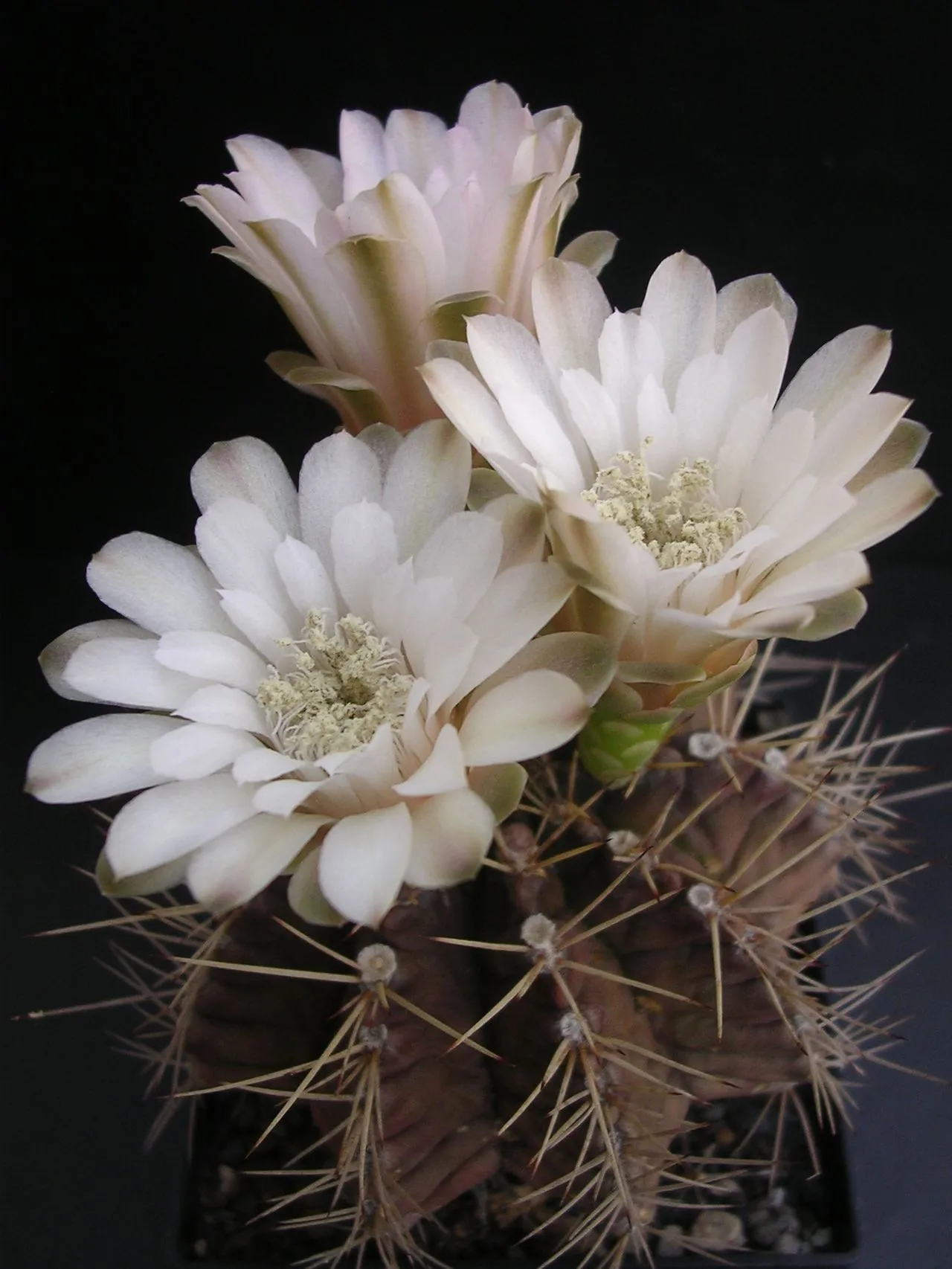
The wild type G. mihanovichii is a flattened-globose cactus 4 to 8 cm in diameter, single-headed when young and sometimes offsetting from the base in old plants. Eight low ribs run vertically, broken into chin-shaped tubercles below each areole; the prominent chin under the areole is typical of Gymnocalycium and gives the genus its common name, chin cactus. Areoles carry five to seven curved or recurved spines, typically yellow-brown ageing to grey, 5 to 12 mm long, all radial. Central spines are absent or very few.
The body colour ranges from dark grey-green to brown-purple, often with paler horizontal banding across each rib. The skin has a slightly waxy bloom that wears off where the body rubs against neighbouring stems in pots. Roots are fine and fibrous, never tuberous, which is one reason the species sits in shallow pots rather than deep ones.
Flowers appear from late spring through summer, opening at the apex around the spineless central areoles. They are small for the genus at 3 to 4.5 cm across, white to pale pink with a faintly pink throat, with smooth scaly buds and a glabrous floral tube. The absence of wool or bristles on the bud is a key Gymnocalycium character. Fruit is a small green to reddish berry, drying with age and splitting to release the small black seeds.
Three look-alikes recur in cultivation. Gymnocalycium baldianum (Speg.) Speg. has a darker, more flattened body and bright purple-pink flowers, never the pale pink of G. mihanovichii. Gymnocalycium friedrichii is the name often applied to stout, more strongly banded forms; some authors treat it as G. mihanovichii var. friedrichii, others as a separate species. Gymnocalycium denudatum (Link & Otto) Pfeiff. ex Mittler has a smooth, near-spineless body with five to eight broad rounded ribs and is sometimes confused with very young mihanovichii; spine count and posture separate them once the plant is past seedling stage.
Cultivation
Wild-type G. mihanovichii on its own roots is straightforward to grow if you treat it as a small Paraguayan grassland cactus rather than a hot-desert species. The chlorophyll-deficient cultivars on grafted rootstock follow the rootstock's regime, not the species described here; that case is covered separately under Notes.
Light should be bright but filtered. Gymnocalycium species in habitat grow between grass tufts that buffer the strongest midday sun. Indoors, an east-facing window or an unobstructed south-facing window behind a sheer curtain works well; outdoors, morning sun until about 11:00 with afternoon shade. In hot Mediterranean or continental climates the body scorches under unbuffered summer sun, leaving permanent pale patches that the plant cannot regrow over.
Water on a deep-soak and dry cycle from spring to early autumn. Saturate the root ball, then wait until the lower half of a 9 cm pot has dried; in a warm bright room that is typically 7 to 14 days. The body firms up perceptibly after a thorough soak, and a soft, slightly puckered stem signals a watering is due. From late autumn through winter, keep the substrate dry and the plant cool. The species tolerates temperatures down to about 3 °C dry without damage, but sustained exposure below freezing causes core tissue collapse. A cool dry rest at 5 to 10 °C between November and March improves the following year's flowering.
Substrate should be predominantly mineral. A working mix is 60 to 70% pumice and grit at 3 to 6 mm with 30 to 40% low-peat compost or loam-based potting soil, moved closer to 80% mineral if you have had losses to rot. The pot should be only 1 to 2 cm wider than the root ball. Terracotta dries faster than plastic and suits humid homes; plastic suits hot dry climates if watering intervals are extended. A drainage hole is non-negotiable.
Fertiliser is light. During active growth, a low-nitrogen cactus feed at quarter strength every 4 to 6 weeks, applied after watering, is enough. The wider light, water, and substrate principles match those covered in the Beginner's Guide to Succulents.
Propagation
Seed is the standard route for the wild type. Fresh G. mihanovichii seed germinates well at 22 to 28 °C on a sterile fine mineral mix kept under high humidity until the cotyledons emerge, typically 7 to 14 days after sowing. Seedlings are slow on their own roots; expect 3 to 5 years to reach 3 cm diameter, faster if you graft them temporarily onto Pereskiopsis spinulosa and de-graft once the body is large enough to root down. Some clones self-pollinate, but for reliable seed set hand-pollinate between two unrelated plants with a fine brush.
Offset division is occasionally possible on older plants that have produced basal pups, though the wild type clusters reluctantly. Where pups exist, detach with a sterile blade once the offset is at least 1.5 cm across, callus the wound for 5 to 7 days in shade, then place the pup on dry mineral substrate and begin light watering after a further week.
Crown cuttings are not generally used for G. mihanovichii because the body is small and a topped plant rarely recovers a clean apex. The exception is rescue: a wild-type plant with basal rot can have its healthy crown cut above the damage, callused, and grafted onto a vigorous rootstock such as Trichocereus pachanoi or Hylocereus undatus.
Notes: the chlorophyll-deficient cultivar trade
Almost every moon cactus or ruby ball in commerce is a chlorophyll-deficient mutant of G. mihanovichii, grafted onto a green rootstock for survival. The first colour mutant, the bright red 'Hibotan', was selected and stabilised in Japan by Eiji Watanabe in 1941. The cultivar group has since expanded:
- 'Hibotan': red, the original and still the most common form in retail.
- 'Hibotan Nishiki': yellow, often variegated over green or pink sectors.
- 'Hibotan Verdancy': pale green; the closest of the named mutants to surviving on its own roots, though still not reliably so over years.
- Pink, orange, and bicolour selections circulated under various nursery names, mostly unstable in habit and frequently reverting or losing colour with age.
The genetics are simple. These cultivars carry a mutation that prevents chlorophyll synthesis. Without chlorophyll the body cannot photosynthesise enough to maintain itself. Grown on its own roots, a chlorophyll-deficient G. mihanovichii lives on stored sugars from the seed or from a previous grafting partner; once those run out, it shrivels and dies, typically within weeks to a few months. Mounted on a green rootstock, the rootstock supplies the carbohydrates and the colourful scion contributes only its body and pigment.
The standard rootstock under supermarket moon cacti is Hylocereus undatus (Haw.) Britton & Rose, the dragon fruit cactus, chosen because it grows fast and is cheap to propagate. The trade-off is durability. A pink moon cactus on Hylocereus in a typical home rarely lasts more than 3 to 5 years before the rootstock corks at the base, the graft union ages, or the scion outgrows the rootstock and topples at the join. Mounted on Trichocereus pachanoi the same scion may last 8 to 15 years; on the slower Eriocereus jusbertii, longer still. No graft is permanent. If you value a particular colour scion long-term, plan to regraft it every 5 to 10 years onto a fresh rootstock.
The label that came with the supermarket plant is also wrong for the rootstock under most moon cacti. Hylocereus undatus is a tropical climbing cactus that wants more water, more warmth, and less cold-dry winter rest than a desert globular cactus. Keep grafted moon cacti above 5 °C, water on a faster cycle than wild-type Gymnocalycium, and avoid the long dry rest at 0 to 5 °C used for desert species; the Hylocereus base will fail well before the colour scion does. This is one of the few situations in cactus growing where the visible plant is not the species you actually need to care for.
Wild-type G. mihanovichii is not field-collected at commercial volumes. Trade demand is met from seed-grown nursery stock, and the genus Gymnocalycium as a whole sits on CITES Appendix II, so international shipments require paperwork even for ordinary forms. The chlorophyll-deficient cultivars are propagated entirely by graft and are essentially unknown in the wild.
See also
- The Complete Cactus Guide: the family-wide context for areoles, ribs, mineral substrate, and the winter-rest rules that frame Gymnocalycium cultivation.
- A Beginner's Guide to Succulents: the light, water, and substrate decisions that scale across the wider succulent collection a G. mihanovichii plant tends to join.
- Gymnocalycium baldianum — a closely related species with darker body and vivid purple-pink flowers for direct comparison.
Frequently Asked Questions
What is a moon cactus?
Moon cactus plants are chlorophyll-free Gymnocalycium scions grafted onto green rootstocks.
Can red or yellow Gymnocalycium mihanovichii grow on its own roots?
Chlorophyll-free forms cannot sustain themselves on their own roots because they lack green tissue for photosynthesis.
What light does Gymnocalycium prefer?
Many Gymnocalycium prefer bright light with some protection from harsh afternoon sun in hot climates.
Why does the rootstock matter?
A grafted plant behaves partly according to the rootstock, so watering and winter temperature are not identical to own-root Gymnocalycium care.