| Question | Short Answer |
|---|---|
| Why is Mammillaria elongata called ladyfinger cactus? | Its clustered narrow stems form golden finger-like growth rather than a single barrel. |
| How do Mammillaria flowers appear? | Mammillaria flowers usually form a ring around the crown from axils between tubercles. |
| Is Mammillaria elongata good for beginners? | Yes, if the grower can provide strong light, mineral drainage, and a dry winter rest. |
| How is Mammillaria elongata propagated? | Offset division is easiest once pups are large enough to handle, followed by callusing and dry mineral potting. |
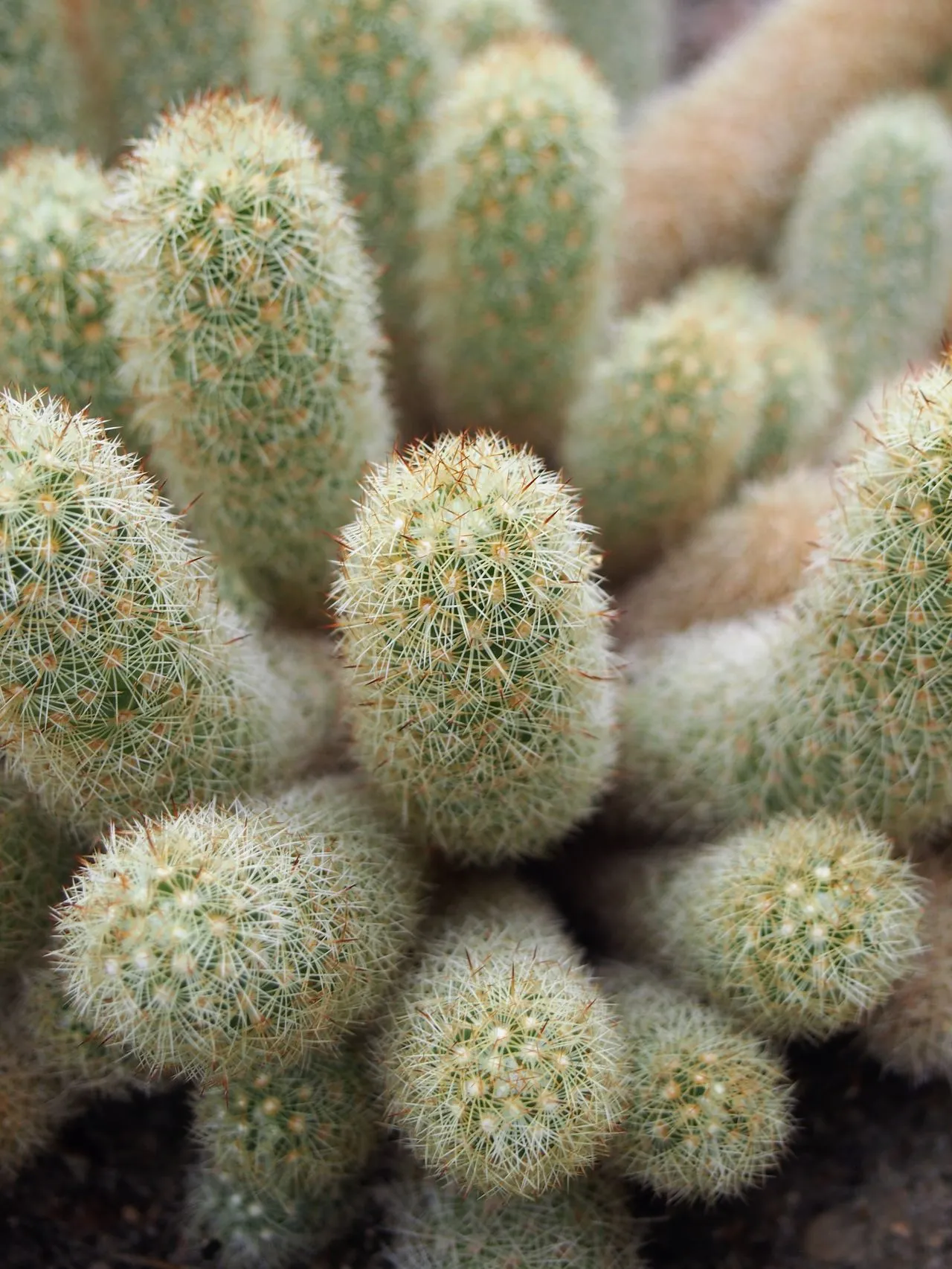
Mammillaria elongata was described by the Swiss-French botanist Augustin Pyramus de Candolle in 1828, the species name reflecting the plant's slender, elongated stems. It is endemic to the central Mexican highlands of Hidalgo, Querétaro, and San Luis Potosí, growing on rocky limestone and basalt slopes at roughly 1,500 to 2,200 m elevation. Its identity is readable at a glance: cylindrical stems no wider than 3 cm, a dense net of interlocking golden-yellow radial spines, and a strong tendency to cluster into low, spreading mounds.
In the field, M. elongata occupies dry scrub on exposed rock outcrops and hillside crevices, often alongside opuntias, agaves, and other small globular cacti. The substrate is nearly pure mineral: decomposed limestone or volcanic grit with almost no organic layer. The regional climate follows the central Mexican pattern, warm and wet from June to September, then cool and dry from October through May. During the dry season, night temperatures at upper elevations drop close to freezing, but the plants experience this cold in bone-dry soil. That combination of cold and dry is the key to understanding what they will and will not tolerate in cultivation. Among small Mexican cacti, this is one of the kinder choices for a beginner because it offsets freely, recovers well from minor root loss, and shows light problems quickly through stretched new stems.
Part of the Complete Cactus Guide.
Identification
The stems of M. elongata are cylindrical, 2 to 3 cm in diameter and 5 to 15 cm long in mature cultivation specimens. They rarely occur singly. Plants branch and offset freely from near the base, forming dense clusters that can reach 20 to 30 cm across in a well-sized container after several years. The stem surface is mid-green when well-watered, fading to grey-green under stress or prolonged drought.
Areoles sit at the tip of each small, conical tubercle. Each areole carries 14 to 25 radial spines, golden-yellow to amber in colour and 5 to 12 mm long. They lie nearly flat against the stem surface, interlocking with spines from neighbouring areoles to form the gold lace lattice the common names describe. Central spines are absent or number 1 to 3; when present, they are slightly stouter than the radials and may carry a faint reddish-brown tip, but they are not dramatically different in length or colour. The axils between tubercles are bare or carry only a few inconspicuous short bristles, in contrast to the dense white wool filling every axil of M. hahniana.
Flowers appear from roughly February to April in the northern hemisphere, forming a ring around the upper stem from the axils rather than from the areole tips. Each flower is 10 to 15 mm across, white to pale cream, occasionally with a faint pinkish midstripe on the outer petals. Individually modest, they appear in enough numbers on a mature clump to cover the crown. The fruit is a small red club-shaped berry that can persist into summer.
Lookalikes. Mammillaria gracilis (the thimble cactus) is the most frequent source of confusion. It shares the slender cylindrical clustering habit but has notably paler, nearly white radial spines that tend to form a sheath-like covering, and it offsets so freely that stems detach with the lightest touch. Mammillaria prolifera (little candles) is also densely clustering but carries clearly visible white wool and long bristles in the axils; M. elongata axils are nearly bare. When the spines are golden and the axils carry no wool, M. elongata is the most likely identification.
Cultivation
Light. Give M. elongata at least 5 to 6 hours of direct sun daily through the growing season. A south-facing windowsill is the indoor minimum, and positioning the plant within 15 to 20 cm of the glass makes a meaningful difference since light intensity drops sharply as distance from the pane increases. In fewer than 4 hours of direct sun per day, new stems elongate visibly within a season, spine colour fades to pale yellow, and the cluster stretches toward the light rather than spreading outward. Outdoors in summer, acclimate over 10 to 14 days rather than moving the plant straight from an indoor position to unfiltered midday sun.
Water. In active growth from roughly March to October, water thoroughly once the top 3 cm of substrate has dried. In a 9 cm terracotta pot on a well-lit south window, that interval is often 10 to 14 days in warm weather. In a 15 cm plastic pot with lower airflow, the interval can stretch to 3 to 5 weeks. A wooden skewer pushed to the base of the pot for 5 minutes is a reliable check: if it comes out cool and damp with particles clinging to it, wait. The dense mound habit means inner stems receive less direct watering; rotating the pot 90 degrees with each session helps ensure the whole root ball wets evenly.
From November to late February, withdraw water almost entirely. At 5 to 10°C the plant rests dry for 8 to 12 weeks without visible harm. If kept warmer under grow lights (above 15°C), a single light watering every 4 to 6 weeks is acceptable, but the substrate must dry completely within a week after each application.
Substrate. A mix of 65 to 70% mineral material gives the drainage this species needs. A reliable starting point: 35% pumice, 15% coarse grit at 3 to 5 mm particle size, 15% lava rock or crushed granite, and 35% loam-based compost. Peat-heavy general potting compost retains moisture too long against the fine root system and promotes rot when the substrate stays wet for more than 7 to 10 days at a stretch, particularly in autumn and winter.
Temperature. Brief exposure to -2°C causes only minor surface damage when the substrate is completely dry. Prolonged cold below -4°C damages stem tissue more seriously. A winter rest at 5 to 10°C, dry and in adequate light, produces the best results and helps set flower buds for late winter and spring. Summer heat up to 35°C is handled well when drainage is sharp and the root zone is healthy.
Pot. Select a pot 1 to 2 cm wider than the current cluster diameter. Terracotta is the better material for humid rooms or cautious waterers; the porous wall wicks excess moisture and helps the substrate dry evenly between waterings. The root system is broad and relatively shallow, so a standard pot depth (roughly equal to the diameter) suits it better than a deep long-tom style.
Propagation
Offset division is both reliable and frequent with M. elongata, which produces offsets more liberally than many mammillarias. Most established clumps will yield several viable divisions per season. In spring, remove an offset of at least 2 cm diameter with a clean blade, or take one that has already separated naturally from the parent. Lay it in a shaded spot for 5 to 7 days until a dry callus has formed over the cut surface, then place it cut-end-down in dry mineral substrate without burying the stem body. Wait another 10 to 14 days before the first light watering; roots form within 3 to 4 weeks at temperatures above 18°C. Success rates from healthy offsets taken in warm weather run around 90%.
Seed is viable and germinates reliably when fresh. Sow on the surface of sterile fine pumice or washed coarse sand held at 22 to 26°C with a clear cover or humidity tent. Most seeds sprout within 7 to 14 days. Growth is faster than for large columnar species; expect a multi-stemmed cluster of flowering size in 4 to 6 years under good light and temperature conditions.
Notes
Cultivars. Two forms circulate regularly in specialist trade. M. elongata 'Cristata' is a monstrose crested variant that produces undulating fan-shaped growth instead of discrete cylindrical stems. It does not offset normally and must be propagated by carefully dividing the crest with a clean blade. Care requirements match the standard form, but the contorted tissue holds moisture more readily in its folds, so err toward drier conditions and improve airflow around the plant. 'Copper King' is a selection with deeper orange-gold to copper-coloured spines; care and habit are otherwise identical to the standard form.
CITES status. The species is listed on CITES Appendix II, which restricts international trade in wild-collected specimens. Nursery-raised plants circulate freely in commerce and are what you will find in reputable shops. Large specimens with decades of weathered character offered at unusually low prices are worth querying for provenance.
Trade confusion. M. elongata and M. gracilis are frequently mislabelled or sold interchangeably. Spine colour is the quickest separator: M. elongata has distinctly golden-yellow to amber spines; M. gracilis has white ones, often arranged into a glass-like sheath when viewed at an angle. Under a hand lens, the tubercles on M. gracilis are smaller and more tightly packed.
Toxicity. The species is not known to be toxic to humans or pets. The real hazard is mechanical: the fine radial spines drive into skin easily and are difficult to remove individually. Use folded newspaper or thick gloves when handling.
See also
- The Complete Cactus Guide, covering Cactaceae anatomy, major genera, cultivation basics, and common problems.
- A Beginner's Guide to Succulents, broader context for first-time growers.
- Mammillaria hahniana, the old lady cactus, a close relative from the same central Mexican highland zone but with a completely different form: dense white axil wool, fewer and stouter stems, and a distinctly slower clustering habit.
- Mammillaria spinosissima, a larger and more heavily armed mammillaria from Guerrero and Morelos that illustrates how dramatically spine density and colouration vary across the genus.
Frequently Asked Questions
Why is Mammillaria elongata called ladyfinger cactus?
Its clustered narrow stems form golden finger-like growth rather than a single barrel.
How do Mammillaria flowers appear?
Mammillaria flowers usually form a ring around the crown from axils between tubercles.
Is Mammillaria elongata good for beginners?
Yes, if the grower can provide strong light, mineral drainage, and a dry winter rest.
How is Mammillaria elongata propagated?
Offset division is easiest once pups are large enough to handle, followed by callusing and dry mineral potting.