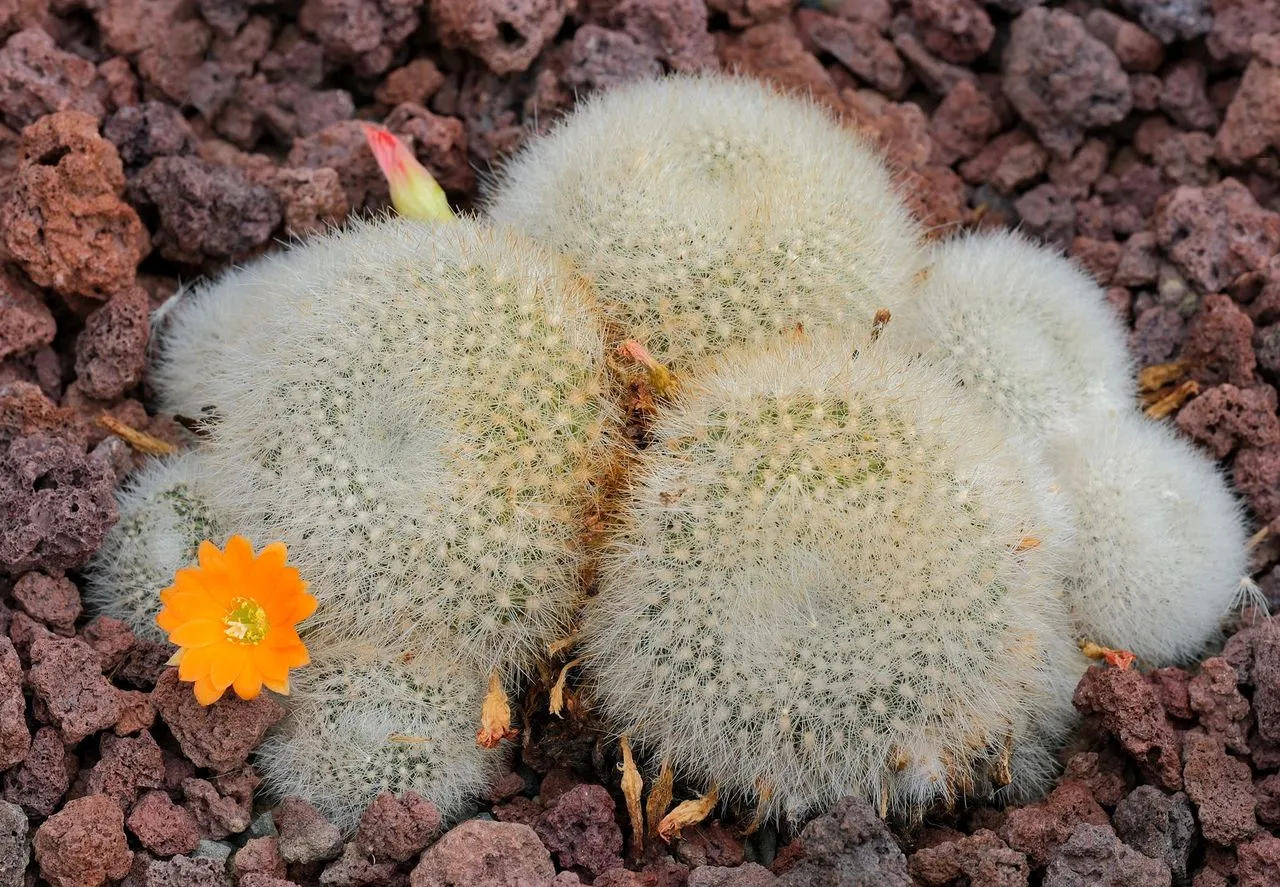
Most cacti can flower — but not all of them will, and not on the grower's schedule. The biology of cactus flowering is tied to maturity, seasonal light change, temperature drop, and drought, all of which are routinely disrupted by indoor cultivation. A cactus that is warm, watered regularly, kept in a generous pot, and never given a winter rest may grow healthily for years and still never produce a single bud. The fix is almost never more fertiliser or a different pot. It is a closer match between the plant's annual rhythm and the conditions you provide.
Part of the Complete Cactus Guide.
Immaturity — the most overlooked cause
Most desert cacti require years of growth before they flower for the first time, and this clock is frequently reset by propagation, repotting, or changes of ownership. A seedling Mammillaria may be 2 to 4 years old before it forms its first ring of flowers. Rebutia minuscula can flower in its second year and is one of the most precocious genera in cultivation. Echinocactus grusonii in containers may take 10 to 15 years to reach reproductive maturity, and even then flowering may be irregular. Gymnocalycium and Parodia species often flower young and reliably once established, but seedlings under 2 years are unlikely.
Purchased plants present a particular uncertainty: a 5 cm cactus from a mass-market display may be a 2-year-old seedling or a 5-year-old slow-grower, and the label does not always clarify. If the plant is healthy, growing compactly, and simply small, the most probable explanation for no flowers is that it has not reached maturity. The only correct response is continued accurate cultivation and patience.
Insufficient winter rest for desert species
This is the most actionable cause for otherwise mature, well-grown cacti. Most desert cacti require a cool, dry, relatively bright winter period to initiate flower buds for the following spring. The mechanism involves temperature and photoperiod changes that trigger hormonal shifts in the meristematic tissue of the growing point. A Mammillaria or Parodia kept at 20°C with regular watering through winter remains vegetatively active but does not accumulate the cold-dry signal that triggers bud initiation. In the following spring, even with strong light, the plant produces new spines and areoles but no buds.
The target rest conditions for most desert genera are 5°C to 12°C at night, essentially no water for 6 to 10 weeks, and bright natural or supplemental light where available. The transition into and out of rest should be gradual: reduce watering over 3 to 4 weeks from late summer as temperatures begin to drop, then withhold water entirely from late autumn. Resume cautiously in early spring once night temperatures reliably exceed 10°C and daylight is visibly increasing. The first spring watering should be modest; a full resumption of the summer water schedule comes only once active new growth is confirmed. Cacti that miss this cycle year after year produce growth without flowers.
The dark period trigger for Schlumbergera
Jungle epiphytes have a completely different flowering mechanism, and the common mistake is applying desert cactus logic to them. Schlumbergera truncata and related Christmas cactus cultivars are triggered to produce flower buds by short days and cool nights, not by drought or cold. This is photoperiodism: when uninterrupted darkness exceeds approximately 12 to 14 hours per night for 4 to 6 consecutive weeks, the plant initiates buds. Indoor cultivation disrupts this reliably because evening artificial lighting in living rooms, kitchens, and hallways interrupts the dark period. A single 40-watt lamp lit after 6 pm near a Schlumbergera can delay or prevent flowering even if everything else is correct.
To trigger blooming on schedule — typically from November in the northern hemisphere — move the Schlumbergera to a room that receives no artificial light after sunset from early to mid September. An unused bedroom, a stairwell with no evening use, or an unheated but frost-free porch with natural light during the day are suitable. Night temperatures of 15°C to 18°C during this 4 to 6-week dark period support bud set; temperatures below 10°C slow the response. Once buds are visible, return the plant to normal display conditions, but do not move, rotate, or dramatically change light or temperature during bud development. Schlumbergera drops buds readily in response to disturbance.
Insufficient light during active growth
Flower bud initiation requires the plant to have accumulated adequate photosynthetic reserves during the growing season. A cactus that has been etiolated, pale, or growing slowly has not built these reserves at the rate a healthy plant does. As described in Cactus etiolation fix, stretched growth is direct evidence that light has been below the threshold for healthy function. A plant that cannot grow compactly is unlikely to generate the reserve needed for flowers.
Most desert cacti need 4 to 6 hours of direct sun during active growth, or an equivalent grow light delivering sufficient photon flux at 20 to 35 cm from the crown. South-facing windows in the northern hemisphere are the reliable indoor minimum for flowering genera such as Mammillaria, Rebutia, and Gymnocalycium. East and west windows often produce vegetative growth without flowers in these genera. Weaker positions — north windows, deep in a room, behind curtains or screens — are consistently inadequate. The plant may survive, but it does not flower.
Pot size and root-zone stress
There is a practical relationship between pot size and flowering in small to medium globular cacti. A moderately pot-bound cactus — one where roots have reached the pot wall but are not severely circling — tends to flower more reliably than the same plant moved into a pot substantially larger than its root ball. The mechanism is likely related to the plant's resource allocation shifting toward reproduction when rootspace appears constrained. This does not mean roots should be severely stressed or waterlogged, but it does mean that repotting into a pot 3 to 4 cm wider than necessary in the hope of encouraging growth can delay flowering by 1 to 2 seasons while the plant establishes new roots in the unused substrate.
For small globular flowering cacti — Mammillaria hahniana, Mammillaria zeilmanniana, Rebutia, Gymnocalycium — use a pot only 1 to 2 cm wider than the root ball. Repot only when roots are pushing through drainage holes or the plant is rocking in the pot.
Over-fertilising with nitrogen
High-nitrogen fertilisation during the growing season produces rapid soft vegetative growth — more areoles, faster offsetting, larger ribs — but suppresses the hormonal signalling needed for bud initiation. A cactus that has been fed heavily with general-purpose high-nitrogen fertiliser through spring and summer may grow impressively but flower rarely. A low-nitrogen balanced cactus fertiliser at one-quarter to one-half label strength every 4 to 6 weeks during active growth is the correct approach. Do not feed during winter rest. If flowering is the priority, some growers switch to a low-nitrogen, higher-phosphorus formula from midsummer, which shifts the plant's emphasis toward reproductive growth as the season shortens.
How to identify the barrier to flowering
| Cause | Plant signs | History clue |
|---|---|---|
| Immaturity | Healthy and compact but small | Plant under 2 to 5 years old depending on species |
| No winter rest | Good growth but no buds in spring | Kept warm and watered year-round indoors |
| Dark period missed (Schlumbergera) | Healthy full segments; no buds in November | Evening lamp or streetlight nearby |
| Insufficient summer light | Etiolated or pale new growth | Below south-window minimum, east or north window |
| Pot too large | Root ball does not fill pot; wet unused substrate | Recently moved to larger container |
| High nitrogen feeding | Soft green growth, few new spines, rapid extension | Heavy regular general fertiliser use |
When to act and when to wait
If the cactus is under 3 years old and growing well, wait and maintain correct care. If it is mature, the cause is identifiable from the table above, and the current season's bud opportunity has passed, begin correcting the relevant variable now so the next season produces flowers. Schlumbergera is the useful exception: if you catch the dark period need before late September, you can still trigger buds in the same season. Professional help is not needed for a cactus that is not flowering; it is a care management issue, not a pathology.
Solutions
Establish a genuine winter rest for desert species
From late September or early October, reduce watering to once every 3 to 5 weeks, then stop entirely by November for most desert genera. Move the plant to the coolest available position, targeting 5°C to 12°C at night with bright natural light during the day where possible. A bright but cool spare room, a frost-free greenhouse, or a north-facing window in an unheated room are suitable. A windowsill in a heated living room at 20°C is not. Maintain this rest for 8 to 12 weeks, then resume water cautiously in late February or March as temperatures and daylight increase. The first watering after rest is modest — enough to wet the root zone, not a full summer soak. Full summer watering frequency resumes only after visible new growth has begun.
Provide the dark period for Schlumbergera
From early to mid September, place Schlumbergera in a room with no artificial evening light, maintaining darkness for at least 12 to 14 hours per night. Check that no indirect light from hallways, screens, or outdoor sources enters. Maintain this regimen for 4 to 6 weeks. Once buds are clearly visible and 5 to 10 mm long, return the plant to its display position without rotating it and maintain consistent temperature — avoid placing near cold draughts or direct heating vents during bud expansion.
Improve summer light and adjust fertiliser
Move the cactus to the best available window from spring through autumn, acclimatising over 10 to 14 days if it has been in a dim position. For species needing more than window light can provide, a full-spectrum grow light positioned 20 to 35 cm from the crown for 12 to 14 hours per day during active growth is an effective substitute. Use a cactus fertiliser low in nitrogen at one-quarter label strength every 4 to 6 weeks during active growth only, always applied after watering the plant first.
Prevention
Prevent non-flowering by building seasonal rhythm into cactus care from the beginning. Winter rest is not a risky deprivation; it is the trigger mechanism by which most desert cacti initiate flowers. Keep desert species cool, dry, and bright from late autumn through winter. Use the correct pot size — not the largest available. Match fertiliser formulation to the growth phase: balanced or slightly phosphorus-forward during active growth, nothing during rest. If a species is new to you, check its typical first-flowering age and mature size before concluding it is underperforming.
See also
- Rebutia minuscula — one of the most reliably flowering small cacti, demonstrating how correct winter rest and spring warmth produce buds from a very young age.
- Mammillaria hahniana — a mature Mammillaria that shows the characteristic crown flower ring when winter rest is provided correctly.
- Schlumbergera truncata — detailed Christmas cactus photoperiod and dark period requirements, including bud-drop prevention during the display period.
Quick answer: why a healthy cactus still will not bloom
A cactus can look healthy and still refuse to flower if its yearly rhythm is wrong. Desert species usually need stronger light in the growing season and a cooler, drier winter rest. Christmas cactus types need long, uninterrupted nights. If the plant is small or recently repotted, maturity may be the only missing ingredient.
Check the root zone before chasing flowers
Flowering depends on stored energy, and roots cannot build that reserve in heavy, wet soil. If your cactus mix stays damp for days after watering, move toward a mineral, fast-draining blend such as Bonsai Jack succulent and cactus gritty mix. Better drainage will not force instant flowers, but it helps the plant grow compactly enough to set buds in the right season.
As an Amazon Associate, we earn from qualifying purchases, at no extra cost to you.
Quick answer: cactus care basics
Cactus care is mostly about restraint. Give the plant bright light, a pot with drainage, and soil that dries fast. Then wait. Watering on a calendar is where many cactus problems start, especially indoors or during short winter days.
Soil and drainage matter more than pot style
A pretty pot will not save roots sitting in damp soil. Use a drainage hole and a gritty mix. If your current mix feels peat-heavy or stays wet for days, repot into something closer to Hoffman Organic Cactus and Succulent Soil Mix and add extra pumice or perlite for plants that hate moisture.
As an Amazon Associate, we earn from qualifying purchases, at no extra cost to you.
Frequently Asked Questions
How often should you water cactus plants?
Water only after the mix has dried deeply. Indoors, that may mean every few weeks in active growth and much less in winter.
What soil do cactus plants need?
Use a fast-draining cactus mix with mineral grit or perlite. Dense potting soil stays wet too long and raises the risk of root rot.
Do all cactus plants need full sun?
No. Many desert cacti want very bright light, but forest cacti and young plants can scorch in harsh direct sun. Match light to the species.