| Question | Short Answer |
|---|---|
| Is Schlumbergera truncata a desert cactus? | No. |
| What triggers flowering in Schlumbergera? | Flowering is triggered by cool nights and short days, not by drought alone. |
| How should Christmas cactus be watered? | Water when the upper 2 to 3 cm of the airy substrate has dried. |
| What light does Schlumbergera need? | Bright filtered light suits it best. |
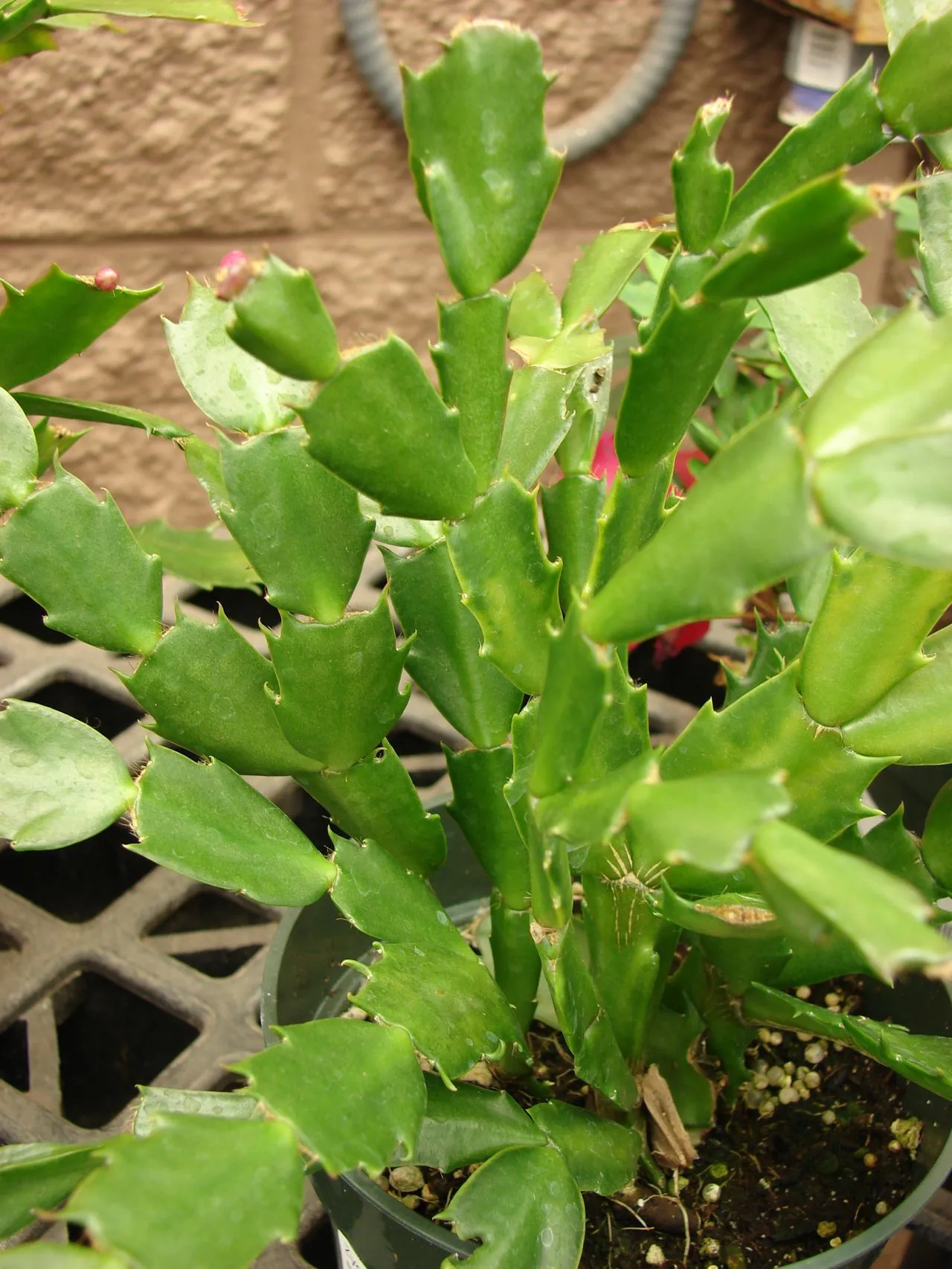
Schlumbergera truncata, the Thanksgiving cactus or false Christmas cactus, was first described by Adrian Hardy Haworth in 1819 as Epiphyllum truncatum, transferred to the genus Zygocactus by Karl Moritz Schumann (the combination Zygocactus truncatus dates from the early 1890s, with Schumann's mature treatment published in 1903), and finally placed in Schlumbergera by Reid Moran in 1953. It is native to the Atlantic Coast forests of southeastern Brazil, growing on tree branches and rocky outcrops at 700 m to 1,500 m in the states of Rio de Janeiro and Espírito Santo. The plant is an epiphyte, not a desert cactus, with pendulous flat segmented stems and sharp pointed teeth along the segment edges that give the species its name (truncata refers to the abruptly cut, toothed segment shape).
In habitat this is a forest plant, not a sand-and-rock specialist. It anchors with shallow roots in moss, leaf litter, and organic detritus trapped on tree limbs, granite outcrops, and rock crevices. Ambient air is humid most of the year, light is bright but filtered through canopy, and water arrives in regular tropical-mountain rain rather than the long dry seasons of Mexican desert habitats. Temperatures in habitat rarely fall below 10 °C; in cultivation, treat 5 °C as the absolute lower limit and avoid any exposure below that. The Brazilian Atlantic Forest itself is reduced to less than 15% of its original extent, and wild populations of several Schlumbergera species are under pressure, although S. truncata is widely propagated in horticulture and not currently classed as threatened.
Part of the Complete Cactus Guide.
Identification
The fastest field check is the segment edge. S. truncata has flat green stem segments (cladodes) with two to four sharp pointed teeth along each side. The teeth project forward like a small saw, often described as crab-claw shape, which is also the source of its other common names "crab cactus" and "claw cactus". Compare this to Schlumbergera bridgesii and the hybrid S. x buckleyi, sold as the true Christmas cactus, which have rounded scalloped segment edges with no pointed teeth. The teeth-versus-scallops difference is the single most reliable way to tell the two apart on a shop shelf, and it holds even when neither plant is in flower.
The flowers are zygomorphic (bilaterally symmetrical) tubes about 6 cm to 8 cm long, in pink, red, white, fuchsia, salmon, or bicoloured forms depending on cultivar. They emerge from the tips of segments in autumn and early winter, typically October to November in the northern hemisphere. That earlier flowering window is where the "Thanksgiving cactus" name comes from in the United States, since S. truncata normally blooms by late November while S. bridgesii and S. x buckleyi flower around mid to late December. Cultivar names such as 'Madame Butterfly', 'Christmas Flame', and 'Limelight Dancer' belong to S. truncata and its hybrids.
Do not confuse S. truncata with Rhipsalis baccifera, the mistletoe cactus. R. baccifera has thin pendent cylindrical stems no thicker than a pencil, produces small translucent white berry fruit, and never carries flat toothed segments. Older trade labels using Zygocactus truncatus refer to the same plant under an obsolete genus name.
Cultivation
Light should be bright and filtered, not direct midday sun behind glass. An east-facing window, or a south-facing window with a sheer curtain, works well year-round in temperate latitudes. Outdoor summer placement under 50% to 70% shade cloth, or beneath high deciduous tree canopy, suits the plant if night temperatures stay above 10 °C. Strong unfiltered sun reddens the segments and can cause permanent beige scorching; deep shade prevents flowering and produces stretched, weak segments.
Water on the wet-and-dry cycle that suits a forest epiphyte, not a desert cactus. In active growth from spring through early autumn, water when the top 2 cm to 3 cm of substrate has dried, soak until water exits the drainage hole, and let excess drain fully. A 12 cm pot at room temperature in bright indirect light usually wants water every 5 to 9 days in summer. The substrate should be moist but never soggy or bone dry; long droughts cause segments to wrinkle and abort flower buds.
Substrate is where most failed Schlumbergera cultivation begins. A heavy peat mix retains too much water and starves the roots of air; a fast desert-cactus mineral mix runs too dry. Aim for an open epiphyte blend of roughly 40% fine to medium orchid bark at 5 mm to 10 mm, 30% pumice or perlite, 20% coir or peat-free compost, and 10% coarse grit at 3 mm to 6 mm. The mix should drain in seconds when watered but still feel slightly damp two days later.
Humidity should sit between 50% and 70% during active growth, higher than the 30% to 50% typical of desert cacti. In dry winter homes with central heating, a pebble tray, a room humidifier, or grouping with other plants is usually needed. Misting alone does little for ambient humidity, although it does no harm if water is kept off open flowers.
Temperature is straightforward in active growth: 18 °C to 25 °C suits the plant. The critical window is autumn flower induction. Schlumbergera species are short-day plants and respond to photoperiod: from late September through October, they need 12 to 14 hours of uninterrupted darkness each night combined with cool night temperatures of 12 °C to 15 °C, for 6 to 8 weeks. During this rest, halve the summer watering rate and stop fertiliser. Even short bursts of artificial light at night (a hallway lamp, a streetlamp through an uncurtained window) can interrupt bud set, so a cool spare bedroom with curtains drawn at dusk often works better than a warm, well-lit living room.
Pots should be wider than they are deep, since the root system is shallow. Plastic pots hold moisture better than terracotta in dry homes. Repot every 2 to 3 years after flowering, in spring, into fresh epiphyte mix. Feed every 3 to 4 weeks during active growth with a balanced low-nitrogen fertiliser at half label strength, stopping in late September before the dark-rest period begins.
Propagation
Stem cuttings are reliable and quick. Detach a healthy two- or three-segment piece by twisting at a joint rather than cutting; the segments separate cleanly at the natural articulation. Allow the cut end to callus in shade for 2 to 4 days, less than for desert cacti since the tissue is thinner and dries faster, then insert the basal segment about 1 cm deep into a moist mix of pumice and coir, or fine bark and perlite. Keep at 20 °C to 24 °C in bright indirect light, mist lightly every few days, and roots typically form in 2 to 4 weeks. Success rates above 90% are normal in spring and early summer; midwinter cuttings root much more slowly.
Seed propagation is feasible but slow and rarely worth the time outside breeding work. Seedlings take 3 to 5 years to reach flowering size, while a cutting will often bloom in its second autumn. Grafting onto Pereskiopsis or Hylocereus rootstocks accelerates growth and is sometimes used for rare cultivar increase, but is not needed for routine cultivation.
Notes
In trade, S. truncata and S. x buckleyi are routinely mislabelled as the same plant or sold under generic "Christmas cactus" tags. The pointed-tooth segment check sorts them out in seconds, regardless of label. Older botanical literature, nursery lists, and inherited plant labels may still use Zygocactus truncatus; it is the same species under an obsolete genus name.
Pests in cultivation are mostly soft-bodied: mealybug at segment joints, scale on older woody stems near the base, and occasional fungus gnats in over-wet substrate. Treat mealybug with 70% isopropyl alcohol on a cotton bud, repeated weekly for 4 weeks, and correct the watering schedule that allowed the infestation. The plant is listed by the ASPCA as non-toxic to cats and dogs, although chewed segments can cause mild gastrointestinal upset from the fibrous tissue.
Bud drop is the most common cultivation complaint, and almost always traces back to sudden change. Moving the plant during bud development, a swing in temperature, dry roots, or a draught from a heater or open window will all dump buds within days. Once buds begin to swell in October, leave the plant where it is and keep watering, humidity, and light cycle steady until flowering finishes.
See also
- The Complete Cactus Guide
- Beginner's Guide to Succulents
- Rhipsalis baccifera — thin-stemmed epiphytic cactus with similar airy substrate and humidity needs
- Epiphyllum oxypetalum — another forest-edge epiphytic cactus with large nocturnal flowers
Frequently Asked Questions
Is Schlumbergera truncata a desert cactus?
No. It is an epiphyte from humid Brazilian coastal mountains, growing on trees and rocks.
What triggers flowering in Schlumbergera?
Flowering is triggered by cool nights and short days, not by drought alone.
How should Christmas cactus be watered?
Water when the upper 2 to 3 cm of the airy substrate has dried.
What light does Schlumbergera need?
Bright filtered light suits it best. Harsh unfiltered midday sun can scorch the segmented stems.