| Question | Short Answer |
|---|---|
| Why is Rhipsalis geographically unusual? | Several Rhipsalis species occur naturally beyond the Americas, probably after long-distance dispersal by birds. |
| Is Rhipsalis baccifera a desert cactus? | No. |
| What light suits Rhipsalis? | An east window or bright indirect light suits it better than harsh full sun. |
| What substrate does Rhipsalis need? | Use fine bark, pumice, and compost so the mix drains quickly but does not remain bone dry for weeks. |
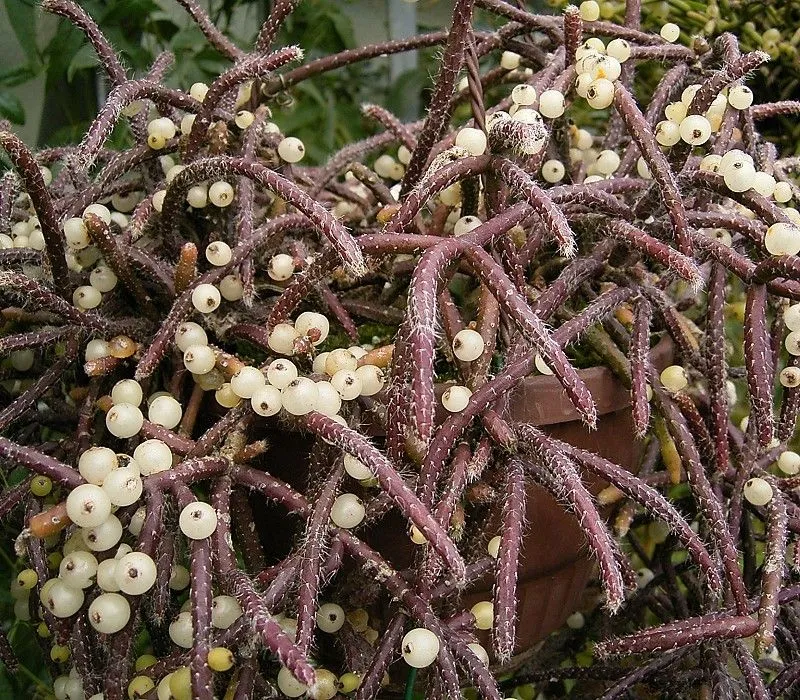
Rhipsalis baccifera, the mistletoe cactus, was given its current name by William T. Stearn in 1939, transferring J. S. Müller's earlier Cassytha baccifera into the genus Rhipsalis. The species is the most widespread cactus on Earth and the only Cactaceae member with native populations outside the Americas, occurring naturally in tropical lowland forest from Florida and the Caribbean through Brazil, and across sub-Saharan Africa, Madagascar, the Mascarenes, and Sri Lanka. It grows as a pendulous epiphyte with thin cylindrical green stem segments forming trailing chains 60 to 200 cm long, ending in small cream flowers and translucent white berries 5 to 8 mm across.
In the Neotropics, R. baccifera occupies tree branches, mossy rock faces, and shaded cliff ledges from sea level to about 1,400 m, often where annual rainfall exceeds 1,500 mm and the canopy keeps air close to saturation. African and Madagascan populations sit in similar deep-shade forest niches along the eastern coastal belt and inland highlands. Whether the Old-World populations represent natural long-distance dispersal, most likely by frugivorous birds carrying seed in sticky fruit pulp, or post-Columbian introduction by Portuguese and other shipping is still debated; molecular work supports a natural origin for at least some African lineages, but the question is not closed. The species is assessed as Least Concern by the IUCN given its wide range, and it appears on no CITES appendix, although fragmented Atlantic Forest populations in Brazil have declined with land conversion.
Part of the Complete Cactus Guide.
Identification
The plant grows as a hanging mass of bright to mid-green cylindrical segments 3 to 5 mm thick, freely branched at irregular joints. Areoles are tiny and inconspicuous, often without visible spines on adult growth, although seedlings and juvenile shoots may carry fine bristles that are shed with age. Flowers are small at about 5 to 8 mm across, white to greenish-white, opening flat against the stem, and emerge directly from lateral areoles rather than from a terminal crown. The fruit is the diagnostic feature: a near-translucent white to pinkish-white berry 5 to 8 mm wide, persisting on the stem for weeks, and giving the plant its common name through the resemblance to European mistletoe (Viscum album) berries.
The lookalikes most often confused with R. baccifera in trade fall into three groups:
- Hatiora salicornioides, the dancing-bones or drunkard's-dream cactus, is also pendulous and segmented, but the segments are bottle- or club-shaped rather than uniformly cylindrical, the whole plant is stiffer and more upright, and flowers are yellow at the segment tips rather than white from lateral areoles.
- Lepismium species (formerly grouped within Rhipsalis) carry flattened or paddle-shaped, often winged stem segments instead of thin cylindrical chains; flower position and fruit colour can also differ between species, and several have red or magenta berries rather than white.
- Large columnar genera such as Cereus or climbing Selenicereus are sometimes mis-shelved alongside trailing cacti in shops. They have ribbed, thick stems 1 to 8 cm or more in diameter and a fundamentally different morphology; once you see the size and ribbing, confusion ends quickly.
Cultivation
Light is the parameter most often misjudged. Unlike desert cacti, R. baccifera grows in deep forest understorey and tolerates noticeably lower indoor light than most Cactaceae. An east window, a north window with a clear sky aspect, or a position 1 to 2 m back from a south window behind a sheer curtain works well. Direct unfiltered midday sun through glass scorches the segments to pale yellow within hours, and the damage does not fade. The plant holds its colour and continues to extend in conditions where a Mammillaria or Echinocactus would etiolate.
Water more often than you would a desert cactus. In active growth, roughly spring through early autumn for most homes, water when the upper 2 to 3 cm of substrate has dried; a moisture probe reading around 20 to 25% in that zone is the trigger. Allowing the entire root ball to dry hard for weeks, as you would for a barrel cactus, causes segments to shrivel lengthwise and drop. In winter, when growth slows, extend the interval to roughly every 2 to 3 weeks at indoor temperatures of 12 to 18°C, but do not impose a complete dry rest; the species comes from a habitat that is moist year-round.
Substrate should be airy and lightly moisture-retentive, closer to an epiphyte mix than a desert cactus mix. A workable recipe is 40% fine orchid bark at 5 to 10 mm grade, 30% pumice or perlite, 20% coir or low-peat compost, and 10% coarse grit. The aim is fast drainage with enough organic content to keep the bark zone gently humid between waterings. Pure mineral mixes built for Astrophytum or Echinocactus tend to dry too aggressively and produce thin, slow growth.
Temperature tolerance is narrower than for desert species. Keep the plant above about 5°C as a hard floor, and ideally above 10°C for any extended period. Brief exposure to 3 to 5°C is survivable if substrate is barely damp, but frost causes blackening and segment collapse from the tips inward. Summer warmth above 30°C is fine in shade with humidity, although growth pauses in dry heat. Hanging baskets exposed to dry conditioned air or radiator updraft benefit from occasional misting or seasonal repositioning.
A 15 to 20 cm hanging basket suits a mature plant for several years; the species does not develop a deep root system and prefers shallow, wide containers with multiple drainage points. Plastic or coir-lined net baskets dry slowly enough to match the moisture preference, while terracotta in dry homes may need watering every 5 to 7 days in summer. Feed during active growth with a balanced fertiliser at one-quarter label strength every 4 to 6 weeks; the species responds to a slightly higher nitrogen ratio than desert cacti without becoming soft.
Propagation
Stem cuttings are reliable and fast. Take a chain of 3 to 5 segments with a clean blade, or detach with a gentle twist at a joint where one separates cleanly. Let the cut surface callus in shade for 2 to 4 days; longer drying offers no advantage on tissue this thin. Insert the basal cut 1 to 2 cm into a moist epiphyte mix. Rooting usually begins within 2 to 3 weeks at 18 to 24°C with bright indirect light. Multiple cuttings in the same basket build a full hanging plant within a single growing season. Success rates above 90% are typical when cuttings come from firm mid-age segments rather than the softest tips.
Seed propagation is possible from ripe white berries, each containing 10 or more small black seeds. Sow on a sterile fine mineral and bark mix, hold at 22 to 26°C with high humidity, and germination follows in 2 to 4 weeks. Seedlings are slow to fill out and rarely worth the effort given how readily cuttings strike. Layering, where a low-hanging segment is pinned into adjacent moist substrate until it anchors, works well in larger collections and lets you remove rooted sections without disturbing the parent.
Notes
In trade, R. baccifera is often unlabelled or sold under the broad tag "rhipsalis", which can mask several species in the same shipment. If you want a true R. baccifera rather than R. cereuscula or R. pilocarpa, look for uniformly cylindrical 3 to 5 mm segments without persistent bristly tufts, and confirm white rather than red or pink fruit when present. The species has no significant toxicity reported for cats or dogs, and the spineless adult habit makes it one of the safer cacti for households with curious pets, although the berries can act as a mild gastric irritant if eaten in quantity.
Pests follow the indoor-epiphyte pattern rather than the desert-cactus pattern: mealybug hidden in segment joints, scale on older woody bases, and occasionally fungus gnats in the bark fraction of damp substrate. Mealybug responds to 70% isopropyl alcohol on a fine brush; persistent scale may need a systemic insecticide labelled for ornamentals. The biogeographic uniqueness of R. baccifera, the only cactus you might genuinely encounter wild in an African or Sri Lankan forest, gives the species a place in a serious collection that goes beyond its appearance.
See also
- The Complete Cactus Guide
- Beginner's Guide to Succulents
- Schlumbergera truncata — another epiphytic cactus with similar humidity and indirect-light requirements
- Epiphyllum oxypetalum — forest-edge epiphytic cactus for comparison of substrate and light needs
Frequently Asked Questions
Why is Rhipsalis geographically unusual?
Several Rhipsalis species occur naturally beyond the Americas, probably after long-distance dispersal by birds.
Is Rhipsalis baccifera a desert cactus?
No. It is an epiphytic forest cactus with thin pendent stems.
What light suits Rhipsalis?
An east window or bright indirect light suits it better than harsh full sun.
What substrate does Rhipsalis need?
Use fine bark, pumice, and compost so the mix drains quickly but does not remain bone dry for weeks.