| Question | Short Answer |
|---|---|
| How large does Echinocactus grusonii get? | Mature plants can exceed 60 cm across after decades, although potted plants grow slowly. |
| Why are the spines so dense? | Dense yellow spines shade the stem and are part of the barrel cactus adaptation to exposed habitat. |
| Is slow growth normal for golden barrel cactus? | Yes. |
| What soil does golden barrel cactus need? | It needs sharp, mineral drainage rather than peat-heavy compost, especially indoors. |
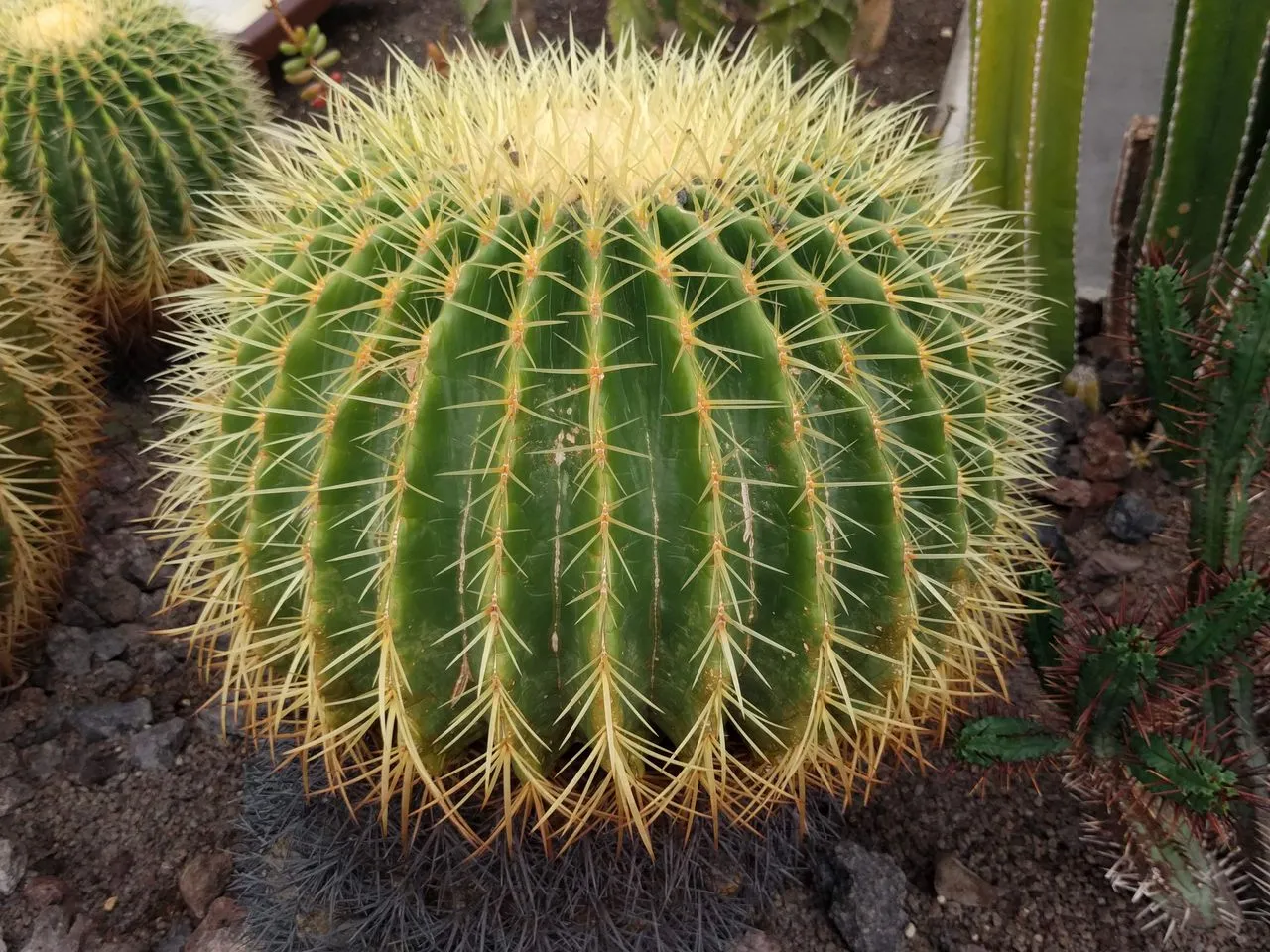
Echinocactus grusonii Hildm. was described by Heinrich Hildmann in 1891, named for the German industrialist and cactus collector Hermann Gruson. It is endemic to central Mexico, historically from Hidalgo, Querétaro, and Zacatecas, where it grew on steep volcanic and limestone slopes in semi-arid scrub. A mature plant forms a heavy globe 60 to 90 cm across, with deep vertical ribs and dense golden yellow spines that make it one of the most recognisable barrel cacti in cultivation.
In habitat, E. grusonii is a lesson in how nursery abundance can hide wild rarity. The species is assessed as Endangered, and only about 25 mature wild plants are known from remnant populations. Much of the best-known habitat near Zimapán was flooded by the Zimapán Dam, leaving scattered plants on inaccessible slopes above the reservoir and in nearby dry valleys. It grows in thin mineral soils where rainfall drains quickly, summer days are hot, and winter nights can be cold but dry. International trade is covered by CITES controls, but nearly all plants offered in shops are seed-raised or nursery propagated, which is why a cactus rare in nature can still be common on benches in garden centres.
Part of the Complete Cactus Guide.
Identification
Young golden barrels are nearly spherical, with a bright green body partly hidden by radiating yellow spines. With age, the stem becomes a broad globe or slightly flattened barrel, usually solitary rather than offsetting. A cultivated plant 20 cm across may already be many years old; a 60 cm specimen represents decades of steady growth. Old plants can approach 90 cm in diameter and develop a woolly crown at the top.
The ribs are strong and regular, usually numbering 21 to 37 on mature plants. They run from crown to base as raised vertical ridges, not as mammillaria-like tubercles. Areoles sit along each rib and carry a tuft of pale wool when young. New areoles near the crown are the cleanest place to judge spine colour, because older spines darken, collect dust, or bleach unevenly in strong sun.
Spines are the feature most growers notice first. Each areole carries 8 to 10 radial spines and usually 3 to 4 stronger central spines, with one central sometimes curved slightly downward. The spine colour is yellow to golden yellow in typical plants, although whitish-spined forms occur in cultivation. The spines are not decorative hairs; they are rigid, sharp, and arranged densely enough to shade the epidermis during high light.
Flowers appear only on mature plants, typically once the stem is at least 40 to 50 cm wide and has developed a woolly crown. That can take 20 to 30 years in a container, sometimes longer indoors. The flowers are yellow, about 4 to 6 cm across, and emerge from the crown in warm weather. Fruits are embedded in the crown wool and are less conspicuous than the flowers.
Lookalikes. Echinocactus platyacanthus can be confused with golden barrel when young, but it becomes much larger, often taller than wide, with broader ribs and heavier grey to brown spines in age. Ferocactus wislizeni has a more cylindrical barrel shape as it matures and usually carries a hooked central spine, a trait absent from typical E. grusonii. Parodia leninghausii has yellow spines too, but it forms slimmer columns, often clusters from the base, and lacks the massive ribbed globe form of a true golden barrel.
Cultivation
Light. Give E. grusonii 5 to 6 hours of direct sun daily during active growth. Indoors, that means a south-facing window in the northern hemisphere, with the plant close to the glass rather than set back on a table. Under weaker light, the new growth at the crown becomes paler, the ribs stretch upward, and the plant loses the compact, heavy outline that makes the species distinctive. Outdoors, acclimate over 10 to 14 days before full summer sun. A plant moved straight from a shop bench to midday sun can bleach on the exposed side within one afternoon.
Water. From spring through early autumn, water deeply, then wait until the mix has dried through most of the pot. In a 15 cm terracotta pot with a 10 to 12 cm plant, that may mean every 14 to 21 days in warm weather. In a 25 cm plastic pot indoors, the interval may be closer to 4 to 6 weeks. A moisture probe should read below 15% in the upper 3 cm and close to dry at depth before watering again. The plant stores water in a large ribbed stem, so slight rib contraction between waterings is normal and safer than keeping the root zone constantly damp.
In winter, keep the plant dry if temperatures are below about 12°C. A dry golden barrel can tolerate brief dips to around -7°C, but wet roots at 2°C are far more dangerous than a dry light frost. For a cool winter rest at 5 to 10°C, I usually give no water for 8 to 12 weeks. If the plant is grown warm under strong lights above 16°C, a light watering every 5 to 8 weeks may be needed to prevent excessive shrivelling, but the mix must dry within 7 to 10 days.
Substrate. Use a mineral-heavy mix, roughly 70% mineral material and 30% low-peat or peat-free organic matter. A practical recipe is 35% pumice, 20% coarse grit at 3 to 6 mm, 15% lava rock or crushed granite, and 30% loam-based compost. Peat-heavy cactus compost holds too much water around the fine feeder roots, especially in deep pots. If your climate is humid or your growing area is cool, push the mineral fraction toward 80%.
Temperature. Active growth is strongest between about 18 and 32°C. The plant tolerates higher heat if the root system is healthy and the pot is not baking against a south wall. In winter, keep it dry and bright between 5 and 12°C where possible. The frequently quoted hardiness of about -7°C applies to brief dry exposure, not to a plant in wet compost on a freezing patio.
Pot. Golden barrels eventually become heavy, so choose stability as well as drainage. Terracotta is useful for plants up to about 25 cm across because it dries evenly and adds weight. For larger specimens, a broad low container with a drainage hole is safer than a tall narrow pot. Repot only when the root ball has filled the container or the plant has become unstable, usually every 3 to 5 years for established plants. Move it with folded newspaper, foam blocks, or a strap around the pot, not by gripping the spines.
Propagation
Seed is the normal propagation method. Fresh seed germinates well on a sterile fine mineral surface at 24 to 28°C, with bright filtered light and a covered tray to hold humidity. Expect germination in 7 to 21 days if the seed is viable. Once seedlings are 3 to 5 mm across, begin increasing ventilation gradually over 2 to 3 weeks so they harden without collapsing. A realistic germination rate from fresh cultivated seed is 60 to 80%, but early losses rise sharply if algae, fungus gnats, or cold wet substrate are present.
Growth is slow after the first year. Seedlings may reach 1 to 2 cm across after two growing seasons under good light and measured feeding. They are often saleable at 4 to 6 cm, but flowering size is a long project. The common nursery supply exists because growers produce thousands from seed, not because individual plants mature quickly.
Offsets are not a dependable method. Typical E. grusonii remains solitary for many years, and basal pups usually appear only after injury, age, or stress. Removing a pup from a valuable old plant is rarely worth the risk unless it already has its own roots and separates cleanly. Grafting can accelerate rare seedlings or variegated forms, but own-root plants are stronger and more natural for ordinary cultivation.
Notes
Conservation. Golden barrel cactus is a conservation success story with an uncomfortable footnote. Cultivation has made the species familiar and affordable, which reduces pressure on the last wild plants. At the same time, the wild population remains critically small in practical terms, with about 25 mature plants known after the Zimapán habitat loss. Buying seed-grown nursery plants is the responsible route; large habitat-collected barrels should be avoided.
Name in trade. Many sources still use Echinocactus grusonii, while some taxonomic treatments place the species in Kroenleinia as Kroenleinia grusonii. The horticultural name on labels remains overwhelmingly Echinocactus grusonii, and that is the name most growers will encounter. The care does not change with the label.
Cultivars and forms. Whitish-spined plants are sold as 'Alba' or under similar nursery names. Nearly spineless forms circulate as 'Subinermis', though they need more caution in strong sun because the reduced spines provide less shade to the stem. Painted or glued-on novelty plants should be avoided; paint blocks normal surface function and makes it harder to inspect for pests.
Pests and handling. Scale insects can hide along ribs and near the crown wool. Inspect new plants with a hand lens, especially if they have been crowded in a shop. The species is not known to be toxic to pets or people, but the mechanical hazard is real. Spines puncture skin easily and can break off, so place mature plants where children, pets, and ankles will not brush against them.
See also
- The Complete Cactus Guide, the main cactus cultivation guide covering areoles, ribs, light, mineral substrate, and winter rest.
- Ferocactus wislizeni, a barrel cactus with stronger hooked central spines and a more cylindrical adult form.
- Echinocactus platyacanthus, a larger Mexican barrel useful for comparing rib structure, spine weight, and adult proportions.
- A Beginner's Guide to Succulents, broader context for matching succulent plants to light, soil, and seasonal water.
Frequently Asked Questions
How large does Echinocactus grusonii get?
Mature plants can exceed 60 cm across after decades, although potted plants grow slowly.
Why are the spines so dense?
Dense yellow spines shade the stem and are part of the barrel cactus adaptation to exposed habitat.
Is slow growth normal for golden barrel cactus?
Yes. Slow growth in pots is normal and should not be corrected with frequent watering.
What soil does golden barrel cactus need?
It needs sharp, mineral drainage rather than peat-heavy compost, especially indoors.