| Question | Short Answer |
|---|---|
| What identifies Ferocactus wislizeni? | It is a barrel cactus with strong central spines, often hooked, matching the Ferocactus pattern described in the cactus guide. |
| Does Ferocactus wislizeni need full sun? | Yes. |
| What winter treatment is best? | A long dry winter rest is safest, especially when temperatures are cool. |
| Is heat the main problem in containers? | Usually no. |
Ferocactus wislizeni (Engelm.) Britton & Rose was formally treated under that combination in 1922, in the second volume of The Cactaceae, building on the earlier diagnosis by George Engelmann, who collected type material during the United States and Mexican Boundary Survey of the mid 19th century. The species is native to the southwestern United States, from southeastern Arizona across southern New Mexico into the trans-Pecos region of west Texas, and continues south into the Mexican states of Sonora and Chihuahua. It grows on rocky bajadas, gravelly slopes, and limestone outcrops in the Sonoran and Chihuahuan deserts, between roughly 300 and 1,800 m elevation. Its most reliable field mark is its spination: each areole carries four strong central spines, and the lower central is bent into a clear hook, the trait that gives the species its common names of fishhook barrel cactus and candy barrel.
In habitat the plant is part of the slow architecture of the Sonoran Desert, sharing ground with saguaros, ocotillos, and several smaller cholla and prickly pear opuntias. A typical adult reaches 0.3 to 3 m tall and 30 to 80 cm across, but those figures describe plants that have spent 30 to 50 years in place. A 60 cm specimen at a trailhead is not a quick sapling; it is older than many of the people walking past it. F. wislizeni is solitary or sparsely clumping, sometimes producing a small group of stems after damage to the main growing point, but rarely forming dense colonies in the way some smaller barrels do. International trade is regulated under CITES Appendix II, which covers the entire family Cactaceae, so any plant moving between countries needs the appropriate export documentation. Within the United States and Mexico, wild collection is also restricted under domestic law, and Arizona in particular protects native cacti by statute.
Part of the Complete Cactus Guide.
Identification
F. wislizeni is a stout, ribbed, columnar barrel that begins life nearly globular and gradually elongates with age. Young plants under 20 cm across can resemble a thick-spined Echinocactus, but as the stem stretches upward the species takes on the cylindrical adult outline that field guides describe. Mature ribs typically number 20 to 28 and run vertically from base to crown, sometimes with a slight spiral twist on older plants.
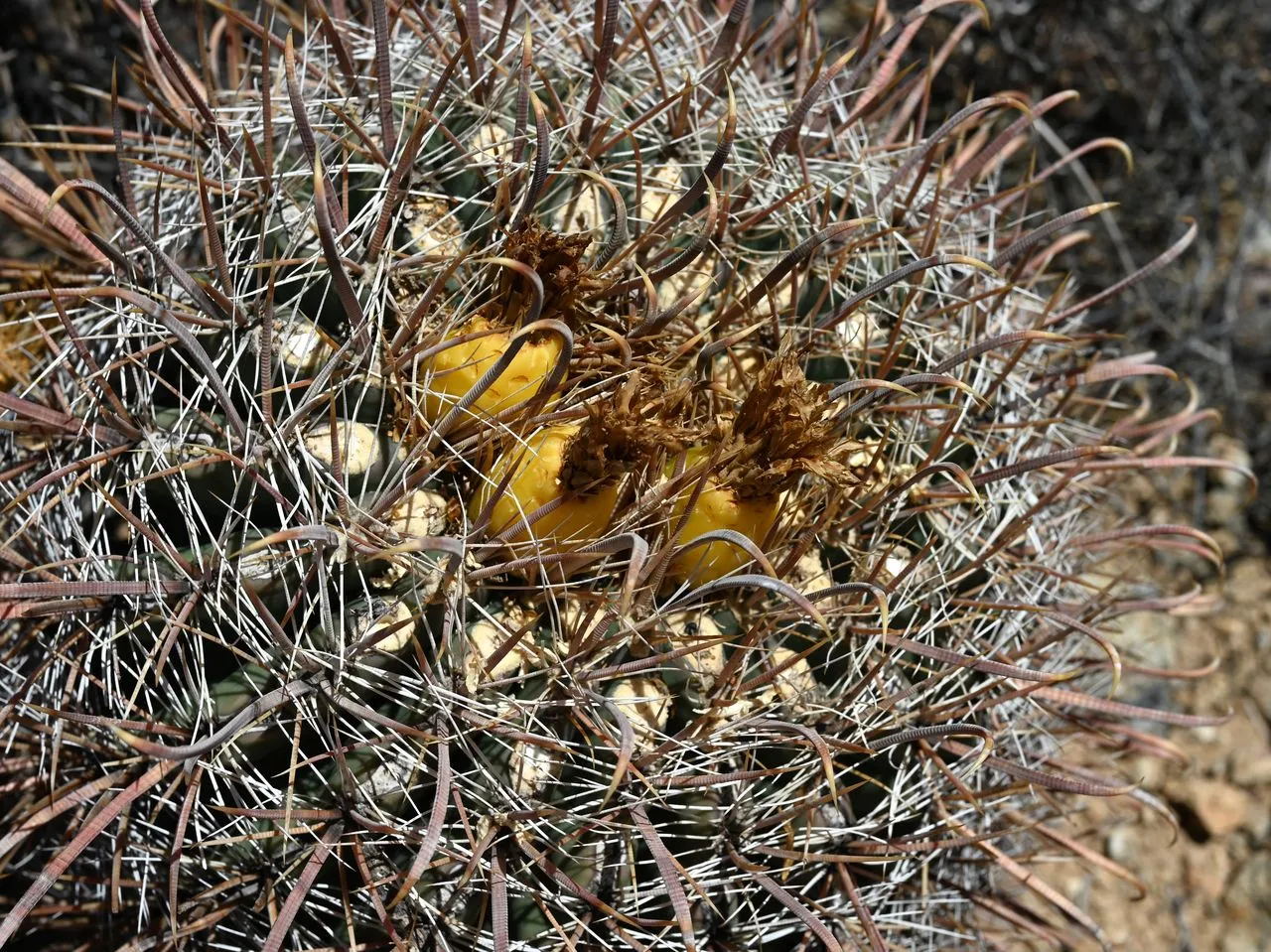
The areoles carry the diagnostic spination. Each one bears 15 to 25 stiff, slender, white to grey radial spines and four heavier central spines. Of those four centrals, the lower one curves down and back into the fishhook shape that names the species. The hook is not a subtle ornament; on a mature areole it is a visible bend at the tip of a flat, ribbon-like spine that can reach 6 to 10 cm. Central spines range from straw yellow on young growth to red, orange, or grey with age, and the colour can shift down a single rib as new areoles emerge from the crown.
Flowering is reliable on mature plants. The blooms appear in a ring around the apex from midsummer into early autumn, with timing tied to monsoon rainfall, and petals run from clear yellow through orange to a deep orange-red that gives the species an alternative common name, red-flowered fishhook barrel. Individual flowers are 5 to 7 cm across and last several days. Fruits are yellow, fleshy, and persistent, often staying on the crown for months and forming a visible ring of small yellow lemons at the top of the plant well into winter.
A second field clue appears as the plant ages. Mature F. wislizeni often tilt noticeably toward the south or southwest, reliably enough that the species shares the common name "compass barrel" with several related ferocacti. The lean is thought to result from greater growth on the shaded northern face of the stem combined with desiccation and reduced cell expansion on the sun-facing side. Heavy old plants can lean far enough to topple during monsoon storms, which is part of how individuals reach the end of their lives in the wild.
Lookalikes. Ferocactus cylindraceus, the California barrel, overlaps in range across western Arizona and southern California. It lacks the strong fishhook on the lower central spine, stays smaller in stature on average, and carries denser, more bristle-like radial spines that partly veil the green body. Echinocactus grusonii, the golden barrel of central Mexico, has uniformly golden spines, no hooked central, a much smaller crown flower around 4 to 6 cm across, and a broadening globe rather than the elongating column of F. wislizeni. If you see hooked centrals and persistent yellow fruit on a tall barrel, you are not looking at E. grusonii.
Cultivation
Light. Give F. wislizeni the strongest light you can manage. Outdoors in mediterranean and warm temperate climates, full sun is appropriate after a 10 to 14 day acclimation. Indoors, a south-facing window with the plant within 30 cm of the glass is the practical minimum; weaker light produces pale, narrowed new growth at the crown that will not later thicken to match the older stem. Plants that have spent winter under shop lighting should not move straight to summer noon sun, as the sun-facing flank can scald within a single afternoon.
Water. From spring through early autumn, soak the substrate thoroughly, then wait until the mix has dried through most of the pot before the next watering. In a 20 cm terracotta pot with a 12 to 15 cm plant, that interval is usually 14 to 21 days in warm dry weather, and longer in cool spells. A moisture probe should read below 15% in the upper 3 cm and close to dry at depth before you water again. The ribbed stem stores its own reserve, so visible rib contraction between waterings is a normal part of the cycle rather than a distress signal. From late autumn through early spring, when temperatures are below about 12°C and light is low, hold water entirely if the plant is at a cool dry rest.
Substrate. Use a strongly mineral mix, roughly 70 to 80% mineral material to 20 to 30% low-peat or peat-free organic matter. A workable recipe is 35% pumice, 25% coarse grit at 3 to 6 mm, 15% lava or crushed granite, and 25% loam-based compost. The species roots in habitat into shallow gravelly soils that drain within minutes of summer rain, and a peat-heavy nursery compost held in a deep pot is the opposite of that environment.
Temperature. Active growth runs from about 18 to 35°C, and well-established plants tolerate higher heat outdoors if the root system is healthy and the pot is not pressed against a south-facing wall. Cold tolerance is a more nuanced point. Dry-rooted F. wislizeni can survive brief exposure to around -10°C in habitat, where winter nights at 1,500 m routinely drop below freezing. In cultivation, that figure only applies if the substrate is dry, the plant is mature, and the cold spell is short. Wet roots at 2°C are far more dangerous than a dry light frost.
Pot. Mature plants become heavy and top-loaded, so stability matters as much as drainage. A wide, shallow terracotta pot is usually safer than a tall narrow plastic one for plants over 25 cm across. Repot only when the root mass has filled the container or the plant has become unstable, typically every 4 to 6 years for established specimens. The hooked spines catch on cloth, gloves, and forearms easily; move plants with foam blocks, a folded carpet sling, or a cinched strap, never by gripping the spines.
Propagation
Seed is the only routine method for this species. Fresh seed germinates well on a sterile fine mineral surface at 24 to 28°C, with bright filtered light and a covered tray to hold humidity. Expect emergence in 10 to 21 days from viable seed, with a realistic germination rate of 50 to 75% from cultivated stock. Seedlings are slow: a year-old plant may be 5 to 8 mm across, and saleable size around 4 to 6 cm represents three to five growing seasons of careful work. Algae and fungus gnats kill more F. wislizeni seedlings than any other factor, so ventilation matters as much as warmth from the second month onward.
Vegetative propagation is rarely a reliable option. The species is normally solitary, and the basal pups that occasionally form after damage are slow to root and not worth removing from a strong parent.
Notes
Conservation and trade. F. wislizeni is widespread and not currently considered globally threatened, but every plant moving across an international border still falls under CITES Appendix II reporting. Wild-collected specimens occasionally surface in trade with vague provenance; those plants are best avoided in favour of nursery-grown seedlings, which are widely available and root more reliably than field-dug adults. The slow growth that makes wild plants tempting also means an old wild barrel cannot be replaced in a human lifetime.
Use by wildlife and people. The yellow fruits attract Gambel's quail, javelinas, and rodents in habitat, and the species has a long history of food and ceremonial use among Sonoran Desert peoples. The popular notion of a barrel cactus full of drinkable water is misleading: the inner tissue is alkaline and oxalate-rich, and direct consumption causes nausea and diarrhoea.
Pests and handling. Scale insects and root mealybug both attack barrel cacti in cultivation, often hidden among radials or under the soil line. Inspect new arrivals with a hand lens before placing them near established plants, and check the inner pot wall and root crown when repotting. The hooked spines are the largest practical hazard at home. Once a hook engages skin or clothing, pulling away widens the wound, so press gently against the entry direction with a tool or a folded card to disengage rather than yanking back.
See also
- The Complete Cactus Guide, the broader cultivation guide covering areoles, ribs, mineral substrate, light, and winter rest.
- Echinocactus grusonii, the golden barrel of central Mexico, useful for comparing rib structure, spine colour, and adult proportions.
- Ferocactus cylindraceus, the California barrel, a closely related species without the strong fishhook central spine.
- A Beginner's Guide to Succulents, broader context for matching succulent plants to light, soil, and seasonal water.
Frequently Asked Questions
What identifies Ferocactus wislizeni?
It is a barrel cactus with strong central spines, often hooked, matching the Ferocactus pattern described in the cactus guide.
Does Ferocactus wislizeni need full sun?
Yes. Ferocactus are high-light plants and should be acclimated to intense sun rather than kept in dim rooms.
What winter treatment is best?
A long dry winter rest is safest, especially when temperatures are cool.
Is heat the main problem in containers?
Usually no. The main container problem is damp organic substrate around cool roots.