| Question | Short Answer |
|---|---|
| Why is Opuntia microdasys called bunny ears? | The paired flattened pads give the plant its bunny ears shape. |
| Does Opuntia microdasys have spines? | It often lacks obvious long spines but has dense glochids that detach into skin. |
| What light does bunny ears cactus need? | It needs strong direct light to keep pads compact and properly shaped. |
| How do you propagate Opuntia microdasys? | Detach a pad, let the cut callus, then root it in dry mineral substrate. |
Opuntia microdasys (Lehm.) Pfeiff., the bunny ears cactus, was first described by Johann Georg Christian Lehmann in 1828 as Cactus microdasys and transferred to Opuntia by Ludwig Karl Georg Pfeiffer in 1837. The species grows across the northern and central Mexican plateau in the states of Chihuahua, Coahuila, Durango, Zacatecas, San Luis Potosí, and Tamaulipas, at elevations of roughly 1,000 m to 2,200 m in semi-arid scrub and grassland. Its defining feature is not its shape, which is pleasant and reads as harmless, but the dense tufts of glochids that fill every areole on every pad.
In habitat, O. microdasys grows in rocky and gravelly soils with excellent drainage, typically on exposed slopes where rainfall concentrates in summer and winters bring dry cold with occasional light frost. Annual precipitation in these zones runs 300–500 mm, arriving unevenly and followed by rapid evaporation. Established plants form dense shrubby mounds 50–100 cm tall and wide. There are no CITES restrictions on this species; it is common in the wild, extensively propagated in cultivation, and widely traded.
Part of the Complete Cactus Guide.
Identification
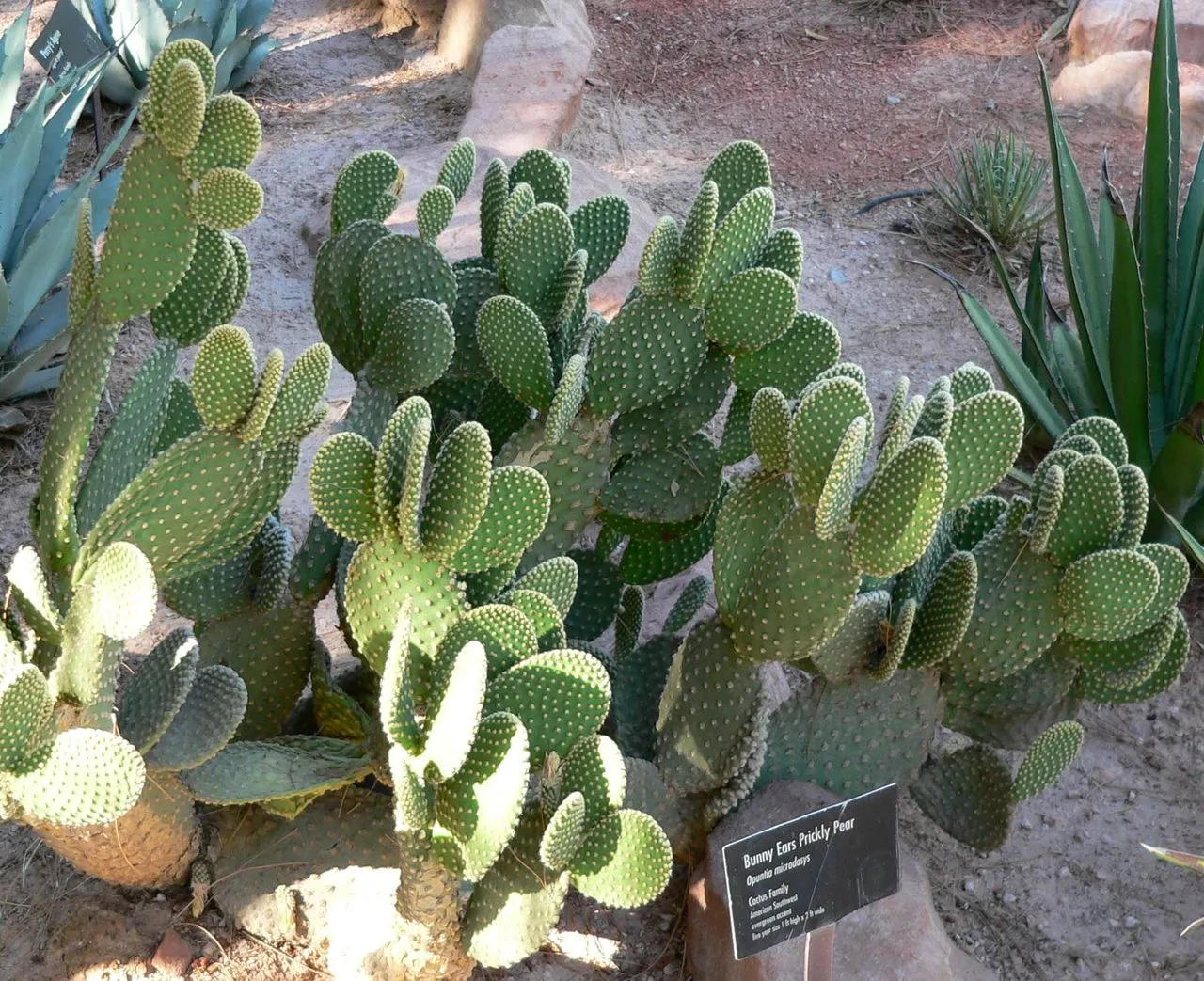
The flat oval pads (cladodes) are the immediately recognizable feature. Each pad is 6–15 cm long and 5–12 cm wide, bright to mid-green, and grows from the tip or along the margin of an older pad. Over time the plant builds a branching mound from this successive pad growth. The surface of each pad is covered in areoles spaced 5–8 mm apart; each areole holds a tuft of 100–600 glochids but no true spines. This spinelessness is the single most deceptive thing about the species.
Two forms are common in cultivation:
- var. albispina: white to cream glochids. Pads look dusted with white powder; this is by far the most common form sold.
- subsp. rufida (sometimes listed as O. rufida, a matter of ongoing taxonomic debate): reddish-brown to cinnamon glochids. The pads read warmer in tone and the glochids are visually more obvious.
Flowers are yellow, 4–6 cm across, and open in late spring to summer on pads that are at least two to three years old. Fruit is red-purple at ripeness, 2–3 cm long, and carries glochids on its surface; handle it with the same caution as the pads.
Two common lookalikes are worth distinguishing by Latin name. Opuntia ficus-indica grows to 5 m or more, bears pads 20–40 cm long, often carries true spines alongside glochids in its areoles, and is the prickly pear cultivated commercially for edible fruit. Opuntia basilaris, the beavertail cactus, has distinctly blue-grey, more wedge-shaped pads and is native to the Mojave and Colorado desert regions of the United States and northern Baja California; it is not a Mexican plateau plant.
Cultivation
Light. Outdoors, O. microdasys takes full sun readily once acclimated; move it outside in spring gradually over 10–14 days starting with morning exposure only, then increasing from there. Indoors, a south-facing window with 5–6 hours of direct sun daily is the practical minimum for compact, upright pad growth. East or west windows can sustain the plant but pads tend to lean toward the light source and growth is slower. Under most artificial lighting alone the plant survives but rarely produces new pads with the density or firmness of a well-lit specimen.
Water. During active growth (April through September in most temperate climates), water deeply when the top 4–5 cm of substrate reads below 15% on a moisture probe, or when a skewer pushed to pot depth comes out dry with no particles clinging to it. For a 12 cm terracotta pot in a south window in summer, that interval is usually 10–18 days. From late October onward, reduce sharply. A plant resting at 8–10°C should receive at most one light watering every 6–8 weeks; none at all if temperatures stay below 6°C. Wet substrate combined with cool roots is the leading cause of pad shrivelling and eventual root loss, far more common than drought damage.
Substrate. Use 65–70% mineral material with 30–35% lean organic matter. A reliable recipe: 40% pumice (3–8 mm), 15% coarse grit, 10% lava rock or expanded shale, 30% loam-based compost, 5% perlite. This yields a pH of roughly 6.5–7.0 and drains fully within 30 seconds of watering. Peat-heavy mixes hold moisture at depth long after the surface appears dry and should be avoided.
Temperature. Outdoor cultivation year-round is possible in USDA zones 9b–11 with sharp drainage. Established plants in bone-dry substrate tolerate brief dips to −5°C without visible pad damage; the same plant in wet substrate at 0°C is at serious risk. Indoors, summer temperatures up to 38°C are tolerated with good ventilation. The ideal winter rest is 8–12°C, completely dry. Never let the pot stand in a saucer of water at any time of year.
Pot. Shallow, wide, unglazed terracotta suits this shallow-rooted species well. Keep the pot no more than 2–3 cm wider than the root ball; excess substrate stays wet past the reach of roots and sets up the conditions for rot.
Propagation
Pad cuttings root reliably; success rates above 90% are normal at 22–28°C. The sole complication is avoiding glochid contact throughout the process.
Detach a pad using long-handled tongs or a thick folded pad of 10–12 sheets of newspaper as a grip tool. Set the detached pad in a dry, shaded position at 20–25°C and leave the cut end to callus for 3–7 days until it is pale, dry, and lightly sealed. Stand the callused end 2–3 cm into dry, very mineral substrate (80% pumice or coarse grit is fine at this stage). Do not water for the first 7–10 days. Then mist lightly once a week for two to three weeks; roots normally emerge in 3–5 weeks. Once the pad resists a gentle tug, begin normal mature-plant watering. A rooted pad in a well-lit spot at 22–26°C typically produces its first daughter pad within 4–6 weeks of establishment.
Seed germination is possible. Sow on the surface of a fine mineral mix at 25°C; most seeds sprout in 10–21 days. A seedling needs 3–5 years to reach the size of a single rooted pad, which is why vegetative propagation is almost always the practical choice.
Glochid Safety
Glochids are the reason O. microdasys ends up in urgent-care waiting rooms. They are 1–3 mm long, pale yellow to cream (cinnamon in subsp. rufida), and each carries microscopic retrograde barbs along its shaft. Every areole holds between 100 and 600 of them, loosely tethered. They release at the lightest contact, including the air movement from a hand passing within a centimetre of the pad. This is not exaggeration: people receive glochids in exposed skin simply by leaning over the plant to look at it.
Why latex and nitrile gloves fail. Examination-grade latex and nitrile gloves are 0.05–0.10 mm thick, with a surface texture that glochids catch on. Under light pressure, the barbed shafts work through the material. The only reliable hand protection is thick leather welding gloves, or a folded pad of newspaper 1–2 cm thick held against the plant body. Standard foam oven mitts compress on contact and transmit glochids much as thin gloves do.
Extraction. Do not rub the affected area. Rubbing drives barbs deeper and snaps the shafts, leaving sub-surface fragments that are far harder to remove. Two methods work well:
- Duct tape or packing tape. Press a fresh strip firmly over the affected skin, smooth it fully, and peel sharply in one motion. Retrograde barbs release more cleanly when pulled perpendicular to the skin surface. Repeat with fresh strips until no glochids transfer to new tape. This is the most accessible method and works on most body areas.
- Depilatory wax strip. Apply warm salon wax, allow it to cool and set completely, then remove perpendicular to the skin. Works better than tape on thin facial skin or wrists, where glochids have barely penetrated and tape adhesive would cause more irritation than the glochids themselves.
For any remaining visible individual glochids after tape removal, fine-tipped tweezers under magnification can extract them, but the shafts snap easily. If a fragment goes below the skin surface and causes inflammation over two to three days, treat it as a retained splinter and see a physician.
Never blow. Blowing on glochid-covered skin, or on the plant during handling, sends airborne glochids toward the eyes and nasal passages. Ocular involvement is a medical emergency: glochids in the cornea require specialist removal and can cause corneal damage if the eye is rubbed. Do not flush aggressively. Seek same-day ophthalmological attention if glochids contact an eye.
Children and pets. Place O. microdasys on a shelf at least 1.2 m from the floor. A dog or cat brushing against the plant receives a concentrated glochid load to the face, and oral or nasal involvement requires veterinary attention.
Notes
The two commercial forms, 'Albispina' and subsp. rufida, are sold interchangeably as "bunny ears cactus" in garden centres and gift shops, routinely without any warning about glochids. The spineless appearance and the name position the plant as approachable; this framing is exactly what leads to most handling injuries.
Flowering from pad cuttings is possible after three to four years, but only with a genuine cool dry winter rest. A plant kept above 18°C year-round, as most gift-shop plants are, grows well but rarely sets buds. Moving it to a cool (8–12°C), dry, bright position from October through February is usually sufficient to trigger flower buds the following spring.
Root mealybug is the main pest concern, causing stalled growth and dulled pad colour before any above-ground signs are clear. Unpot the plant and look for white waxy deposits on roots and along the inner pot wall. Scale insects sometimes appear near areoles; remove them with a cotton bud dipped in 70% isopropyl alcohol, taking care not to drag glochids across the wound site in the process.
See also
- The Complete Cactus Guide, family-wide cultivation reference covering substrate, watering, winter rest, and major genera.
- Opuntia ficus-indica, the large edible prickly pear; shares the genus but differs dramatically in scale, spine habit, and edible-fruit use.
- Opuntia basilaris, beavertail cactus; similar spineless pad habit, blue-grey in colour, native to the Mojave and Colorado desert regions.
- Cactus sunburn recovery — how to safely acclimate broad-pad cacti to stronger outdoor sun and manage scorch damage.
Frequently Asked Questions
Why is Opuntia microdasys called bunny ears?
The paired flattened pads give the plant its bunny ears shape.
Does Opuntia microdasys have spines?
It often lacks obvious long spines but has dense glochids that detach into skin.
What light does bunny ears cactus need?
It needs strong direct light to keep pads compact and properly shaped.
How do you propagate Opuntia microdasys?
Detach a pad, let the cut callus, then root it in dry mineral substrate.