| Question | Short Answer |
|---|---|
| Is Opuntia compressa cold-hardy? | The post treats it among hardy prickly pears; winter dryness is still essential for root survival. |
| Are Opuntia pads leaves? | No. |
| Why are glochids important? | Tiny glochids detach into skin easily and can be more irritating than larger spines. |
| What winter condition matters most? | Dry roots matter most. |
Opuntia humifusa (Raf.) Raf. is the eastern prickly pear, the only cactus native across the broad temperate east of North America. Constantine Samuel Rafinesque published the species in 1820 as Cactus humifusus, then transferred it to Opuntia a decade later. Four years after Rafinesque's first description, James Macbride published Opuntia compressa for what later workers concluded was the same plant; that name dominated horticultural and regional botanical sources for most of the twentieth century, but the rules of nomenclatural priority give Rafinesque's earlier humifusa precedence, and O. compressa is now treated as a synonym in most current floras. The defining features in the field are the low ground-hugging mat habit, the bright green obovate pads, and the seasonal collapse and re-plumping of pads through the winter cycle.
The native range stretches from Massachusetts and southern Ontario south to Florida, west across the Mississippi basin to eastern Texas, with disjunct populations into the lower Great Lakes and along the Appalachian rain shadow. No other Opuntia comes close to that distribution in eastern temperate North America. Habitats are open and sharply drained: rocky outcrops on glades, sand barrens, coastal dunes, dry prairies, and the back-dune scrub of the Atlantic and Gulf coasts. Annual precipitation across the range varies hugely, from 800 mm on the New England coast to 1,400 mm in parts of the Appalachian piedmont, but the local microsite is always free-draining and sun-exposed. The IUCN lists the species as Least Concern; populations are widespread, with state-level concerns mostly about habitat loss to woody succession rather than species-wide decline.
Part of the Complete Cactus Guide.
Identification
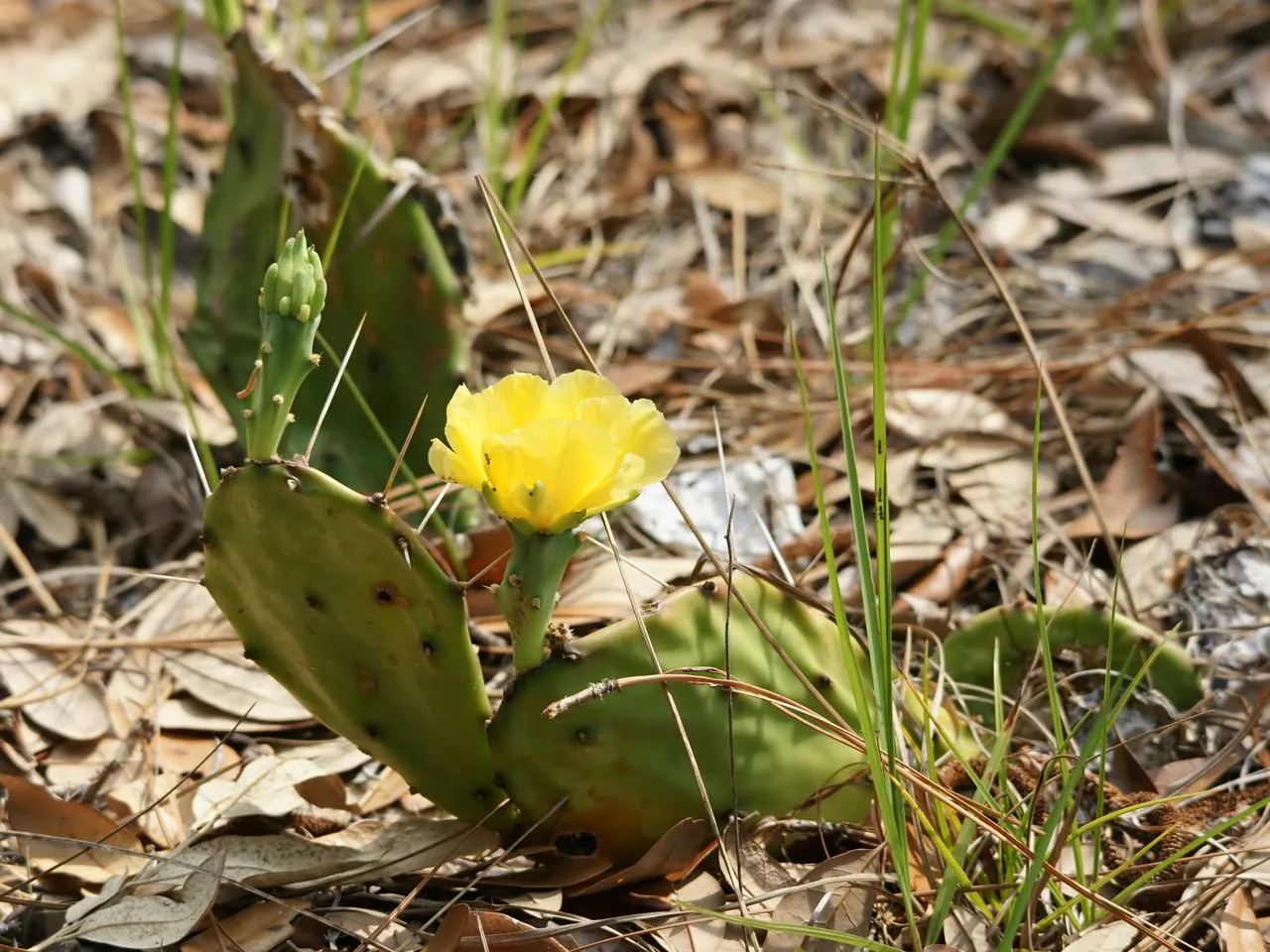
Plants form low spreading mats 10 to 30 cm tall, building outward by ground-level pad budding and rarely lifting more than a hand's height off the substrate. A mature clump can spread 1 m or more across a favourable rock ledge. The pads (cladodes) are 5 to 12 cm long, obovate to nearly round, fresh mid-green with a faint waxy sheen, and noticeably thicker through the centre than the wedge-shaped pads of O. basilaris. The green colour is the first separator from the desert opuntias most growers know: there is no purple bloom, no grey-blue cast, only a clean grass-to-olive green that deepens slightly under stress.
Areoles are spaced 1 to 2 cm apart and carry both true spines and persistent glochid clusters. Spine count is variable across the range and is one of the points that has been used to split out segregate species in the past: most plants carry 1 to 3 spines per areole, 1 to 3 cm long, white to pale yellow at first and ageing grey-brown. Some Florida and Texas populations are nearly spineless on younger pads but develop spines on older tissue. The glochids are short, 1 to 3 mm, reddish-brown to straw, packed in a low tuft below the spines. They detach with the same retrograde-barbed grip as those of every Opuntia and demand the same handling care.
Flowers open from late May into early July depending on latitude, 5 to 8 cm across, in a clear lemon to butter yellow. Many populations carry an orange-red blush at the petal base, occasionally extending to a fully orange-centred flower in some Florida and southern Appalachian stock. Petals are silky, with a dense ring of yellow stamens that respond to touch by closing inward. Fruits ripen through summer to a fleshy dull purple-red, 2 to 4 cm long, edible if de-glochided but not in the league of O. ficus-indica fruit for size or sweetness.
The diagnostic winter behaviour is unique among the Opuntia species in common cultivation. As temperatures drop in autumn, plants withdraw water from the pads into the root crown and the pads shrivel, lose turgor, wrinkle visibly, and lie flat against the substrate. The whole clump can read as dead or freeze-killed to an unfamiliar eye. This drought-deciduous appearance is the species' main cold-survival mechanism: the dehydrated tissue resists ice damage in a way that turgid summer pads cannot. As soils warm in March or April, the pads re-plump within two to three weeks, returning to full green by mid-spring.
Three Opuntia lookalikes are worth separating. Opuntia basilaris, the western beavertail cactus, has matt grey-purple wedge-shaped pads, no true large spines, magenta flowers, and a desert range from the Mojave to Sonora; the colour and the absence of true spines decide it on sight. Opuntia ficus-indica, the Indian fig, is a tree-form plant 3 to 5 m tall with mid-green pads 25 to 40 cm long; scale alone separates it, and it does not undergo the eastern winter pad collapse. Opuntia fragilis, the brittle prickly pear, overlaps with O. humifusa in the upper Midwest and Great Plains but has much smaller almost cylindrical pads 2 to 4 cm long that detach at the lightest touch (the species name means breakable), it is even more cold-hardy at around minus 40 °C, and its mat habit is denser and lower than O. humifusa's.
Cultivation
Light. Full sun is the working assumption everywhere in the species' range. Outdoors, an open south- or southwest-facing position with at least 6 hours of direct sun gives compact pads, reliable spring flowering, and the firm tissue needed for winter dormancy. Plants grown in part shade etiolate, lose flower set, and become more vulnerable to rot when the pads carry too much water into autumn. Indoors, this species rarely thrives long term; even a south-facing window in temperate latitudes does not match the open-sky exposure of its native habitat.
Water. Drought tolerance is high. From April through September, water deeply when the top 4 cm of substrate has dried completely; in a 20 cm terracotta pot in summer that interval is typically 14 to 21 days. Reduce sharply through October and stop entirely from November to March. The species needs cold and dry winter conditions to express full hardiness, and a wet root zone at sub-zero temperatures is the main failure mode in collections outside the natural range.
Substrate. A 70 to 80% mineral mix is the working baseline: 45% pumice or scoria at 5 to 10 mm, 20% coarse grit, 10% lava rock, 20% loam-based compost, 5% perlite. The plant tolerates a slightly higher organic fraction than the desert opuntias once established outdoors, but in containers the mineral-heavy mix prevents root rot during the long winter dry rest.
Temperature. Cold hardiness is the standout trait and the reason this species appears in gardens from Boston to Calgary. Established plants in bone-dry substrate tolerate brief exposure to about minus 30 °C without losing pads, placing the working hardiness at USDA zone 4b in well-drained sites. Reports from open-ground specimens at the Denver Botanic Gardens, the Royal Botanical Gardens at Burlington (Ontario), and several Czech and Polish private collections confirm field survival at minus 25 to minus 30 °C provided the substrate stays dry through the freeze period. Summer heat to 40 °C is no problem.
Pot. Wide and shallow suits the spreading mat habit. A 25 to 35 cm wide unglazed terracotta or concrete bowl, no more than 12 cm deep, gives roots the lateral run they prefer and dries quickly through the cold months. For garden use, a raised bed of pure mineral grit on a south-facing slope is the most reliable installation outside the species' native range.
Propagation
Pad cuttings root with success rates above 95% at 22 to 28 °C. Detach a healthy single pad with long-handled tongs or a folded newspaper grip, callus the cut end in dry shade for 5 to 10 days, then stand the callused end 2 to 4 cm into dry mineral substrate. Withhold water for the first 10 to 14 days, then resume sparing watering once a gentle tug meets resistance. Roots normally anchor in 3 to 5 weeks; the first daughter pad appears within 6 to 10 weeks of rooting under good light. A pad cutting can produce its first flowers within 2 to 3 years, faster than most opuntias because the species is precocious.
Seed germination is slow but reliable. The seed coat is hard; light scarification with fine sandpaper or a 24-hour soak in tepid water improves the germination rate. Surface-sow on fine mineral mix at 25 to 30 °C; most seeds break dormancy within 14 to 30 days. Outdoor sowings in autumn that experience natural winter chill often germinate more uniformly the following spring than spring-sown indoor batches. Seedlings reach the size of a single rooted pad in 3 to 5 years.
Notes
The taxonomic situation deserves one more line. O. humifusa in the modern circumscription is a wide-ranging, morphologically variable species, and several segregates once treated separately (O. austrina, O. cumulicola, O. rafinesquei, O. fuscoatra) are now folded into it. Trade names, regional floras, and older horticultural literature still use the synonyms freely, so a plant labelled O. compressa at a nursery is almost certainly the same biological entity as one labelled O. humifusa.
Glochid handling matters even though the spines look manageable. Use thick leather gloves or a folded newspaper grip whenever moving, repotting, or weeding around plants. Tape removal works for skin contact; do not rub the affected area, since rubbing snaps glochid shafts below the skin and turns transient irritation into a retained-foreign-body problem. The fruit is technically edible but commonly hosts a dense glochid load; singe or brush before peeling.
The beginner-friendly framing this plant gets in cold-climate gardening guides is mostly accurate, but the winter-dry requirement is the part most often missed. See the Beginner's Guide to Succulents for the underlying principles of light, mineral substrate, and winter rest that apply across the family before adding O. humifusa to a young collection.
See also
- The Complete Cactus Guide, family-wide reference covering substrate, watering, winter rest, and the major genera in cultivation.
- Opuntia ficus-indica, the Indian fig or prickly pear; tree form with green pads and edible-scale fruit, the commercial nopal and tuna species.
- Opuntia basilaris, the beavertail cactus; low-growing Mojave and Colorado desert species with purple-grey wedge-shaped pads and bright magenta flowers.
- Beginner's Guide to Succulents, the master pillar covering general light, water, and substrate principles for cacti and other succulents.
Frequently Asked Questions
Is Opuntia compressa cold-hardy?
The post treats it among hardy prickly pears; winter dryness is still essential for root survival.
Are Opuntia pads leaves?
No. Opuntia pads are flattened stem segments.
Why are glochids important?
Tiny glochids detach into skin easily and can be more irritating than larger spines.
What winter condition matters most?
Dry roots matter most. Cold combined with wet substrate is far more damaging.