| Question | Short Answer |
|---|---|
| What are Opuntia pads? | The flattened pads are stem segments, not leaves. |
| What are glochids? | Glochids are tiny detachable barbed bristles in Opuntia areoles and can irritate skin easily. |
| How is Opuntia basilaris propagated? | Stem pad cuttings should callus before being placed in dry mineral substrate. |
| Does beavertail prickly pear need strong light? | Yes. |
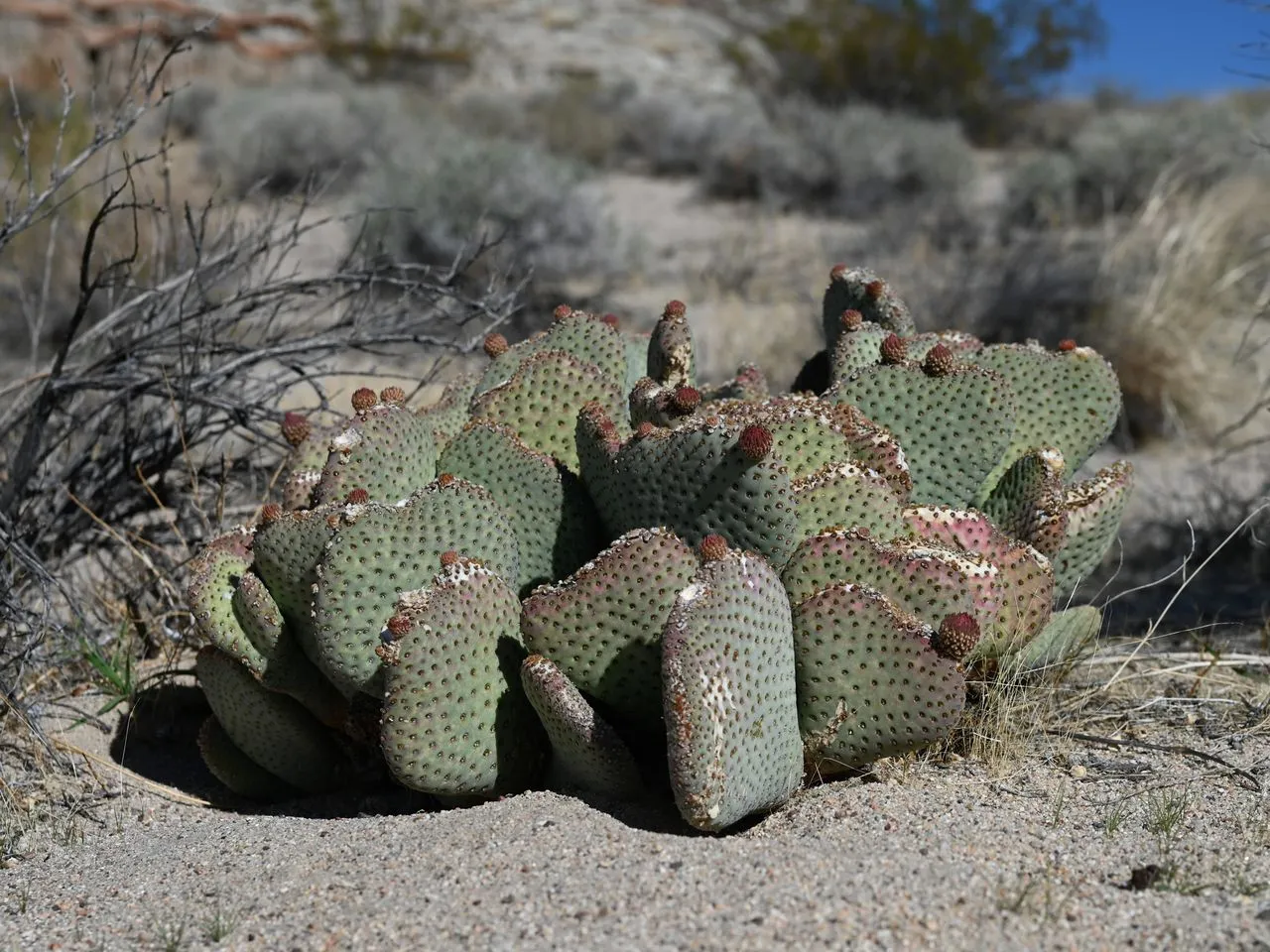
Opuntia basilaris Engelm. & J.M.Bigelow, the beavertail cactus, was described by George Engelmann and John Milton Bigelow in 1856 from collections made during the Pacific Railroad surveys of the southwestern United States. Its range covers the Mojave, Sonoran, and southern Great Basin deserts of California, Nevada, Arizona, and Utah, extending into northwestern Mexico in Sonora and Baja California, at elevations of roughly 50 to 2,500 m. The defining feature in the field is the combination of broad, wedge-shaped grey-purple pads that read more like flat paddles of slate than green cactus tissue, and the complete absence of true large spines on the areoles.
In habitat, O. basilaris grows on rocky desert pavement, alluvial fans, gravelly slopes, and the lower edges of pinyon-juniper woodland. The substrate is sharply drained mineral grit, often with a thin biological soil crust, and rainfall is winter-dominant in the Mojave portion of the range and bimodal further east. Annual precipitation runs 100 to 300 mm. Plants form low spreading mats 30 to 60 cm tall and considerably wider, building outward by ground-level pad budding rather than climbing into a shrubby canopy. The species is one of the most cold-tolerant in the genus and is not currently of conservation concern; populations are widespread and protected on large tracts of US federal land including Joshua Tree, Death Valley, and Anza-Borrego.
Part of the Complete Cactus Guide.
Identification
The pads are the giveaway. Each cladode is 10 to 25 cm long, 6 to 15 cm wide, distinctly wedge-shaped (broader at the tip than the base), and a matt grey-purple to blue-green colour that intensifies toward purple under stress: cold, drought, or intense UV. Surface texture is finely felted with short hairs visible only under a hand lens, which gives the pads their soft visual quality from a distance. The glaucous bloom is real but rubs off readily, and lifelong handling marks are common on cultivated specimens.
Areoles are spaced 1.5 to 3 cm apart. This is the diagnostic point that separates O. basilaris from almost every other Opuntia in cultivation: the areoles carry no true spines. What they do carry is a tight cluster of glochids, 2 to 5 mm long, brown to reddish-brown, packed into a low domed tuft at the centre of each areole. A casual viewer reads the plant as harmless. It is not. The glochids detach with the same retrograde-barbed enthusiasm as those of O. microdasys, and the absence of obvious large spines puts hands closer to the pad surface than they would otherwise come.
Flowers open between April and June depending on elevation, 5 to 8 cm across, in a saturated magenta-pink that is unmistakable in the field. Petals are silky, with a darker base and a ring of bright yellow stamens. Fruits ripen tan to grey-brown, dry rather than juicy, 2 to 3 cm long, and full of large angular seeds. Unlike the fleshy fruits of O. ficus-indica, these are not a meaningful food source for either humans or most wildlife.
Three Opuntia lookalikes are worth separating by Latin name. Opuntia ficus-indica is a tree-form plant 3 to 5 m tall with mid-green pads 25 to 40 cm long and either no spines or one to four short whitish ones; colour and scale alone are decisive. Opuntia microdasys, the bunny ears cactus, is a small Mexican shrub with bright green pads 6 to 15 cm long and persistent dense yellow or white glochid tufts; it never reaches a spreading mat habit and does not develop the purple cast. Opuntia compressa (now usually treated as O. humifusa), the eastern prickly pear, has a similarly low spreading habit but bright green pads, occasional true spines, and an entirely separate eastern North American range from southern Canada down through the Appalachians to Florida; it is not a desert plant.
Cultivation
Light. Full direct sun is the working assumption for any specimen older than a young rooted pad. Outdoors in dry-summer climates, O. basilaris takes anything the sky offers; pad colour shifts toward deeper purple under intense exposure and back toward green under shade. A south-facing position with at least 6 hours of direct sun is the minimum for compact growth, firm pads, and reliable spring flowering. Indoors, this species rarely thrives long term; light levels at most windows fall well below desert ambient, and pads etiolate into longer, paler, less colourful tissue.
Water. Drought tolerance is unusual even by Opuntia standards. Pads are drought-deciduous in the field: under prolonged dry conditions they shrink visibly, lose turgor, and lie flat against the ground, plumping back up within a week of significant rain. In cultivation, water deeply when the top 4 cm of substrate has dried completely and pads have lost their tight summer plumpness. For a 20 cm terracotta pot in summer, that interval is typically 18 to 28 days. From mid-October through February, withhold water entirely if temperatures stay below 10 °C. Combining wet substrate with cold roots is by far the most common cause of loss in containerised plants.
Substrate. Use a 70 to 80% mineral mix; this species rots in compost-heavy media faster than most opuntias. A working recipe: 45% pumice or scoria at 5 to 10 mm, 20% coarse grit, 10% lava rock, 20% loam-based compost, 5% perlite. The intent is to push water through the pot and out within seconds, and to dry the root zone within two to three days at summer temperatures.
Temperature. Cold tolerance is the standout trait. Established plants in bone-dry substrate tolerate brief dips to about −15 °C without losing pads, and reports from open-ground specimens in Colorado, Utah, and inland eastern Europe place the working hardiness at USDA zone 6b in well-drained sites. The same plant in wet substrate at −2 °C is at serious risk: the failure mode is not freezing damage to the pads but root rot following freeze-thaw cycles in saturated media. Summer heat to 45 °C is tolerated provided the plant is well rooted and the substrate dries rapidly between waterings.
Pot. Wide and shallow suits the spreading mat habit better than tall and deep. A 25 to 35 cm wide unglazed terracotta or concrete bowl, no more than 12 to 15 cm deep, gives roots the lateral run they prefer and keeps the centre of the pot from holding water past the point where roots can use it.
Propagation
Pad cuttings root with success rates above 95% at 22 to 28 °C, and the technique is the same as for any Opuntia, with one extra precaution: glochid contact. Detach a healthy pad with long-handled tongs or a folded newspaper grip, callus the cut end in dry shade for 5 to 10 days until it is pale and lightly sealed, then stand the callused end 2 to 4 cm into dry mineral substrate (80% pumice is reliable at the rooting stage). Withhold water for 10 to 14 days, then resume sparing watering once a gentle tug meets resistance. Roots normally anchor in 3 to 5 weeks; the first daughter pad appears within 6 to 10 weeks of rooting under good light. A cutting can produce its first flowers within 2 to 3 years.
Seed germination is straightforward but slow. The seed coat is hard; light scarification with fine sandpaper or a 24-hour soak in tepid water improves the germination rate. Surface-sow on fine mineral mix at 25 to 30 °C; most seeds break dormancy within 14 to 30 days, with a long tail of late germinators over the following months. Seedlings reach the size of a single rooted pad in 3 to 5 years, which is why vegetative propagation dominates in cultivation.
Notes
The colour shift to deep purple is not a defect or a stress alarm to be corrected. It reflects accumulation of betalain pigments and is the normal expression of the species under cool nights, intense sun, or moderate drought. A plant kept warm, shaded, and well-watered loses the purple cast and reads as grey-green; this is also normal but is not what most growers are after visually.
Glochid management is the single most important handling note. The absence of large spines makes the plant look approachable, and the small reddish-brown tufts at each areole are easy to overlook on the matt purple surface. Use thick leather gloves or a folded newspaper grip whenever moving, repotting, or pruning. Tape removal works for skin contact, exactly as for O. microdasys; do not rub the affected area, since rubbing snaps glochid shafts below the skin and turns a transient irritation into a retained-foreign-body problem.
In trade, O. basilaris circulates under several variety names, most commonly var. basilaris (the typical wedge-pad form), var. brachyclada (a dwarf high-elevation form from the Transverse Ranges of southern California with very short, almost circular pads), and var. longiareolata from the eastern Grand Canyon. The differences are real but subtle; gift-shop and online stock is rarely identified to variety with any confidence, and most plants offered as "beavertail cactus" are the typical form or a hybrid of unclear parentage. For consistent garden use in cold climates, source from a specialist nursery that can confirm provenance and frost history.
The beginner-friendly framing this plant gets in casual succulent guides ignores both the glochid hazard and the strong winter-dry requirement. See the Beginner's Guide to Succulents for the underlying principles of light, mineral substrate, and winter rest that apply across the family before adding O. basilaris to a young collection.
See also
- The Complete Cactus Guide, family-wide reference covering substrate, watering, winter rest, and the major genera in cultivation.
- Opuntia ficus-indica, the large edible prickly pear; tree form with green pads and edible-scale fruit, the commercial nopal and tuna species.
- Opuntia microdasys, the bunny ears cactus; small Mexican shrub with bright green pads and persistent dense yellow or white glochid tufts.
- Beginner's Guide to Succulents, the master pillar covering general light, water, and substrate principles for cacti and other succulents.
Frequently Asked Questions
What are Opuntia pads?
The flattened pads are stem segments, not leaves.
What are glochids?
Glochids are tiny detachable barbed bristles in Opuntia areoles and can irritate skin easily.
How is Opuntia basilaris propagated?
Stem pad cuttings should callus before being placed in dry mineral substrate.
Does beavertail prickly pear need strong light?
Yes. It is a high-light prickly pear that needs direct sun and sharp drainage.