| Question | Short Answer |
|---|---|
| What type of cactus is Echinocactus platyacanthus? | It is a large Mexican barrel cactus, grown for a massive ribbed body rather than fast flowering. |
| Does Echinocactus platyacanthus grow quickly? | No. |
| What substrate suits Echinocactus platyacanthus? | A mineral-heavy cactus mix with sharp drainage suits the exposed barrel-cactus habit. |
| How should it be watered? | Water deeply in active growth, then wait until the pot dries through before watering again. |
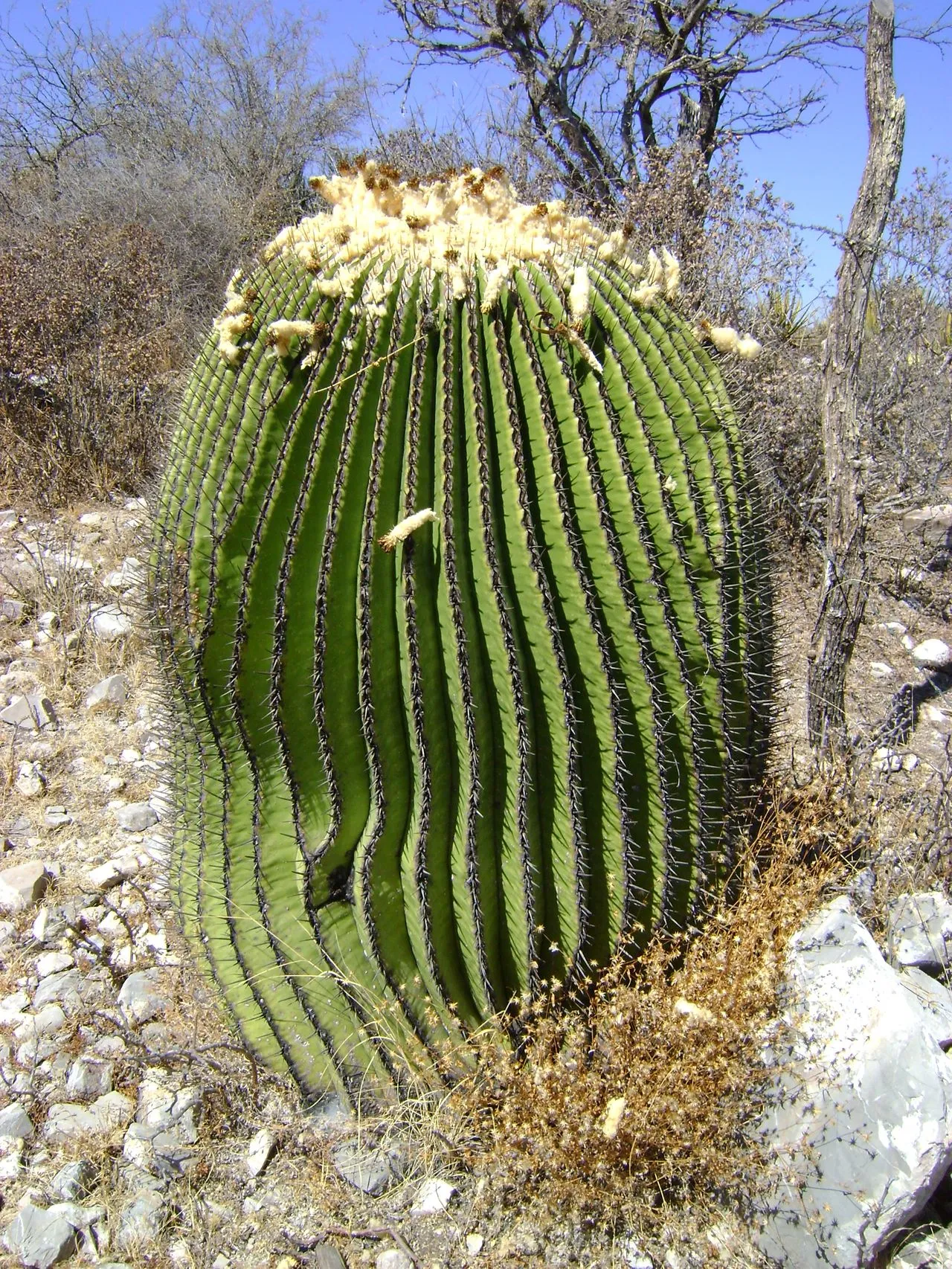
Echinocactus platyacanthus Link & Otto was described in 1827 from material collected in central Mexico, and it remains the largest barrel cactus in the family Cactaceae. The species is native to the central Mexican states of Hidalgo, Oaxaca, Puebla, and San Luis Potosí, where it grows on volcanic ash, basalt, and limestone slopes between roughly 1,000 and 2,500 m elevation. A mature plant begins as a slow globe and elongates over decades into a heavy column 1 to 2.5 m tall, 50 to 100 cm across, with 21 to 30 prominent ribs and stiff, flat, curving spines that give the species its name; the epithet platyacanthus means "flat-spined". Specimens of 3 m or more are known from the most sheltered habitat sites.
In habitat E. platyacanthus is part of a sparse xerophytic shrubland with Yucca, Agave, Opuntia, and various smaller cacti. Soils are thin and mineral-rich, often weathered directly from volcanic tuff or limestone, so summer rains drain within minutes of falling. Winters are cool and dry, with frosts at higher elevation sites. The species sits on CITES Appendix II as part of family-level cactus controls, and it is also subject to Mexican domestic protection because the cooked, candied flesh of the stem (sold historically as "acitrón") was harvested from wild plants for centuries and the local pressure on slow-growing populations is real. Most legitimate trade today involves seed-grown nursery plants; wild collection is illegal in Mexico without permits.
Part of the Complete Cactus Guide.
Identification
E. platyacanthus spends its first decades as a flattened globe that gradually thickens before it begins to elongate. A 30 cm wide plant in cultivation is already old; a 60 to 80 cm specimen represents a lifetime of patient work. Average growth is only about 2 to 5 cm per year, putting the species on a similar timescale to the saguaro Carnegiea gigantea, and field estimates put the lifespan of old wild specimens at 200 to 300 years. As the stem elongates the older basal tissue corks over and turns grey, while the green crown carries the active areoles.
The ribs are massive and regular, typically 21 to 30 in number on adult plants, running vertically with sharp dorsal edges. Each areole sits on the rib crest and carries 7 to 9 stout spines, of which 4 are central and the remainder radial. The diagnostic feature is the spine geometry: stiff, broad, flat in cross section, 5 to 10 cm long, and curving along their length rather than perfectly straight. New spines emerge yellow to amber and darken to grey or brown with age. A dense felt of pale wool covers the apex, and old plants develop a thick woolly cap from which flowers and fruit emerge.
Flowering takes patience. Plants begin flowering only after the stem exceeds about 30 to 40 cm across, which usually means more than 20 years of growth. The flowers open from the apex in summer, are bright yellow, 4 to 6 cm across, and surrounded by the woolly crown. Fruits ripen embedded in the wool and are less conspicuous than the blooms, but they hold viable seed for years if collected and stored dry.
Lookalikes. Echinocactus grusonii, the golden barrel, is the most frequent confusion in trade: it matures at 60 to 90 cm, stays globe-shaped or slightly broader than tall, and carries dense, slender, golden spines that are round in section rather than flat, with around 10 to 14 spines per areole. By contrast E. platyacanthus becomes taller than wide and carries fewer, broader, flatter spines. Ferocactus wislizeni is a smaller barrel with a hooked lower central spine that E. platyacanthus never produces, and a much narrower stem at any given age. Ferocactus cylindraceus shares the columnar adult silhouette but lacks the flat broad spines and instead carries dense, slender, ribbon-curved centrals that partly veil the stem. If you see fewer than ten stiff flat-sectioned spines per areole on a plant taller than wide, you are almost certainly looking at E. platyacanthus.
Cultivation
Light. Give E. platyacanthus the strongest light you can provide. In Mediterranean and warm temperate climates, full outdoor sun is appropriate after a 10 to 14 day acclimation. Indoors, a south-facing window within 30 cm of the glass is the practical minimum; weaker light produces narrow, pale new growth at the crown that will not later thicken to match the older stem. A plant moved straight from a shop bench to summer noon sun can scald on the exposed flank within a single afternoon, so step it out under shade cloth first.
Water. From spring through early autumn, soak the substrate thoroughly, then wait until the mix has dried through most of the pot before the next watering. In a 25 cm terracotta pot with a 15 to 20 cm plant, that interval is usually 14 to 21 days in warm dry weather and longer in cool spells. A moisture probe should read below 15% in the upper 3 cm and close to dry at depth before you water again. The ribbed stem stores its own reserve, and slight rib contraction between waterings is normal. From late autumn through early spring, hold water entirely once temperatures are below about 10°C and the plant has settled into a dry rest.
Substrate. Use a strongly mineral mix, around 75 to 80% mineral material to 20 to 25% low-peat or peat-free organic matter. A workable recipe is 35% pumice, 25% coarse grit at 3 to 6 mm, 15% lava or crushed granite, and 25% loam-based compost. The species roots in habitat into shallow gravelly soils that drain within minutes of summer rain, and a peat-heavy nursery compost held in a deep pot is the opposite of that environment.
Temperature. Active growth runs from about 18 to 32°C, and well-established plants tolerate higher heat outdoors if the root system is healthy and the pot is not pressed against a south-facing wall. Mature dry-rooted specimens cope with brief light frost, with field reports of survival to around -4°C at the upper end of the elevation range. That tolerance only applies if the substrate is dry, the plant is mature, and the cold spell is short. Wet roots at 2°C are far more dangerous than a dry light frost.
Pot. E. platyacanthus becomes heavy, and its centre of gravity rises as the stem elongates, so stability matters as much as drainage. A wide, shallow terracotta pot is usually safer than a tall narrow plastic one for plants over 25 cm across. Repot only when the root mass has filled the container or the plant has become unstable, typically every 4 to 6 years for established specimens. Move it with foam blocks, a folded carpet sling, or a cinched strap, never by gripping the spines.
Propagation
Seed is the only practical propagation method for this species. Fresh seed germinates well on a sterile fine mineral surface at 24 to 28°C, with bright filtered light and a covered tray to hold humidity. Expect emergence in 14 to 28 days from viable seed, with a realistic germination rate of 50 to 70% from cultivated stock. Seedlings are very slow: a year-old plant may be 4 to 7 mm across, and saleable size around 4 to 6 cm represents four to six growing seasons of careful work. Algae, fungus gnats, and damping-off kill more E. platyacanthus seedlings than any other factor, so ventilation matters as much as warmth from the second month onward.
Vegetative propagation is not a routine option. The species is normally solitary and produces basal pups only after damage, and seed-grown plants are stronger and more natural in form. Grafting onto a faster rootstock can shorten the time to a saleable plant, but own-root specimens hold their shape better in the long run.
Notes
Conservation and acitrón. E. platyacanthus has been used in central Mexico for centuries, principally as the source of acitrón, a candied confection made by cooking strips of stem flesh in sugar. Demand for acitrón through the 20th century combined with very slow regrowth pressed wild populations hard, and the species is listed as Near Threatened on the IUCN Red List. Modern Mexican law restricts wild harvest, and most acitrón sold today is either made from cultivated Cucurbita substitutes or from regulated salvage of plants displaced by construction. As a buyer, choose seed-raised nursery plants and avoid any large specimen with vague provenance.
Slow growth, long horizon. A grower who plants a 10 cm seedling now will not see the first flowers for at least twenty years, and probably not until the plant is approaching a head wider than a dinner plate. That is part of the appeal: E. platyacanthus outlives most of the gardens it sits in, and a well-grown specimen is a piece of the Mexican high desert maintained on a patio or in a glasshouse. Plan repotting cycles, sun exposure, and pot weight with that timescale in mind.
Pests and handling. Scale insects and root mealybug both attack barrel cacti in cultivation, often hidden among the radial spines or under the soil line. Inspect new arrivals with a hand lens before placing them near established plants, and check the inner pot wall and root crown when repotting. The flat curving spines are the largest practical hazard at home; they catch clothing and forearms with ease and can break off in skin. Mature plants belong away from foot traffic, children, and pets.
See also
- The Complete Cactus Guide, the broader cultivation guide covering areoles, ribs, mineral substrate, light, and winter rest.
- Echinocactus grusonii, the smaller globular golden barrel useful for comparing rib structure, spine density, and adult proportions.
- Ferocactus wislizeni, the fishhook barrel with hooked central spines and a more cylindrical adult outline.
- A Beginner's Guide to Succulents, broader context for matching succulent plants to light, soil, and seasonal water.
Frequently Asked Questions
What type of cactus is Echinocactus platyacanthus?
It is a large Mexican barrel cactus, grown for a massive ribbed body rather than fast flowering.
Does Echinocactus platyacanthus grow quickly?
No. Barrel cactus growth is slow in pots and should be treated as normal.
What substrate suits Echinocactus platyacanthus?
A mineral-heavy cactus mix with sharp drainage suits the exposed barrel-cactus habit.
How should it be watered?
Water deeply in active growth, then wait until the pot dries through before watering again.