| Question | Short Answer |
|---|---|
| Is Epiphyllum oxypetalum a desert cactus? | No. |
| When do the flowers open? | The species is grown for large flowers that open at night. |
| What light suits Epiphyllum oxypetalum? | Bright filtered light or gentle morning sun is appropriate. |
| What soil should orchid cactus use? | Use a chunky epiphyte mix with bark and pumice so the roots receive air while retaining mild moisture. |
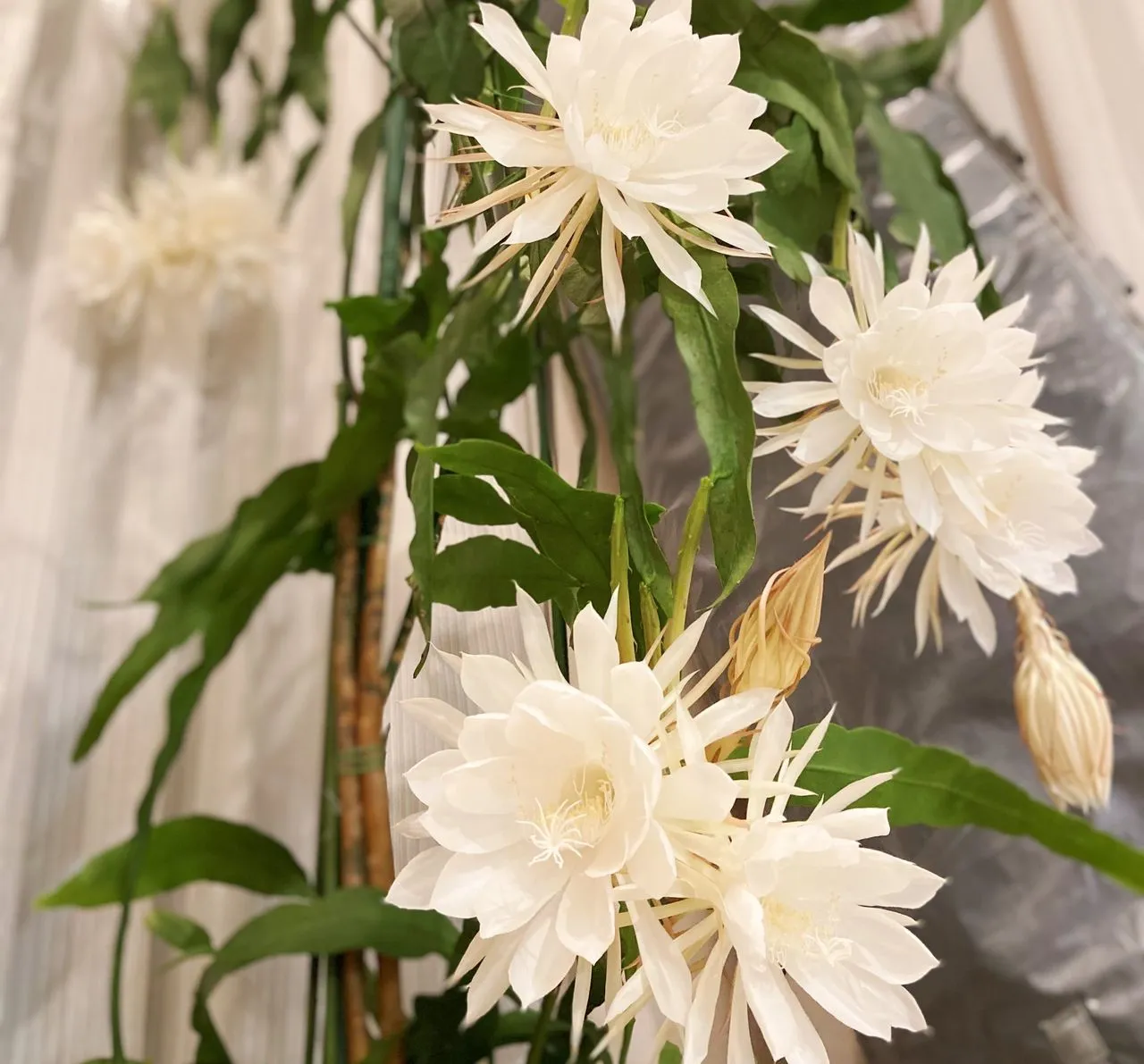
Epiphyllum oxypetalum, described by Adrian Hardy Haworth in 1812, is a climbing epiphytic cactus native to southern Mexico, Central America, and northern South America, with records from Belize, Guatemala, Costa Rica, Venezuela, Colombia, Suriname, and Brazil at elevations of 100 m to 1,000 m. It grows on rainforest trees rather than in soil, carries flat leaf-like stems instead of ribbed columnar ones, and produces large white nocturnal flowers that open for a single evening before withering by morning. That dramatic one-night bloom is the source of its common name, queen of the night.
Part of the Complete Cactus Guide.
In the wild, E. oxypetalum lives as a true epiphyte, anchored to bark by aerial roots and supported by neighbouring branches as the long flexible stems scramble through the canopy. Its range covers the lowland and middle-elevation tropical and subtropical forests of Central and northern South America, with a typical altitude of 100 m to 1,000 m. The substrate around its roots in habitat is not soil but a thin layer of moss, leaf litter, and decaying bark; rainfall is high but drainage is rapid, so roots are wetted briefly and then exposed to airflow. The IUCN classifies the species as Least Concern, and it has been grown ornamentally across the tropics and subtropics for centuries, with naturalised populations in parts of Asia. There is no edible fruit of commercial importance, so this plant should not be confused with the dragon fruit cactus.
Identification
The flat, broad, leaf-shaped stems are the easiest field mark. Each segment is 30 cm to 100 cm long and 5 cm to 10 cm wide, dark green, with a notched, undulating margin that gives the impression of large drooping leaves. New growth typically emerges from the central rib of an older blade, producing a scrambling, branched habit that can reach 1.5 m to 3 m in total length. There are no functional spines on mature flat stems; only small areoles sit recessed in the notches.
The flowers are the second diagnostic feature. Each is 25 cm to 30 cm wide and 10 cm to 15 cm long, with narrow outer tepals that recurve as the flower opens and broad inner tepals framing a cluster of stamens around a long pale style. Buds emerge from areoles along the stem margins, swell over four to six weeks as elongated pendant tubes, then open at sunset on a single evening, usually between June and August in the Northern Hemisphere. The fragrance is heavy and sweet, and it carries across a room. By the next morning the bloom has collapsed. In habitat, hawk moths in the family Sphingidae are the main pollinators; the long floral tube, white colour, and night-opening rhythm match that pollination syndrome closely.
Several plants get confused with E. oxypetalum in trade.
- Selenicereus undatus, the climbing dragon fruit cactus (formerly placed in Hylocereus), has three-winged or three-ribbed triangular stems, not flat blades. It produces large white nocturnal flowers of similar size, but its pink-skinned edible pitahaya fruit settles the identification.
- Schlumbergera truncata, the Thanksgiving or crab cactus, has small segmented pendant stem joints with toothed edges, much smaller flowers in pink, red, or white, and an autumn flowering peak triggered by short days. Whole-plant size is a fraction of E. oxypetalum.
- Hylocereus as a separate genus has now been folded into Selenicereus by recent taxonomy. The triangular three-winged stem cross-section it shares with S. undatus is the quickest way to rule out Epiphyllum.
If a plant sold as "queen of the night" has triangular ribbed stems, it is almost certainly a Selenicereus, not an Epiphyllum.
Cultivation
This is a forest-edge epiphyte, not a desert cactus, and the care reflects that difference at every step.
Light. Bright indirect light produces the strongest growth and the most reliable flowering. An east-facing window, or a south or west window with a sheer curtain, suits the plant well in temperate homes. Direct midday sun behind glass scorches the flat stems and can leave permanent pale yellow patches within hours. Outdoors in summer, dappled light under a tree, or 40 to 60% shade cloth, replicates the canopy edge it prefers.
Water. From late spring through early autumn, water deeply when the upper 2 cm to 3 cm of substrate has dried, typically every 7 to 10 days in a 15 cm pot in a warm room. Stems should feel firm; mild softening of the segments signals thirst, while persistent sponginess at the base signals rot.
Substrate. Use an airy epiphyte mix rather than mineral cactus grit. A reliable recipe is 50% fine to medium orchid bark, 25% pumice or perlite, 15% peat-free compost or coco coir, and 10% coarse charcoal. The mix should drain within seconds of watering and never go waterlogged. A pot 1 cm to 2 cm wider than the root mass works well; oversized pots stay damp at the centre and invite rot.
Temperature. The plant grows best between 18 °C and 28 °C during active growth. The frost limit is around 5 °C; brief exposure below this causes irreversible damage to the flat stems. A practical minimum for routine winter nights is 10 °C to 12 °C.
Winter rest and flowering trigger. Reliable flowering depends on a six-week winter rest at 12 °C to 15 °C with sharply reduced water, only enough to prevent stem shrivel. Without this cool-dry break, mature plants often produce vigorous foliage and few or no buds. After the rest, return the plant to normal warmth and routine watering; flower buds typically initiate as days lengthen and temperatures rise. Move buds as little as possible while they swell, since sudden changes in light angle can cause bud drop.
Pot and support. Mature plants become heavy and pendulous, and they flower most freely when allowed to hang. A wide-rimmed terracotta pan or a hanging basket with a sphagnum lining suits them. Plastic pots dry slowly and increase rot risk in cooler rooms, so reserve plastic for hot climates where rapid drying is the limiting factor.
Propagation
Stem cuttings are the standard method and they root readily. Take a healthy flat stem segment 15 cm to 25 cm long with a sterile blade, cutting at a natural notch where possible. Allow the cut surface to callus in shade for 7 to 14 days; thicker cuts in humid weather need the longer end of that range. Insert the calloused base 2 cm to 4 cm deep into a barely damp epiphyte mix, support with a stake if the cutting is top-heavy, and keep it in bright indirect light at 20 °C to 25 °C. Roots usually form in 3 to 6 weeks, after which light watering can begin. First flowers typically appear within 2 to 4 years on cutting-grown plants, faster than from seed.
Seed propagation is slower and rarely used in the home, since named clones come true only from cuttings. Hand-pollinated seed germinates readily on a sterile bark and pumice surface at 22 °C to 26 °C in 10 to 21 days, but seedlings need 4 to 6 years before first bloom and they segregate genetically, producing flower variation rather than identical copies of the parent.
Notes
In trade, plants sold as "queen of the night" can be E. oxypetalum, a Selenicereus species, or one of the many large-flowered Epiphyllum hybrids developed for cut-flower style display. Stem shape settles the question quickly: a flat broad blade points to Epiphyllum, while a three-winged triangular stem points to Selenicereus. The species is not on common toxicity lists for cats or dogs, but ingestion of any cactus tissue can cause mild gastrointestinal upset, so keep nibbling pets away.
Hawk moth pollination in habitat means the night fragrance and the pure white colour are not decorative accidents; both are signals targeted at long-tongued nocturnal pollinators. Indoors, the flowers still run the same opening sequence in the absence of moths, then close and abort the following morning. Many growers organise small viewing evenings for friends when buds are within a day or two of opening, which is a fair use of the plant's biology.
See also
- The Complete Cactus Guide for the wider cactus family context, including other jungle epiphytes.
- A Beginner's Guide to Succulents for foundational watering, light, and substrate principles.
- Schlumbergera truncata — another epiphytic cactus with similar filtered-light and airy-substrate needs
- Selenicereus undatus — large night-flowering climbing cactus for comparison of epiphytic care requirements
Frequently Asked Questions
Is Epiphyllum oxypetalum a desert cactus?
No. It is an epiphytic orchid cactus with flattened stems and forest-edge requirements.
When do the flowers open?
The species is grown for large flowers that open at night.
What light suits Epiphyllum oxypetalum?
Bright filtered light or gentle morning sun is appropriate. Direct midday sun behind glass can scorch flattened stems.
What soil should orchid cactus use?
Use a chunky epiphyte mix with bark and pumice so the roots receive air while retaining mild moisture.