| Question | Short Answer |
|---|---|
| What fruit does Selenicereus undatus produce? | It produces the dragon fruit sold in shops. |
| How does Selenicereus undatus grow? | Its triangular or winged stems climb or scramble and root along supports. |
| How warm should dragon fruit cactus be kept? | The pillar notes temperatures should stay above about 12°C for active, safe culture. |
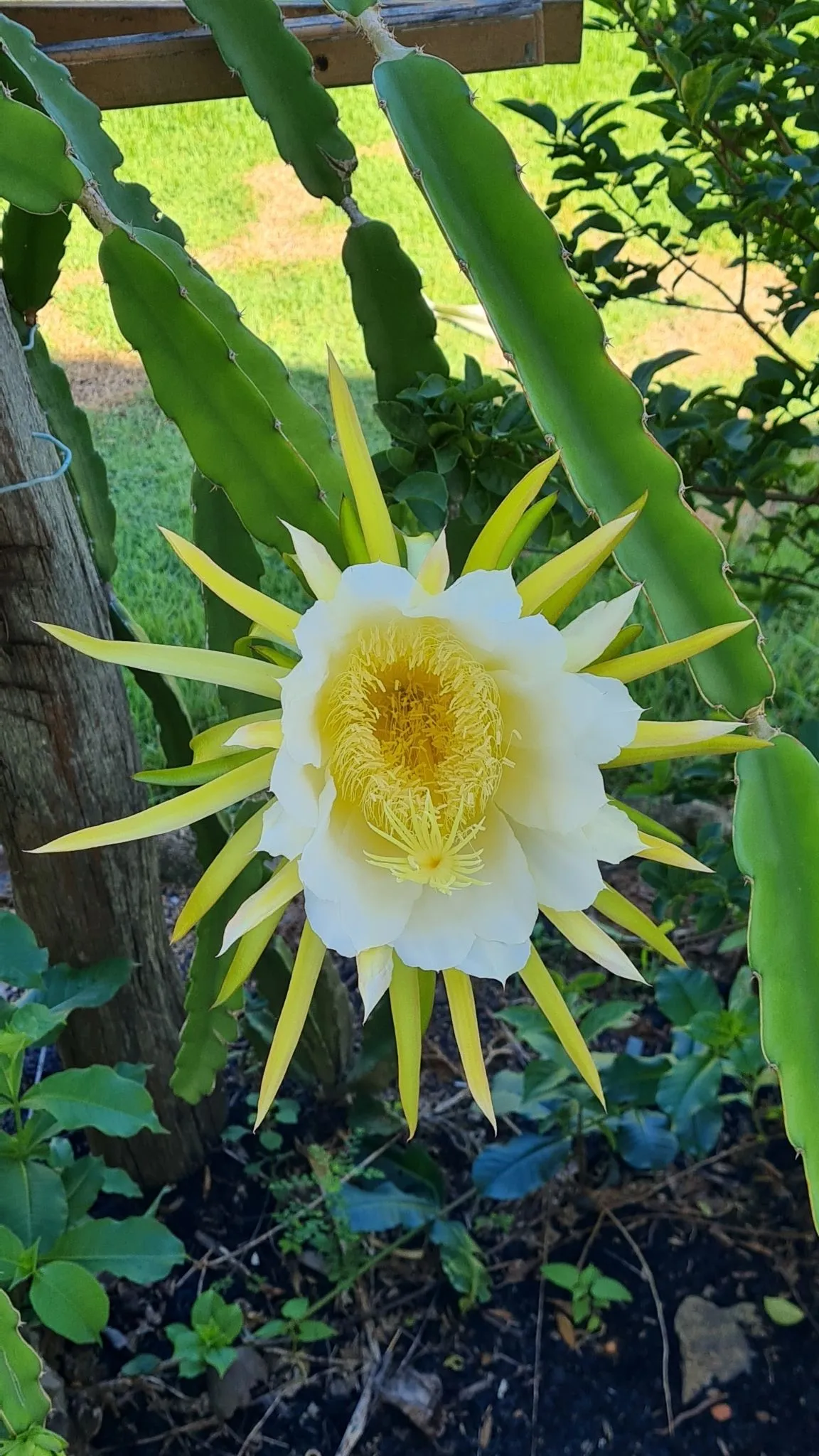
| When do the flowers open? | The large flowers open at night and may last only one evening. |
Selenicereus undatus began life in print as Cereus undatus Haworth, 1830, was transferred into the new genus Hylocereus by Britton and Rose in their 1918 monograph The Cactaceae, and finally moved into Selenicereus by Korotkova and colleagues in 2017 after molecular work showed that Hylocereus sat firmly inside the older genus Selenicereus. Its native range covers lowland Mexico (especially the Yucatán Peninsula), Belize, Guatemala, Honduras, Nicaragua, Costa Rica, Panama, and the northern Caribbean basin into northern South America, from sea level to around 1,500 m. The defining features are the three-winged green climbing stems 5 to 12 cm wide, the long aerial roots that grip whatever the plant is climbing, and the massive white nocturnal flowers 25 to 30 cm across that ripen into the red-skinned, white-fleshed fruit sold in supermarkets as dragon fruit or pitahaya.
In habitat S. undatus is a hemiepiphytic vine cactus, scrambling up tree trunks, cliff faces, and limestone outcrops in tropical deciduous and semi-evergreen forest, often in the seasonally dry karstic landscapes of the Yucatán and adjacent Central America. The stems are not self-supporting; an aerial root emerges from each areole on the shaded side of the plant, anchors into bark or a rock crevice, and lifts the growing tip into better light. Annual rainfall in the native range runs 1,000 to 2,500 mm with a pronounced dry season. The IUCN Red List places the species in the Least Concern category, supported by extensive feral populations and large-scale cultivation. Vietnam now leads global production by a wide margin, with Israel, Thailand, southern China, Taiwan, Florida, and Hawaii also growing it commercially under the Vietnamese name "thanh long" or as pitahaya.
Part of the Complete Cactus Guide.
Identification
Stems are sharply three-winged in cross-section, with three flat to slightly concave faces meeting at thin keeled edges that are gently scalloped or "undate", which is the source of the species epithet. Width across the wings is typically 5 to 12 cm, and segments can run 1 to 3 m before branching. Colour is mid-green, often with a faint waxy bloom, paler on new growth and bronzing slightly under strong sun. Each areole sits in the notch of a scallop along a wing edge and produces 1 to 3 short brownish or grey spines, 2 to 5 mm long; on greenhouse plants the spines often barely emerge from the wool. Aerial roots are abundant on horizontally trained or shaded stems.
Flowers are the most distinctive feature. They are 25 to 30 cm long and 25 to 30 cm wide when fully open, with linear greenish to yellow-green outer tepals and broad pure-white inner tepals around a dense brush of cream stamens and a multi-armed pale stigma. Anthesis begins at dusk, peaks around midnight, and the flower has usually closed by mid-morning the following day. Fragrance is sweet and strong, occupying a small greenhouse for the duration of the bloom. Pollination in habitat is mainly by bats and large nocturnal moths.
Fruit ripens 30 to 50 days after pollination into an oblong red-pink berry 10 to 15 cm long, with leafy green-tipped scales on a glossy magenta skin. The flesh is white, juicy, mildly sweet, and dense with tiny black seeds.
Three look-alikes are commonly confused with S. undatus:
- Selenicereus setaceus is more delicate, with thinner stems (typically 1.5 to 4 cm wide), often more than three ribs in some populations, smaller flowers around 17 to 22 cm, and smaller fruit. The wings of S. setaceus are noticeably less pronounced than the deep, sharp three-wing geometry of S. undatus.
- Hylocereus megalanthus (often listed in current taxonomy as Selenicereus megalanthus) produces the yellow-skinned, white-fleshed dragon fruit of South American origin. Stems are smaller and narrower, sometimes four-ribbed, and the ripe fruit carries unmistakable spines.
- Epiphyllum oxypetalum, the orchid cactus, is also night-blooming with flowers of similar size, but its stems are flat and leaf-like rather than three-winged, and it does not produce edible commercial fruit.
Cultivation
Light is the first lever. S. undatus tolerates more shade than most cacti because in habitat seedlings begin life in deep forest understorey, but to flower and fruit reliably the plant wants full sun for at least 4 to 6 hours daily, ideally morning sun with afternoon filtering through 30 to 50% shade cloth in climates above latitude 30°. Indoors, a south-facing or unobstructed east-facing window keeps the stems firm; lower light produces pale, etiolated wings that snap easily and never flower.
Water is generous by cactus standards. During spring and summer growth, water deeply when the top 5 cm of substrate falls below 20% on a moisture probe; in a warm greenhouse this can mean every 5 to 7 days for a 25 cm pot. Reduce to roughly monthly through winter if temperatures stay above 12 °C; if winter temperatures drop near 5 °C, withhold water entirely. Substrate should be well-drained but more organic than for desert cacti: 50% mineral material (pumice, lava grit, perlite at 3 to 8 mm) blended with 50% bark-based or coir-based compost works.
Temperature tolerance is narrow on the cold side. The frost-free limit is around 5 °C; anything below 2 °C produces blackened tissue and rapid rot at the wing margins. Sustained growth happens between 20 and 32 °C, and brief excursions to 38 °C are tolerated if roots are healthy and humidity is moderate. A robust trellis, post, or wall must be in place before planting; a 2 m wooden post wrapped in coir mat is the standard commercial training support. Pot specimens benefit from a stout central stake the cactus can root onto, with the upper stem allowed to cascade once it reaches the top.
Propagation
Stem cuttings are the dominant method, which is one reason commercial dragon fruit is propagated almost exclusively this way. Take a section 25 to 50 cm long with a clean blade through firm tissue, callus the cut for 7 to 10 days in shade, and pot upright into mineral-leaning substrate. Roots emerge in 2 to 4 weeks at 22 to 28 °C, and a well-rooted cutting can begin throwing new wing growth within 6 weeks. Cuttings taken in spring root faster than autumn cuttings. Reported field success rates for nursery-scale dragon fruit production exceed 95%.
Seed is used mostly for breeding rather than propagation. Fresh seed germinates in 7 to 14 days at 25 to 30 °C on a sterile fine mineral surface kept under humidity. Seedlings reach 30 cm within the first year given strong light, but flowering from seed takes 4 to 7 years. Commercial cultivars are clonal selections from seedling populations; white-fleshed clones widely sold in Vietnam ("Bình Thuận") and Israel are propagated only from cuttings to keep fruit traits stable.
Self-incompatibility varies by clone. Some accessions set fruit on their own pollen; many require cross-pollination with a genetically distinct plant. To get fruit on a single greenhouse specimen, hand-pollinate at midnight with a small soft brush, and ideally have a second clone available.
Notes
The genus transfer from Hylocereus to Selenicereus still confuses retailers. Britton and Rose erected Hylocereus in 1918 to separate the climbing, three-winged forest cacti from the columnar desert genera. Molecular phylogenies published from the late 1990s onward repeatedly recovered Hylocereus as nested within an older, broader Selenicereus, and Korotkova and co-authors formalised the merger in 2017. Most current botanical authorities (Plants of the World Online, the IPNI, GBIF) now use S. undatus; horticultural trade and a great deal of agricultural literature still call it Hylocereus undatus. Both names refer to the same plant.
Pests in cultivation are dominated by mealybugs in greenhouse settings and by snails or slugs on flower buds outdoors. The flesh is non-toxic to pets and humans, and the fruit is widely consumed across its native and introduced range with no recorded toxicity. For first-time growers, the Beginner's Guide to Succulents covers shared fundamentals such as substrate behaviour, watering rhythm, and light tracking that apply equally to climbing cacti like this one.
See also
- The Complete Cactus Guide, the broader Cactaceae context
- Beginner's Guide to Succulents, foundations for first-time growers
- Cereus peruvianus, another large nocturnal-flowered columnar cactus with edible fruit
- Epiphyllum oxypetalum, the orchid cactus, also night-blooming but with flat leaf-like stems
Frequently Asked Questions
What fruit does Selenicereus undatus produce?
It produces the dragon fruit sold in shops.
How does Selenicereus undatus grow?
Its triangular or winged stems climb or scramble and root along supports.
How warm should dragon fruit cactus be kept?
The pillar notes temperatures should stay above about 12°C for active, safe culture.
When do the flowers open?
The large flowers open at night and may last only one evening.