| Question | Short Answer |
|---|---|
| How many ribs does Astrophytum myriostigma have? | The typical plant has 5 ribs, but 4 to 8 ribs occur naturally. |
| Is Astrophytum myriostigma spineless? | Yes. |
| When does Astrophytum myriostigma flower? | Yellow flowers open from the apex in warm bright weather. |
| How should bishop cap cactus be overwintered? | Keep established plants dry and bright at 6°C to 12°C for 8 to 12 weeks. |
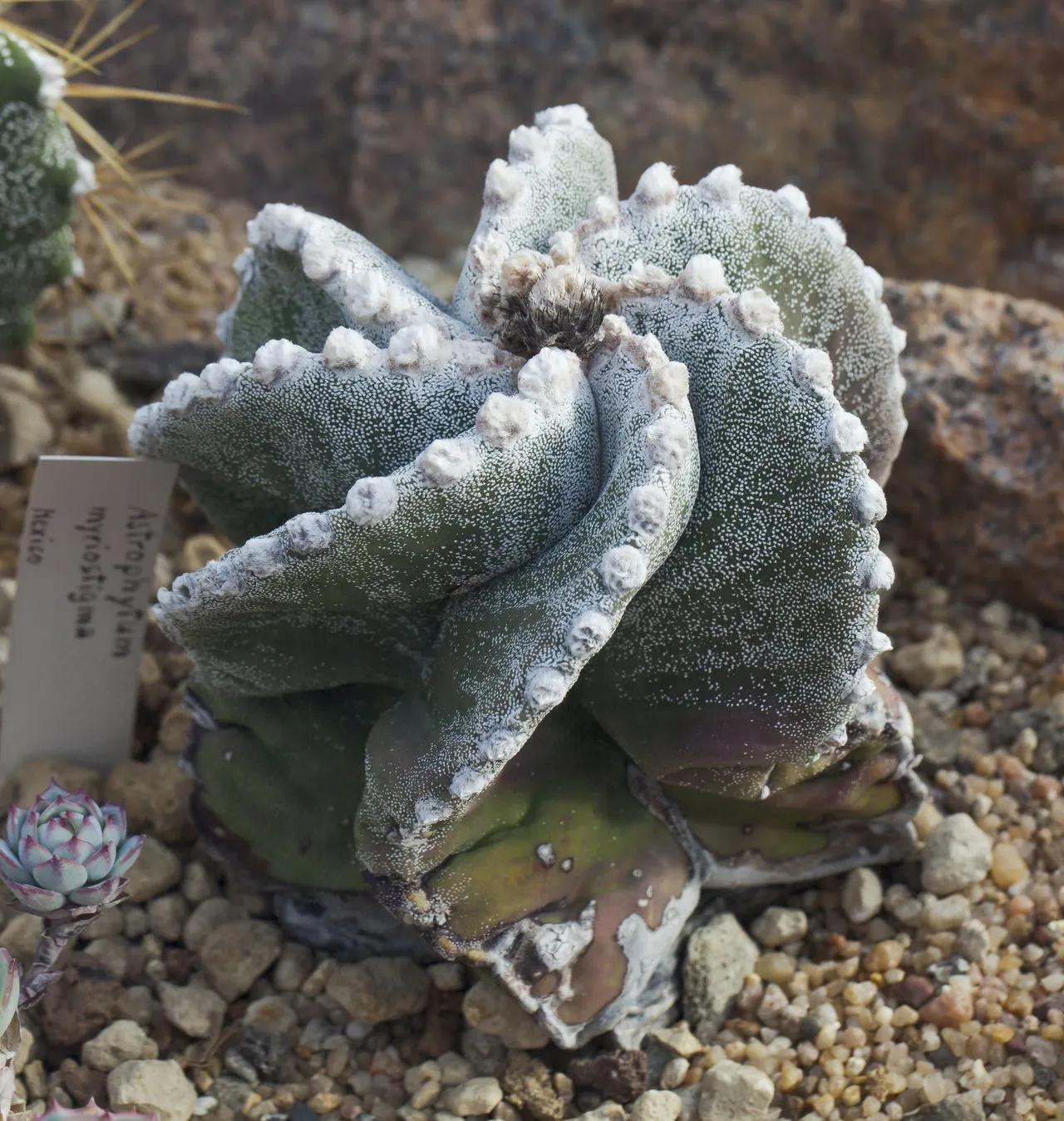
Astrophytum myriostigma Lem. was described by Charles Lemaire in 1839, and it remains the cleanest example of the bishop's cap outline in cultivation. It is native to north-central Mexico, including Coahuila, Nuevo León, Tamaulipas, San Luis Potosí, and Hidalgo, where it grows around 800 to 1,500 m elevation on gypsum and limestone-derived soils. A mature plant is a spineless, globular cactus that becomes short-columnar with age, usually 10 to 25 cm tall in pots, with 4 to 8 ribs, a woolly apex, yellow flowers, and a grey-green epidermis often dusted with white trichomes.
In habitat, A. myriostigma grows in open scrub, rocky slopes, and thin mineral pockets where summer rain moves through the root zone quickly. The soils are alkaline, stony, and low in organic matter. That does not mean the plant wants starvation or permanent drought in a pot; it means roots need air after each watering and should not sit in cool wet compost. Like most cacti, it is covered by CITES Appendix II, so nursery-grown seed or documented cultivated plants are the proper route into a collection.
Part of the Complete Cactus Guide.
Identification
The bishop's cap name comes from the rib geometry. Young plants are rounded, almost ball-like, but older plants become taller than wide and can form a neat five-angled column. In cultivation, 10 to 25 cm height is common for mature own-root plants; old glasshouse specimens can exceed that, but slow compact growth is normal. The crown carries a small patch of white wool, and new flowers emerge from that upper growing point rather than from the sides.
Rib count is the most useful diagnostic feature and also the reason this species circulates under so many cultivar labels. The typical plant has 5 ribs, which gives the bishop's mitre silhouette when viewed from above. Four-ribbed plants are sold as quadricostate forms, 3-ribbed plants as tricostate forms, 5-ribbed plants as pentacostate forms, and 6-ribbed plants as hexacostate forms. The species can show 4 to 8 ribs naturally, and rib number may shift as a seedling matures, so I would treat these labels as horticultural descriptions, not hard botanical ranks.
The surface varies from powdery grey-green to almost plain green. The white flecks are tiny woolly trichomes on the epidermis, not scale insects or residue from spraying. Wild-type plants usually have a fine, even dusting. 'Onzuka' lines were selected in Japan for heavy white spotting, sometimes so dense that the green tissue appears broken into islands. 'Nudum' forms lack the white spotting and show a clean green body, which can be attractive but also makes sun scorch easier to spot.
There are no functional spines on normal A. myriostigma. The areoles sit along the rib edges as small woolly points, but they do not produce the long defensive spines seen in many related Mexican cacti. Flowers are yellow, usually 3 to 6 cm across, and open from the apex in warm bright weather. Most own-root plants need patience before flowering, often 5 to 10 years from seed, although grafted or strongly grown seedlings may flower earlier.
Lookalikes. Astrophytum asterias is much flatter, usually a low disc rather than a rising column, and it commonly has 8 broad ribs with areoles arranged in grooves. Astrophytum capricorne has long, twisting spines, so it should not be confused with a spineless bishop's cap once mature. Astrophytum ornatum also has spines, often stronger growth, and spotted ribs that lengthen into a more columnar plant. A small A. ornatum seedling can resemble A. myriostigma at a glance, but emerging spines and a more vigorous vertical habit usually separate it early.
Cultivation
Light. Give A. myriostigma very bright light with 4 to 6 hours of direct sun during active growth, adjusted for climate. Indoors in the northern hemisphere, a south window is the practical starting point; a strong west window can work if summer heat is moderated. Outdoors, morning sun with bright afternoon shade is safer in hot inland climates. Plants with dense white trichomes tolerate stronger sun than 'Nudum' forms, but any plant moved from shade to full sun needs 10 to 14 days of acclimation.
Water. Water deeply during warm growth, then wait until the pot has dried through. In a 7 to 9 cm terracotta pot under strong light, that often means every 14 to 21 days in summer. In a plastic pot indoors, it may be closer to every 3 to 5 weeks. A moisture probe should read below 15% in the upper 3 cm and close to dry near the lower root zone before the next watering. If the body has softened slightly but the mix is still damp, wait; root oxygen matters more than refilling the stem immediately.
Winter care should be dry and bright. At 6 to 12°C, established plants can rest for 8 to 12 weeks without water. This dry rest reduces rot and helps mature plants set flower buds for the following warm season. If you grow under lights above 16°C all winter, you may give a small drink when the body contracts, but the pot must dry again within a week. Cold wet substrate is a common cause of sudden collapse in otherwise healthy bishop's cap plants.
Substrate. Use a mineral-heavy mix, about 70% to 80% mineral material. A practical blend is 35% pumice, 25% coarse grit or limestone chippings at 2 to 5 mm, 15% lava rock or expanded shale, and 25% low-peat loam-based compost. Gypsum or limestone habitat does not require you to add powdered lime to every pot, but the mix should drain sharply and avoid acidic peat dominance. Fine sand is the wrong shortcut because it packs around the neck and holds a damp film.
Temperature. Active growth is strongest around 20 to 30°C. Dry plants tolerate hotter days with airflow, but small black nursery pots can heat roots beyond what the plant experiences in stony ground. For winter, keep the plant above about 5°C unless you have a dry, controlled glasshouse. Brief cool dips are less dangerous than dampness, but this is not a cactus for a wet frost-prone balcony.
Pot. Choose a pot only 1 to 2 cm wider than the root ball. A. myriostigma has a modest root system, and oversized containers stay wet below the roots. Terracotta is useful in humid homes; plastic is acceptable in hot, dry rooms if you lengthen the watering interval. Repot every 3 to 4 years at the start of warm growth, set the neck slightly proud of the mix, and keep it dry for about a week after repotting.
If you are new to cactus timing, read the broader Beginner's Guide to Succulents before treating the plant like a drought ornament. The goal is not withholding water indefinitely. The goal is watering when light, warmth, and root aeration allow the plant to use it.
Propagation
Seed is the reliable method for A. myriostigma, and it is also the cleanest way to keep cultivar lines honest. Use fresh seed from cultivated parents. Sow on damp, sterilised pumice or a fine mineral seed mix at about 22 °C, with bright filtered light and high humidity. Fresh seed commonly gives around 80% germination under these conditions, often within 7 to 14 days. I prefer damp pumice for the first stage because it holds air even when moist, which reduces the stale wet surface that encourages algae and fungus gnats.
After germination, keep seedlings enclosed for the first few weeks, then open the cover gradually over 2 to 3 weeks. Sudden dry air can wrinkle tiny seedlings faster than their roots can adjust. Once they reach 4 to 6 mm across, begin giving more air movement and let the surface dry briefly between light waterings. Individual 4 to 5 cm pots usually make sense in the second year, still with a mineral-heavy mix and filtered light.
Offsets are not a normal propagation route. A. myriostigma is usually solitary unless it has been damaged, grafted, or selected as an abnormal clustering plant. Grafting is common for variegated seedlings, weak cultivars, and show plants, but grafted specimens grow according to the rootstock as much as the scion. They can become faster, softer, and less representative of the species outline. For long-term cultivation, an own-root seedling is slower but more stable.
Notes
Cultivar circulation. Rib count forms and epidermal patterns are traded heavily. 'Onzuka' should mean dense white patterning, 'Nudum' should mean a green body without flecking, and tricostate, quadricostate, pentacostate, and hexacostate labels describe rib count. Seedlings segregate, so labels are not guarantees. Buy the plant in front of you, especially if symmetry matters.
Pests. Root mealybug is the main hidden problem. A plant can look unchanged for weeks while the roots are being drained. Inspect new purchases during warm weather, remove peat-heavy nursery plugs if present, and quarantine show plants before placing them near seedlings. Scale can settle in the woolly areoles, where a fine brush with 70% isopropyl alcohol is more precise than repeated whole-plant spraying.
Pet safety. A. myriostigma is not known for toxic sap and has no spines, but it is not a chew-safe houseplant. A bitten crown can scar permanently and may rot if saliva or compost enters the wound.
See also
- The Complete Cactus Guide, the main guide to cactus anatomy, mineral substrate, watering rhythm, and winter rest.
- Astrophytum asterias, the flatter sand dollar cactus with a low disc body and usually 8 broad ribs.
- Astrophytum ornatum, a larger spotted species with spines and a stronger columnar tendency.
- A Beginner's Guide to Succulents, broader help for light, pots, soil, and seasonal watering.
Frequently Asked Questions
How many ribs does Astrophytum myriostigma have?
The typical plant has 5 ribs, but 4 to 8 ribs occur naturally. Rib-count labels are horticultural descriptions, not hard botanical ranks.
Is Astrophytum myriostigma spineless?
Yes. Normal plants have woolly areoles along the rib edges but no functional long spines.
When does Astrophytum myriostigma flower?
Yellow flowers open from the apex in warm bright weather. Own-root plants often need 5 to 10 years from seed before flowering.
How should bishop cap cactus be overwintered?
Keep established plants dry and bright at 6°C to 12°C for 8 to 12 weeks. Warm winter culture needs only small drinks if the pot can dry within a week.