| Question | Short Answer |
|---|---|
| How large does Astrophytum asterias get? | A mature own-root plant is usually 1 to 3 cm tall and up to about 8 cm wide. |
| Is Astrophytum asterias spineless? | Yes. |
| How often should Astrophytum asterias be watered? | Water only during active growth after the whole pot dries. |
| Why does provenance matter for Astrophytum asterias? | The species is Endangered and listed under CITES Appendix I. |
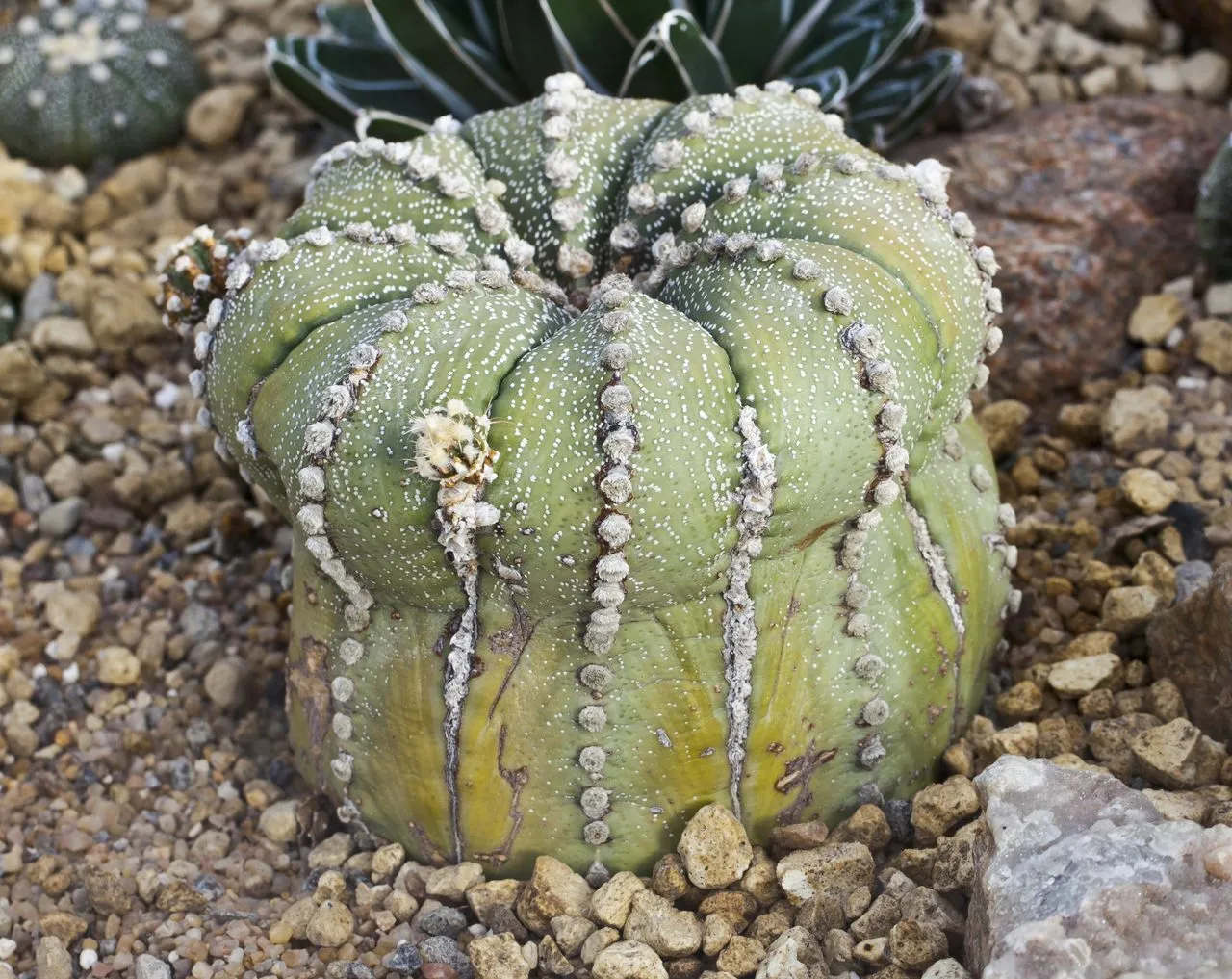
Astrophytum asterias (Zucc.) Lem. was published by Charles Lemaire in 1868 after earlier treatment as Echinocactus asterias. It is a lowland endemic of south Texas and north-eastern Mexico, especially Tamaulipas and Nuevo León, where it grows in sparse thornscrub on mineral flats and low limestone or clay soils, often below 200 m elevation. A mature plant is a spineless, flat green to silver-grey disc with 5 to 8 broad ribs, white woolly areoles in the central groove of each rib, pale speckling across the epidermis, and yellow summer flowers with a red throat.
In habitat, A. asterias is not a forgiving generalist cactus. It occupies open patches among grasses and shrubs where rain drains away quickly, but the root zone can still receive brief pulses of moisture during warm weather. The species is assessed as Endangered by the IUCN and is listed under CITES Appendix I, the most restrictive cactus trade category. Wild plants have been hit hard by habitat loss, grazing, road work, and severe collection pressure, especially for the Japanese and international market around heavily speckled 'Super Kabuto' lines. Across borders, only documented seed-grown nursery material is legal; habitat plants should not be bought, even when they are presented as old collection pieces.
Part of the Complete Cactus Guide.
Identification
The common names sand dollar cactus and sea urchin cactus both describe the body well. A mature own-root plant is usually only 1 to 3 cm tall and up to about 8 cm wide, flattened rather than globular, with a gently domed crown. Seedlings begin as tiny green buttons and then widen slowly, often taking many years to show the adult disc shape.
The ribs are broad, shallow, and regular, most often 8 but sometimes 5, 6, or 7. Each rib has a central groove lined with white woolly areoles. These areoles are the "false eyes" that give the plant its starfish-like symmetry when viewed from above. Unlike many small Mexican cacti, there are no functional spines in normal adult plants.
The surface is green to grey-green, often with a velvety silver cast from countless tiny white trichome flecks. Those flecks are the "stars" behind the genus name Astrophytum. In plain wild-type plants the speckling is modest and scattered. In 'Super Kabuto', the white flecks can be so dense that the plant looks dusted or netted in chalk. 'V-type' plants show V-shaped flecks or chevrons on the ribs, while 'Onzuka' refers to Japanese show-bred plants selected for dramatic markings and symmetry.
Flowers appear from the crown in warm weather, usually summer under cultivation. They are bright yellow, often 3 to 5 cm across, with a red to orange-red throat. A small plant can flower when it is still only a few centimetres wide if it has been grown hard, bright, and dry through winter.
Lookalikes. Astrophytum myriostigma is taller, usually more upright, and has sharper rib angles, with the classic bishop's cap outline. Astrophytum capricorne has long twisting spines that A. asterias lacks. Lophophora williamsii is also spineless and low, but it has rounded tubercles rather than continuous ribs, flowers that are usually pale pink to white, and no sand-dollar pattern of woolly areoles in rib grooves.
Cultivation
Light. Give A. asterias very bright light with 3 to 5 hours of direct sun during active growth. Indoors, a south or strong west window in the northern hemisphere is the usual minimum; under grow lights, aim for bright cactus conditions without placing the plant so close that the crown heats above 40°C. Outdoor plants should receive morning sun and bright afternoon shade in hot climates. A plant moved from a shaded shop bench into full midday sun can scar within one day because the spineless epidermis has little physical shading.
Water. Water only in active growth, and only after the substrate has dried through the full depth of the pot. In a 7 to 9 cm terracotta pot, that may mean every 14 to 21 days in warm, bright summer weather. In a plastic pot indoors, the interval may stretch to 4 weeks or longer. A moisture probe should read below 15% in the upper 3 cm and close to dry near the base before watering again. When you do water, soak the whole root ball, then drain completely. Frequent shallow sips leave salts near the fine roots and do not match the brief, warm rain pulses this species uses in habitat.
Stop watering during cool winter rest. If the plant is kept at 6 to 12°C in bright light, I would keep it dry for 8 to 12 weeks, sometimes longer for an established own-root specimen. If it is grown warm under lights above 16°C, give a small drink only when the body has noticeably contracted and the mix can dry again within a week. Cold damp substrate is the fastest way to lose this species.
Substrate. Use a sharply mineral mix, closer to 80% mineral material than the 60% to 70% used for tougher desert cacti. A practical recipe is 35% pumice, 25% coarse grit at 2 to 5 mm, 20% lava rock or akadama, and 20% low-peat loam-based compost. The particle size matters. Fine sand packs around the neck and holds a damp film exactly where rot starts. Top-dress with clean grit so the crown sits dry and slightly proud of the mix.
Temperature. Active root growth is best around 20 to 30°C. The plant can tolerate hotter days with airflow and dry mineral substrate, but small pots heat rapidly on benches and windowsills. Winter rest is safest at 8 to 12°C, dry and bright. Brief dry dips near 2°C may not kill a hardened plant, but this is not a frost-hardy cactus for a wet patio. Treat 5°C as a practical lower limit unless you have a controlled dry glasshouse.
Pot. Choose a shallow pot only 1 to 2 cm wider than the root system. Oversized pots are risky because unused mix stays wet below the roots. Terracotta is useful in humid homes; plastic can work in hot dry conditions but requires stricter timing. Repot every 3 to 4 years, preferably at the start of warm growth. Keep the neck dry for a week after repotting before watering.
Grafted juveniles are common in the trade, especially on Hylocereus rootstock, because grafting can push tiny seedlings to saleable size much faster than own-root culture. They are not bad plants, but they behave like the rootstock as much as the scion. A grafted plant often grows taller and softer, needs warmer winter conditions, and may outgrow the neat flattened profile. Ungrafted plants are slower, sometimes taking decades to reach a full adult disc, but they are the standard for long-term species cultivation.
Propagation
Seed is the reliable method and the responsible one for a CITES Appendix I species. Use documented nursery seed from cultivated parents. Sow on the surface of a sterile fine mineral mix at 24 to 28°C, with bright filtered light and high humidity. Fresh seed often germinates in 5 to 14 days. Once seedlings are 2 to 3 mm wide, open the tray gradually over 2 to 3 weeks so they adapt to drier air.
The first year is the most delicate. Seedlings rot quickly if algae, fungus gnats, or stale wet compost develop, so keep the tray warm, clean, and ventilated after germination. A careful grower may get 50% to 70% of fresh seed through the first six months. By the second year, seedlings can be moved into individual 4 to 5 cm pots, still in a mineral-heavy mix.
Offsets are not a normal propagation route. A. asterias is solitary unless damaged, grafted, or selected as an unusual clustering form. Cutting the crown of an own-root plant to force pups is poor practice for ordinary cultivation and especially inappropriate for rare legal material. Grafting has a place for preserving weak seedlings, variegates, and show cultivars, but it should not be used to excuse buying questionable wild plants.
Notes
Conservation and trade. This is the cactus where paperwork matters. CITES Appendix I means international trade in wild plants is effectively prohibited, and legal movement depends on documented artificially propagated stock. If a seller cannot tell you whether the plant is seed-grown, or if an old scarred plant is offered without clear provenance, walk away. Demand for 'Super Kabuto' and other show forms has made field collection profitable enough to damage small wild populations.
Cultivars. 'Super Kabuto' is the name most growers meet first, but it is a horticultural selection, not a separate wild species. The heaviest white patterning can reduce visible green surface area, so grow these plants bright but not brutally exposed. 'V-type' and 'Onzuka' plants vary widely because seedlings segregate. Buy the individual plant you like, not only the label.
Pests. Root mealybug is a serious problem because the plant can sit unchanged for weeks while roots are being drained. Inspect the root ball of new purchases during warm weather, and quarantine show plants before placing them near seedlings. Scale can lodge in the areole wool, where alcohol on a fine brush is safer than spraying the whole crown repeatedly.
Pet safety. The species is not known for toxic sap, and it has no spines to puncture skin, but a bitten crown is slow to recover and often becomes the starting point for rot.
See also
- The Complete Cactus Guide, the main cactus cultivation guide covering areoles, mineral substrate, light, watering rhythm, and winter rest.
- Astrophytum myriostigma, a taller bishop's cap species useful for comparing rib shape, speckling, and spineless cactus form.
- Astrophytum capricorne, a related species with long twisting spines and a more open desert-cactus outline.
- A Beginner's Guide to Succulents, broader help for matching succulents to light, pots, soil, and seasonal watering.
Frequently Asked Questions
How large does Astrophytum asterias get?
A mature own-root plant is usually 1 to 3 cm tall and up to about 8 cm wide. It widens slowly into a flattened disc.
Is Astrophytum asterias spineless?
Yes. Normal adult plants have woolly areoles in the rib grooves but no functional spines.
How often should Astrophytum asterias be watered?
Water only during active growth after the whole pot dries. In a 7 to 9 cm terracotta pot that is often every 14 to 21 days in warm bright weather.
Why does provenance matter for Astrophytum asterias?
The species is Endangered and listed under CITES Appendix I. Legal, responsible plants should be documented artificially propagated stock.