| Question | Short Answer |
|---|---|
| How large does Astrophytum ornatum grow? | Species-size plants can reach 50 to 100 cm tall and 15 to 30 cm wide. |
| How is Astrophytum ornatum different from A. myriostigma? | A. |
| When will Astrophytum ornatum flower? | Own-root plants are slow, commonly needing 8 to 15 years from seed before regular yellow flowers appear. |
| What pot suits Astrophytum ornatum? | Young plants need a pot only 1 to 2 cm wider than the root ball. |
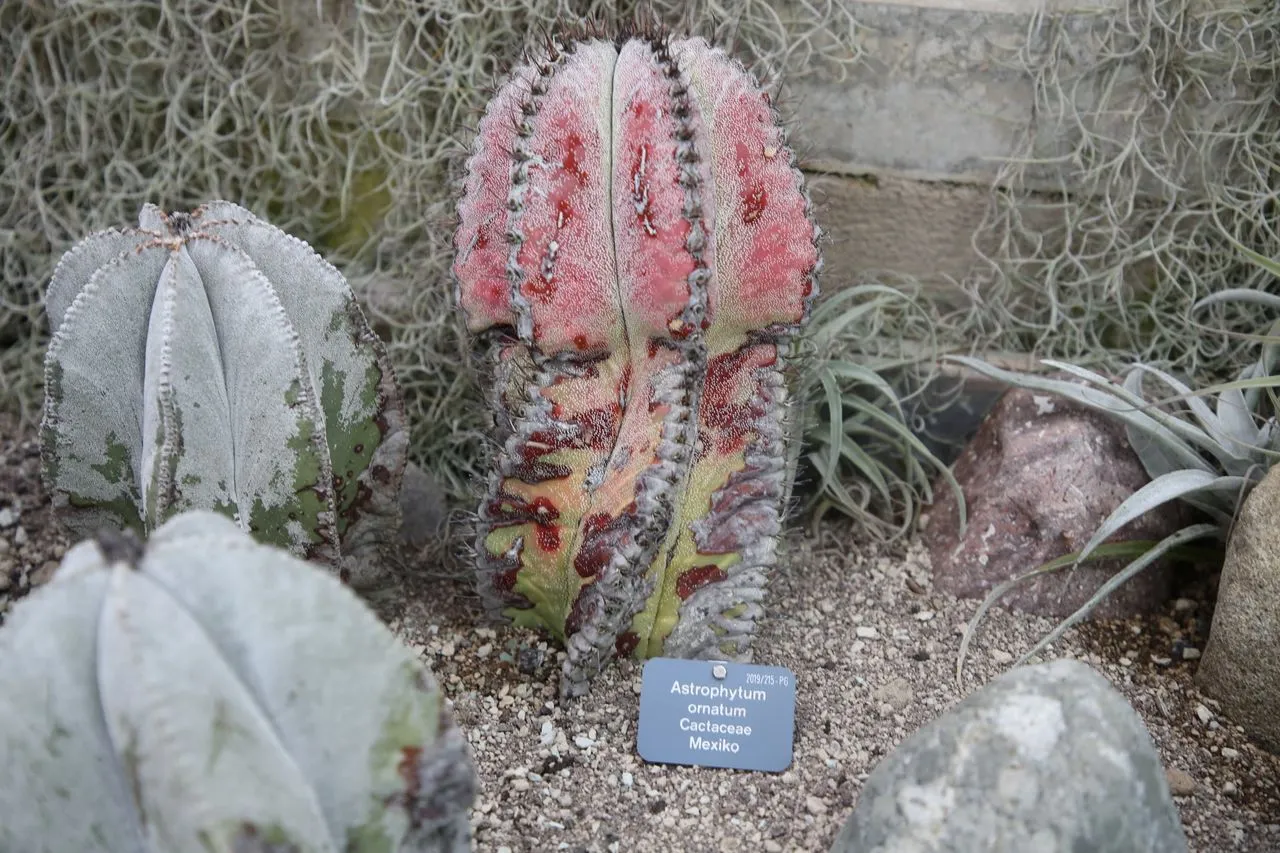
Astrophytum ornatum (DC.) Britton & Rose is the largest species in the genus, first published as Echinocactus ornatus by Augustin Pyramus de Candolle in 1828 and placed in Astrophytum by Charles Lemaire in 1839. It is native to central Mexico, especially Hidalgo and Querétaro, where it grows around 1,000 to 1,800 m elevation on limestone slopes. A mature plant begins globular, then becomes a strong column 50 to 100 cm tall and 15 to 30 cm wide, usually with 8 ribs, curved yellowish spines, white woolly trichomes in bands across the ribs, and yellow flowers from the apex after a long juvenile phase.
In habitat, A. ornatum grows in open xeric scrub, rocky ravines, and steep limestone-derived soils where rain is seasonal and drainage is immediate. The roots are not searching for rich compost; they are occupying mineral pockets that dry with air movement and sun. Plants receive stronger exposure than the flatter and smaller Astrophytum species, which is why shaded, soft-grown seedlings often stretch before they become properly ribbed. Like most cacti, A. ornatum is covered by CITES Appendix II, so cultivated seed-grown plants are the responsible source for collections.
Part of the Complete Cactus Guide.
Identification
A. ornatum is the big, architectural member of Astrophytum. Seedlings start as ribbed green globes, but the species does not stay low and button-like. Given years of bright growth, the body rises into a column with a rounded crown and pronounced vertical ribs. In pots, many plants remain 20 to 40 cm tall for a long time, but old greenhouse specimens can reach the species range of 50 to 100 cm tall and 15 to 30 cm wide.
The typical rib count is 8, although 7 or 9 ribs occur. Each rib is high and fairly sharp, with areoles set along the ridge. The white marks are not random dusting. They are woolly trichomes arranged in distinct bands and broken chevrons across the ribs, often giving the plant a chalk-striped appearance from above. Pattern density varies by seed line, and the green epidermis may show clearly between the bands.
Spines separate this species from most cultivated bishop's cap plants. Each areole usually carries 5 to 10 spines, yellowish to brownish with age, curved rather than straight, and strong enough to catch fingers or sleeves. They are not the long papery spirals of A. capricorne, but they are functional spines and should be treated as part of the plant's identity. The woolly crown produces yellow flowers in warm bright weather. Own-root plants are slow to flower, commonly needing 8 to 15 years from seed before reliable blooming.
Lookalikes. Astrophytum myriostigma is smaller, usually 10 to 25 cm tall in pots, and normally spineless, with a cleaner bishop's cap outline. Astrophytum asterias is very flat, usually a low disc with 8 broad ribs, no spines, and areoles set in grooves rather than along tall rib ridges. Astrophytum capricorne has longer twisted papery spines that curl and tangle around the body, while A. ornatum has shorter curved spines and a heavier upright habit. If a young plant is labelled only as "Astrophytum mixed," the first useful checks are spine type, rib height, and whether the white trichomes form bands rather than an even dusting.
Cultivation
Light. Give A. ornatum more sun than A. myriostigma or A. asterias. Indoors in the northern hemisphere, a south-facing window is the minimum I would choose, and supplemental light may be needed through winter. Outdoors, aim for 5 to 7 hours of direct sun during active growth, with light afternoon protection only in very hot inland climates. A plant moved from nursery shade to full sun should be acclimated over 10 to 14 days; the trichome bands help reflect light, but soft new epidermis can still scar.
Water. Water deeply in warm growth, then allow the whole pot to dry. In a 9 to 12 cm terracotta pot under strong summer light, that often means watering every 14 to 21 days. In a plastic pot indoors, the interval may be 3 to 5 weeks. A moisture probe should read below 15% in the upper 3 cm and close to dry near the base before you water again. The body can lose a little firmness between waterings without harm. If the plant is cool or the lower mix is damp, wait.
Winter should be bright, cool, and dry. At 6 to 12°C, an established plant can rest for 8 to 12 weeks without water. A. ornatum has better cold tolerance than many small show Astrophytum species and can take brief light frost when bone-dry, but cold wet substrate is still dangerous. Treat 5°C as a conservative lower limit in ordinary home culture unless you have a dry, ventilated greenhouse. If you grow warm under lights above 16°C, give only small drinks when the body contracts and the mix can dry again within a week.
Substrate. Use a mineral-heavy mix, about 70% to 85% mineral material. A practical blend is 35% pumice, 25% coarse grit or limestone chippings at 2 to 5 mm, 15% lava rock or expanded shale, and 25% low-peat loam-based compost. Limestone chippings suit the species' alkaline habitat, but drainage and particle size matter more than chasing a specific pH number. Avoid fine sand, which packs around the neck and keeps a damp film against the epidermis.
Pot. Young plants do well in pots only 1 to 2 cm wider than the root ball. As the column gains height, shift to a heavier terracotta pot or a squat clay pan that resists tipping. The root system is stronger than that of A. asterias, but an oversized deep pot still stays wet below the active roots. Repot every 3 to 4 years at the start of warm growth, set the neck slightly proud of the top-dressing, and keep the plant dry for about a week afterward.
If this is one of your first cacti, read the broader Beginner's Guide to Succulents before using a fixed calendar. A. ornatum is tolerant of bright sun and dry pauses, but it still grows best when watering matches light, warmth, and root aeration.
Propagation
Seed is the normal and reliable method for A. ornatum. Use fresh seed from cultivated parents and sow on a sterile mineral seed mix at 22 to 28°C. Bright filtered light, steady warmth, and high humidity give the best start. Fresh seed commonly germinates within 7 to 14 days, often at 70% to 90% if the seed is recent and the surface stays clean.
Keep seedlings enclosed for the first few weeks, then open the cover gradually over 2 to 3 weeks. They can look robust early because the ribs and spines appear while the plants are still small, but the neck remains sensitive to stale moisture. Once seedlings reach 5 to 8 mm across, give more air movement and let the surface dry briefly between light waterings. Individual 5 cm pots usually make sense in the second year.
Offsets are not a normal propagation route. A. ornatum is usually solitary, and cutting a healthy column to force pups is unnecessary for ordinary collections. Grafting can speed weak seedlings or variegated material, but it also changes the plant's proportions. Own-root plants are slower and may take 8 to 15 years to flower, yet they show the heavy ribbed adult form more faithfully.
Notes
Cultivars. 'Mirbelii' is used for plants with denser white spotting or banding, sometimes making the body appear much paler than the usual striped form. 'Glabrescens' refers to plants with little or no white spotting, leaving a greener body. These names are common in horticulture, but seedlings vary. Buy for the visible pattern and spine character, not only the label.
Pests. Root mealybug is the hidden problem I check for first, especially in plants bought in peat-heavy nursery plugs. Scale can settle in the areole wool near the rib edges, where it is easier to miss than on a smooth cactus body. Quarantine new plants, inspect roots during warm weather, and use a fine brush with 70% isopropyl alcohol for isolated scale rather than repeated whole-plant spraying.
Handling. The spines are curved and can hook fabric. When repotting larger plants, fold a strip of newspaper or soft foam around the body and lift from below the root ball. Do not grip the woolly crown; damage there can mark the flowering point for years.
See also
- The Complete Cactus Guide, the main guide to cactus anatomy, mineral substrate, watering rhythm, and winter rest.
- Astrophytum myriostigma, the smaller spineless bishop's cap that helps separate rib shape from spine characters.
- Astrophytum capricorne, a related species with longer twisted papery spines and a looser outline.
- A Beginner's Guide to Succulents, broader help for matching light, pots, soil, and seasonal watering.
Frequently Asked Questions
How large does Astrophytum ornatum grow?
Species-size plants can reach 50 to 100 cm tall and 15 to 30 cm wide. Many potted plants remain 20 to 40 cm tall for years.
How is Astrophytum ornatum different from A. myriostigma?
A. ornatum is larger, spined, and more columnar. A. myriostigma is usually smaller and spineless with a cleaner bishop cap outline.
When will Astrophytum ornatum flower?
Own-root plants are slow, commonly needing 8 to 15 years from seed before regular yellow flowers appear.
What pot suits Astrophytum ornatum?
Young plants need a pot only 1 to 2 cm wider than the root ball. Taller columns need heavier terracotta or a squat clay pan for stability.