| Question | Short Answer |
|---|---|
| What makes Mammillaria zeilmanniana a Mammillaria? | It has tubercles rather than ribs, with flowering from the axils near the crown. |
| Is Mammillaria zeilmanniana large? | No. |
| How do you encourage flowers? | Bright summer light and a cool dry winter rest improve the chance of crown-ring flowering. |
| What potting mix is appropriate? | Use a mineral cactus mix in a pot close to the root-ball size so unused substrate does not stay wet. |
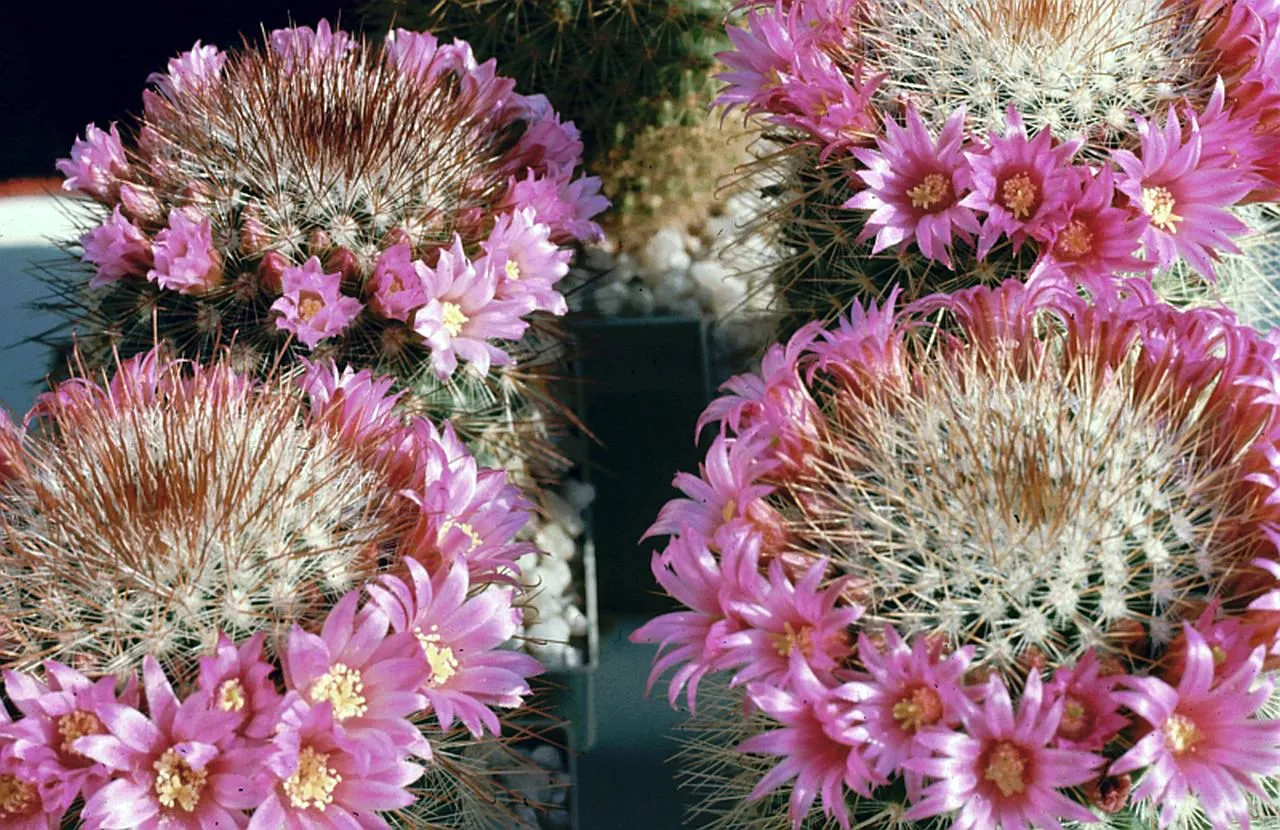
Mammillaria zeilmanniana Boed., the rose pincushion cactus, was described by Friedrich Boedeker in 1929 from material collected in Guanajuato, Mexico. It is a narrow endemic of the Sierra de Guanajuato near Cañon del Marfil, where it grows around 1,800 to 2,000 m on limestone cliffs. In cultivation it is recognized by its small cylindrical-globular stem, 18 to 20 white radial spines per areole, four red-brown hooked central spines, and a spring ring of magenta-pink flowers around the apex.
In habitat, M. zeilmanniana is not a general desert-floor cactus. It occupies cliff pockets and limestone crevices in one restricted canyon system, with roots wedged into mineral grit, decomposed rock, and very small amounts of organic debris. Rain arrives mainly in the warmer part of the year; winter is bright, cooler, and much drier. That cliff ecology matters in pots. The plant tolerates strong light and a cool dry rest, but it has little patience for wet compost held around the root neck.
The conservation side is unusually serious for such a common nursery plant. M. zeilmanniana is assessed as Critically Endangered by the IUCN and is listed on CITES Appendix I, reflecting its tiny wild range and past collection pressure. Fortunately, seed-grown nursery plants are widely available, and fresh seed germinates well under controlled conditions. Buy only propagated stock with a clear nursery source. A cheap old clump with no provenance is not a bargain when the wild population is confined to a single Guanajuato canyon.
Part of the Complete Cactus Guide.
Identification
M. zeilmanniana is compact even when mature. Young plants are globular, then become shortly cylindrical with age, usually 4 to 6 cm wide and 6 to 10 cm tall in pots. Older plants often cluster from the base, forming a tight group of small heads rather than one tall column. The body is medium green, divided into rounded tubercles arranged in spiral lines. Axils may carry a little wool when young, but the plant should read as a neat, spiny pincushion rather than a woolly white species.
The diagnostic character is the hooked central spine. Each areole normally carries about 18 to 20 white radial spines arranged around the tubercle tip, plus four stronger central spines that are red-brown to chestnut. The central spines curve or hook distinctly at the tip. Those hooks separate M. zeilmanniana from most commonly sold Mammillaria at a glance, especially when the plant is not in flower.
Flowers appear in spring from the upper axils and form a ring, or nearly complete ring, around the crown. The colour is a saturated magenta-pink, a useful field and trade character because many Mammillaria species flower in paler pink, cream, or pink-cream tones. Individual flowers are small, but a well-rested plant can make a clean band of colour around the apex. After pollination, narrow red fruits may emerge from the axils later in the season.
The two comparison species you are most likely to meet are M. spinosissima and M. hahniana. M. spinosissima is taller, often 15 to 30 cm in cultivation, with a more columnar habit and central spines that are usually straight rather than hooked. Its flowers are commonly lighter pink to magenta and its spine colour varies widely, so flower colour alone is not enough. M. hahniana is shorter and much more woolly, with white axil hair partly hiding the body and no hooked centrals. If the plant is white-haired, soft-looking, and lacks obvious red-brown hooks, it is not M. zeilmanniana.
Do not rely on the common name rose pincushion by itself. Several small Mammillaria in trade are sold under pincushion names, and nursery labels are sometimes copied from a supplier list without close inspection. Use the combination of small clustering body, white radials, four red-brown hooked centrals, and magenta flower ring.
Cultivation
Light. Give M. zeilmanniana bright, direct light for compact growth. Indoors, a south-facing or very bright west-facing window is usually needed, with the plant close to the glass rather than across the room. Under grow lights, 12 to 14 hours daily during active growth keeps the crown tight. Outdoors, acclimate over 10 to 14 days before giving several hours of direct sun. The small green body can scorch if moved from a shaded shop bench into unfiltered midday heat in one step.
Water. From March to October, water thoroughly, then let the pot dry deeply before watering again. In a 7 to 9 cm terracotta pot in warm bright light, that may be every 10 to 16 days. In plastic, or on a cool windowsill, the interval may stretch past three weeks. A moisture probe should read below 15% in the top 3 cm before you water. If you prefer the skewer method, insert it to the lower half of the pot and wait five minutes; damp particles clinging to the wood mean the plant can wait.
In winter, keep the plant almost dry. A rest at 5 to 10°C with strong light and minimal water is the usual route to a good spring flower ring. If your plant is kept above 16°C under lights, give a small drink every 5 to 7 weeks only if the stem wrinkles and the substrate can dry within a few days. Avoid overhead watering in cool weather. Water held between tubercles and spines evaporates slowly and can mark the crown.
Substrate. Use a mineral-led mix, roughly 70% to 80% mineral material and 20% to 30% low-peat organic matter. A practical recipe is 40% pumice, 20% coarse grit at 3 to 6 mm, 15% lava grit or crushed granite, and 25% loam-based compost. Limestone grit can be included in small amounts if your water is not already very hard, matching the species' limestone cliff origin. The important point is dry-down speed: a small pot should not remain wet for more than 7 to 10 days after watering.
Temperature. Warm summer days around 25 to 32°C suit active growth if air movement is good. Brief higher temperatures are tolerated when the roots are healthy and the pot is not baking inside a closed windowsill cachepot. In winter, keep it dry and cool rather than warm and dim. Brief dips to about -2°C are usually tolerated by dry, established plants, but I keep cultivated specimens above 2°C unless the mix is bone-dry and the forecast is stable. Damp cold is the real danger.
Pot. Choose a pot only 1 to 2 cm wider than the root ball. A 7 cm pot is enough for many single heads; a modest clump may need 9 to 11 cm. Terracotta is useful in humid rooms because it shortens the wet phase after watering. Avoid oversized decorative pots, which leave unused substrate wet around a small root system. If you are still learning how pot size changes drying time, the broader Beginner's Guide to Succulents gives a useful framework for reading weight, firmness, and seasonal growth cues.
Propagation
Seed is the most responsible and scalable method for M. zeilmanniana. Fresh seed sown on damp fine pumice at about 22°C can germinate at roughly 80% when the seed is viable. Use a shallow container, surface-sow the seed, and cover it to hold humidity until germination begins. Most seedlings appear within 7 to 21 days. Once you see green dots, open the cover daily so stagnant humidity does not invite fungal growth. Seedlings need bright shade for the first months, not direct midday sun.
Because the species is Critically Endangered in habitat and listed on CITES Appendix I, seed provenance matters. Buy seed from established cactus nurseries, seed exchanges that document cultivated parent plants, or growers who can state that their stock is nursery-raised. Do not buy field-collected plants or seed advertised with habitat locality data unless legal propagation and documentation are explicit. Conservation-minded cultivation should reduce pressure on the canyon population, not create a market signal for more collecting.
Offsets are useful once a plant has started to cluster. In spring or early summer, remove a head at least 2 cm wide with a clean blade, then let the wound callus in dry shade for 5 to 7 days. Set it on dry mineral substrate and wait another week before the first light watering. At 20 to 26°C, offsets usually anchor within 3 to 5 weeks. Success from healthy offsets is often 80 to 90%, but seed remains better for maintaining a broader cultivated population.
Notes
Flowering. A plant that grows but refuses to flower is usually missing either strong summer light or a cool dry winter. M. zeilmanniana can survive on a bright windowsill without a cold rest, but it often flowers poorly if kept warm and slightly damp through winter. The spring ring forms best after several months of reduced water.
Pests. Mealybugs hide at the base and between clustered heads. Inspect with a hand lens during warm growth, especially after buying a plant from a mixed cactus bench. Alcohol spot treatment works on exposed insects, but let treated areas dry fully before returning the plant to a cool resting position.
Handling. The hooked central spines catch skin, sleeves, and soft brush bristles. Lift plants with folded newspaper, foam tongs, or a strip of stiff paper wrapped around the stem. Pulling straight away from a hooked spine can tear the areole or leave a spine tip in your finger.
Trade pressure. Nursery-grown M. zeilmanniana is common enough that there is no reason to accept vague provenance. Seedlings and small clumps are the ethical choice. If a seller emphasizes wild origin, old collected character, or a precise canyon locality without paperwork, walk away.
See also
- The Complete Cactus Guide, the site pillar for cactus anatomy, mineral substrates, dormancy, and common cultivation problems.
- A Beginner's Guide to Succulents, useful for calibrating pot size, watering intervals, and dry-down cues.
- Mammillaria hahniana, the white-haired comparison species with woolly axils and no hooked central spines.
- Mammillaria spinosissima, the taller spiny pincushion with straighter centrals and a more columnar habit.
Frequently Asked Questions
What makes Mammillaria zeilmanniana a Mammillaria?
It has tubercles rather than ribs, with flowering from the axils near the crown.
Is Mammillaria zeilmanniana large?
No. It is grown as a compact cactus rather than a large barrel or columnar plant.
How do you encourage flowers?
Bright summer light and a cool dry winter rest improve the chance of crown-ring flowering.
What potting mix is appropriate?
Use a mineral cactus mix in a pot close to the root-ball size so unused substrate does not stay wet.