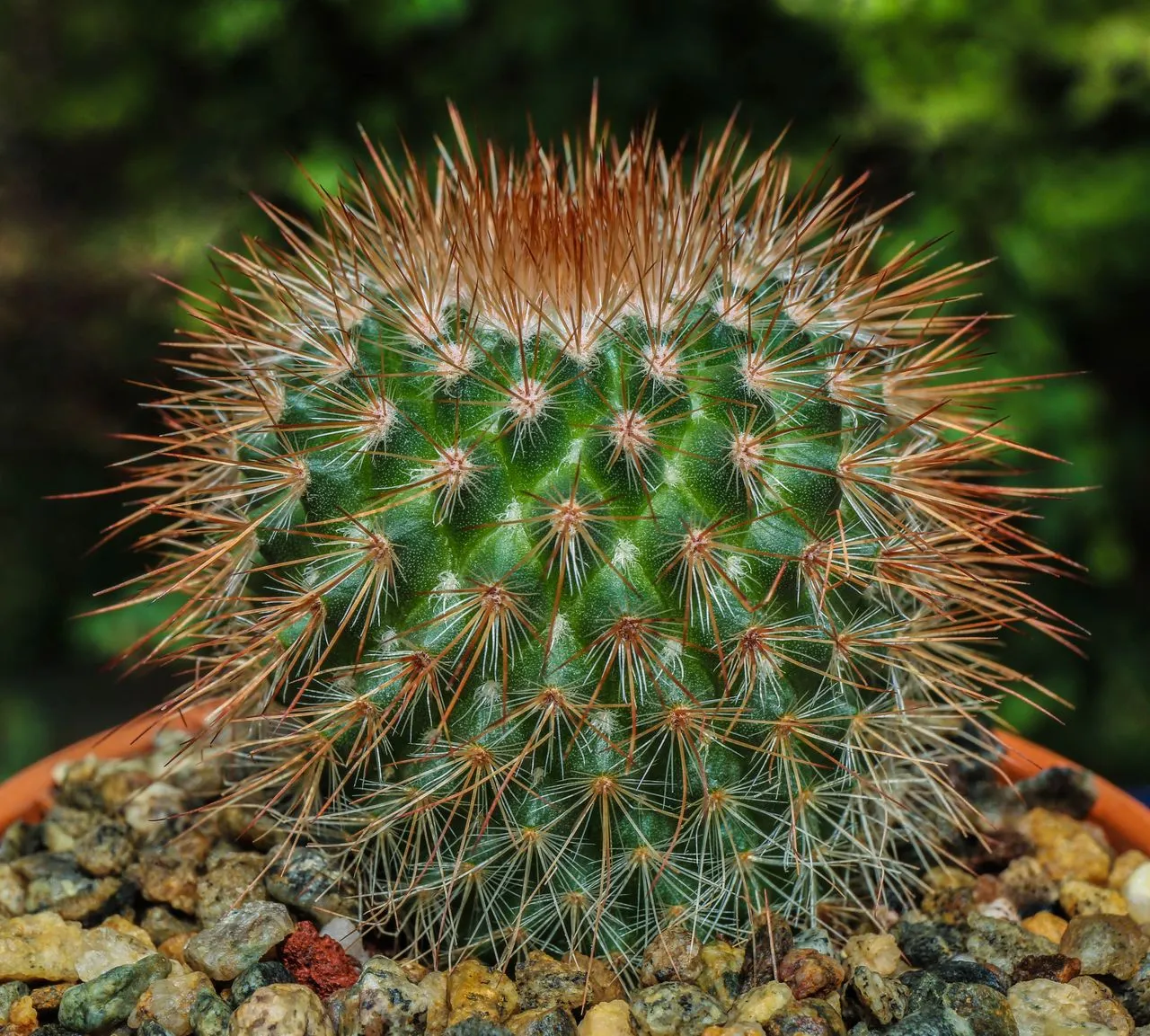
| Question | Short Answer |
|---|---|
| Does Mammillaria spinosissima have ribs? | No. |
| Where do Mammillaria flowers appear? | Flowers usually form a ring around the crown from the axils between tubercles. |
| What care keeps it compact? | Strong light, a mineral mix, and a dry winter rest keep growth dense. |
| Can it be propagated from offsets? | Clustering Mammillaria can be propagated by offsets when pups are large enough to remove and callus. |
Mammillaria spinosissima Lem., the spiny pincushion cactus, was described by Charles Lemaire in 1838 from central Mexican material. It is native to Morelos, Guerrero, and Estado de México, where it grows at roughly 1,500 to 2,200 m elevation on volcanic rock. In cultivation it is recognized by its cylindrical to columnar stem, dense tubercles, highly variable spine colour, and a spring crown of pink to magenta flowers around the apex.
In habitat, M. spinosissima occupies exposed rocky slopes and crevices where mineral particles, weathered lava, and thin pockets of organic debris collect around the roots. Rain is concentrated in the warm season, while winter is cooler and much drier. That combination explains two things growers notice quickly: the plant can take bright sun and a dry cool rest, but it dislikes cold moisture around the root neck. Like most cacti in international trade, the species is covered by CITES Appendix II; cultivated nursery plants are the appropriate source.
Part of the Complete Cactus Guide.
Identification
M. spinosissima is not the soft white ball many people picture when they hear Mammillaria. The stem is upright from a young age, cylindrical or shortly columnar, usually 15 to 30 cm tall in pots and 5 to 10 cm in diameter. Some plants remain single for years. Others produce basal offsets and form clumps of several columns, especially older cultivated material and selected forms.
The tubercles are arranged in clear spirals, with small woolly axils between them. The axil wool is present but not the main visual character. The plant reads as spiny rather than hairy. This separates it from Mammillaria hahniana, which is shorter, globular to briefly cylindrical, and covered in long white wool that partially hides the green body.
Spines are the feature that causes most label confusion. Radial spines are numerous and glassy to bristly. Central spines are stronger, usually straight, and their colour varies widely. Seed-grown plants and named selections can show white, yellow, copper, red, brown, or mixed spines. The red-spined forms are often sold under names such as var. rubrispina or as cultivar material. A green stem with red-brown spines may still be the same species; colour alone is not enough to separate it.
Flowers appear in spring, usually from the upper axils, and form the typical Mammillaria ring or partial crown around the stem apex. They are small but numerous, pink to magenta, and contrast sharply with red or brown-spined plants. After pollination, narrow red fruits may push out from the axils later in the season.
Three comparisons are worth making before you accept a nursery label. Mammillaria elongata has thinner stems, usually 2 to 4 cm across, and forms low branching clusters rather than upright columns 5 to 10 cm wide. M. hahniana is much shorter and white-haired, with axil wool as the dominant feature. M. spinosissima 'Un Pico' is not a separate species; it is a cultivated form selected for one prominent central spine per areole. Similar 'Pico' forms circulate under slightly different nursery names, so check the spine count and habit rather than treating the name as botanical rank.
Cultivation
Light. Give M. spinosissima strong light for compact growth. Indoors, a south-facing window is the minimum in most northern hemisphere homes, with the plant within 20 cm of the glass. Under grow lights, aim for 12 to 14 hours daily during active growth. Outdoors, it handles full morning sun and several hours of later sun after a 10 to 14 day acclimation period. Sudden exposure from a shaded shop bench to midday summer sun can bleach the epidermis between the spines.
Water. During active growth from March to October, water thoroughly, then wait until the mix is dry through at least the upper half of the pot. In a 9 to 11 cm terracotta pot in warm bright light, that often means every 10 to 18 days. In plastic, or in a cool room, the interval may be three weeks or more. A moisture probe should read below 15% in the top 3 cm before watering again; a wooden skewer should come out dry or nearly dry after five minutes at depth.
From late autumn through winter, keep the plant almost dry. A cool rest at 5 to 10°C improves flowering and keeps growth tight. If your room stays above 16°C under strong lights, give a light drink every 5 to 7 weeks only if the stem begins to wrinkle. Do not water by misting the crown. Water trapped among spines and axil wool can sit against the stem in cool weather.
Substrate. Use a mineral-led mix, roughly 65% to 75% mineral material and 25% to 35% low-peat organic matter. A practical recipe is 35% pumice, 20% coarse grit at 3 to 6 mm, 15% lava grit or crushed granite, and 30% loam-based compost. The root system is not large enough to rescue a peat-heavy pot that stays wet for two weeks. If you are still learning dry-down timing, the broader Beginner's Guide to Succulents will help you read pot weight, root health, and seasonal growth cues.
Temperature. Warm summer conditions suit it, including daytime temperatures around 30 to 35°C if air movement is decent and roots are not stagnant. In winter, light frost is tolerated only when the plant is bone-dry. Brief dips around -2°C usually cause no lasting damage in a dry mineral mix, but damp substrate at the same temperature can rot roots or mark the stem base. Keep plants above 2°C if you cannot guarantee dryness.
Pot. Choose a pot only 1 to 2 cm wider than the root ball. Terracotta is useful in humid homes because it shortens the wet phase after watering. The upright stem eventually becomes top-heavy, so avoid very light nursery pots for older specimens. A broad standard pot is better than a deep narrow one, unless the plant has developed an unusually long root system.
Propagation
Offset division works when the plant is a clustering form. In spring or early summer, remove an offset at least 2 cm across with a clean blade or a controlled twist if it detaches naturally. Let the wound dry in shade for 5 to 7 days. Set the offset on dry mineral substrate, keep it upright with grit if needed, and wait 7 to 10 days before the first light watering. At 20 to 26°C, rooted offsets usually anchor within 3 to 5 weeks. Healthy offsets taken in active growth often succeed at 85% or better.
Seed is better when you want variation, especially spine colour. Sow fresh seed on damp fine pumice or a sterile pumice and grit surface at about 22°C. Cover the container to hold humidity, but open it daily once germination begins so fungal pressure stays low. A realistic germination rate is about 70% on damp pumice at 22°C. Most viable seeds sprout within 10 to 21 days. Seedlings should stay bright but out of harsh direct sun for the first year, then be hardened gradually into the adult mineral mix.
Do not assume seed-grown plants will match the parent exactly. Spine colour, central spine strength, and clumping habit all vary. Named forms such as 'Un Pico' should be kept by offsets if you want the cultivar character preserved.
Notes
Trade names. M. spinosissima appears under many spine-colour names, and not all are applied consistently. Red-spined plants are popular, but a red form is not automatically 'Un Pico'. That name refers to the single central spine character. If a plant has several central spines, it may still be attractive and healthy, but it is not correctly labelled as 'Un Pico'.
Pests. Mealybugs hide well between tubercles and around the stem base. Inspect the crown and the lowest areoles with a hand lens every few weeks in warm weather. A dry soft brush removes dust from the spine field. Use alcohol spot treatment carefully and keep it away from a cold resting plant until the treated area has dried fully.
Flowering. If an adult plant refuses to flower, the usual cause is a warm, dim winter. Strong summer light builds the reserves, but the cool dry rest helps initiate the spring ring of buds. A plant kept at household warmth all winter may grow a pale pointed crown instead of setting flowers.
Handling. The spines are straight but sharp enough to enter skin cleanly. Wrap the stem in folded newspaper or use foam tongs when repotting. Gloves alone often fail because the centrals pierce through fabric and then snap when you pull away.
See also
- The Complete Cactus Guide, the site pillar for cactus anatomy, substrate, dormancy, and common problems.
- A Beginner's Guide to Succulents, useful if you are calibrating watering intervals and mineral mixes for the first time.
- Mammillaria elongata, the thinner, lower-growing clustering comparison species listed in the related profiles.
- Mammillaria hahniana, the white-haired old lady cactus, useful for separating wool-dominant Mammillaria from spine-dominant forms.
Frequently Asked Questions
Does Mammillaria spinosissima have ribs?
No. Mammillaria species are tubercled, with areoles and flower axils arranged around those projections.
Where do Mammillaria flowers appear?
Flowers usually form a ring around the crown from the axils between tubercles.
What care keeps it compact?
Strong light, a mineral mix, and a dry winter rest keep growth dense.
Can it be propagated from offsets?
Clustering Mammillaria can be propagated by offsets when pups are large enough to remove and callus.