| Question | Short Answer |
|---|---|
| Why is Mammillaria plumosa called feather cactus? | Its white feathery spines cover the body and give the plant a soft, downy appearance. |
| Is Mammillaria plumosa spineless? | No. |
| What is the main watering risk? | Water trapped in the feathered crown can linger and encourage rot. |
| Does Mammillaria plumosa need strong light? | Yes. |
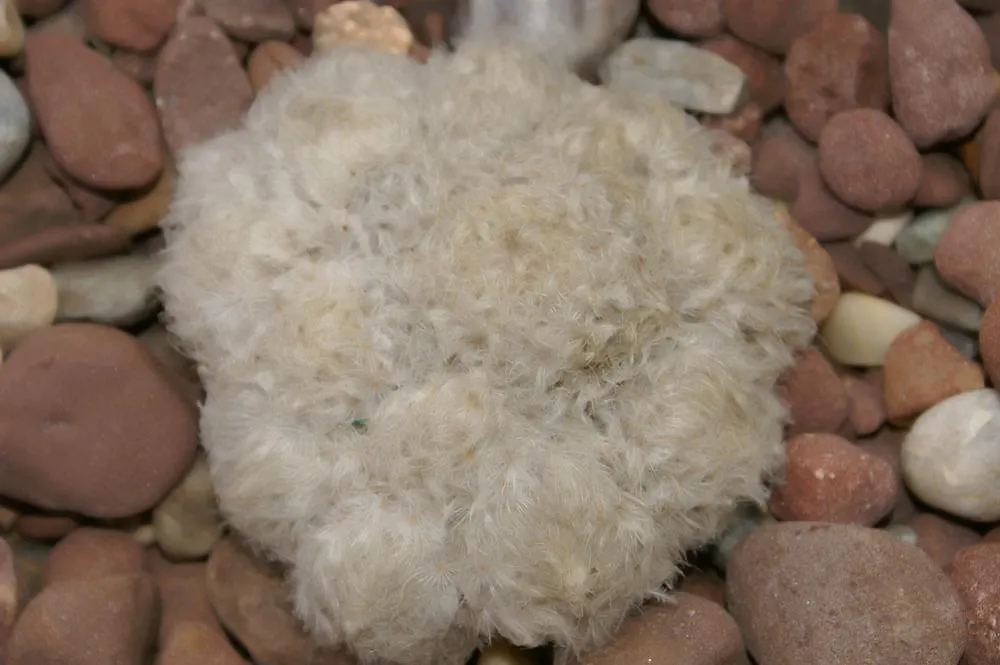
Mammillaria plumosa F.A.C.Weber, the feather cactus, was described by Friedrich Albert Constantin Weber in 1898. It is endemic to Nuevo León, Mexico, especially around Galeana and San Pedro Iturbide, where it grows at about 1,800 to 2,500 m elevation on Cretaceous limestone cliffs. Its small clumping body is hidden beneath soft, pure white, plumose radial spines that make the plant look more like a cotton pad than a cactus.
In habitat, M. plumosa occupies narrow cracks, ledges, and pockets of grit on steep limestone faces. Rain drains away almost immediately, while cool nights and strong mountain light keep growth compact. The species is covered by CITES Appendix II, and it is also trade-pressure-sensitive because wild plants are small, desirable, and slow to replace. Buy nursery-raised stock only. A label that names field-collected material, or a seller who cannot explain provenance on an old specimen, should make you walk away.
Part of the Complete Cactus Guide.
Identification
M. plumosa is a small species, not a tall columnar Mammillaria. Individual heads are globular to short-cylindrical, usually 4 to 7 cm wide, and older plants form dense low clumps as offsets press outward from the base. A mature cultivated clump may fill a shallow 10 to 12 cm pot, but each head remains modest. If a white Mammillaria is growing as a tall single cylinder, check the label carefully.
The stem surface is divided into small tubercles, but on a healthy plant you usually cannot see them. Each areole produces roughly 30 to 40 radial spines, all soft, white, and feather-like. These radials curve back over the body and interlock into a downy mat that hides the green epidermis completely. There are no central spines. This absence matters: if you can see stiff brown or reddish central spines, you are not looking at a typical M. plumosa.
The common name is accurate, but it can also mislead new growers. The feathery covering is made of spines, not wool. Each radial is flattened and finely divided, giving the soft plumose texture. It feels less aggressive than many cacti, yet the spines still catch in skin and fabric. Handle the plant by the pot whenever possible, and use folded paper or foam if you need to repot a loose clump.
Flowers are small and restrained, usually white to cream, sometimes with a faint pinkish or greenish midstripe. They appear in winter or late winter under shorter day length, emerging from the upper axils and often sitting partly within the white spine cover. Do not expect the bright magenta ring seen on many Mammillaria species. On M. plumosa, the flower display is subtle, and the white-on-white effect is part of the plant's character.
The most common confusion is with Mammillaria hahniana. M. hahniana has long white hair-like wool and bristles in the axils, plus visible central spines, often with brownish tips. M. plumosa has the feathered radial spines at the areoles, no central spines, and a more even cottony cover over the whole stem. A hand lens makes the separation straightforward: M. hahniana looks hairy between the tubercles, while M. plumosa looks feathered from the areoles themselves.
Cultivar names sometimes appear in specialist trade, but genuine M. plumosa cultivars are rare compared with ordinary seed-grown or offset-grown plants. Treat names that promise unusual colours or exaggerated feathering with caution unless the seller shows the parent plant and propagates vegetatively. Many attractive plants are still plain M. plumosa, and that is not a lesser thing.
Cultivation
Light. Give M. plumosa bright light with several hours of direct sun, but avoid sudden exposure to hard midday sun after indoor culture. Indoors, a south or very bright east window is the usual minimum, with the pot within 20 cm of the glass. Under grow lights, 12 to 14 hours daily during active growth keeps the heads compact. Outdoors, acclimate over 10 to 14 days; the white spines reflect light, but the hidden stem can still scorch if a shade-grown plant is moved straight into summer sun.
Water. The feathered spine cover is the main watering constraint. It traps droplets and slows evaporation around the stem, so water the substrate, not the plant. From March to October, water thoroughly only after the mix has dried through at least the upper half of the pot. In a 9 cm terracotta pot in warm bright conditions, this often means every 12 to 18 days. In plastic, or in a cool room, wait longer. A moisture probe should read below 15% in the top 3 cm before you water again.
During winter, keep the plant mostly dry. A cool rest at 5 to 10°C suits its high-elevation origin and helps set the white to cream winter flowers. If the plant is held warmer than 16°C under lights, give a small drink every 5 to 7 weeks only if the heads visibly soften or wrinkle. Never mist the spine cover. Moisture held in the feathery mat during cold weather is one of the quickest ways to mark or rot the stem.
Substrate. Use a sharply mineral mix, roughly 70% to 80% mineral material and 20% to 30% low-peat organic matter. A practical recipe is 35% pumice, 20% crushed limestone or limestone grit, 15% coarse granite or lava grit at 3 to 6 mm, and 30% loam-based compost. The limestone component is useful for matching its cliff habitat, but drainage matters more than chemistry. If a mix stays damp for more than 7 to 10 days after watering in warm weather, it is too fine or too organic.
Temperature. Dry plants tolerate cool nights well. Brief dips to about -2°C are usually survived if the substrate is bone dry, but cold wet roots are dangerous even above freezing. For winter storage, aim for 5 to 10°C, dry, and bright. In summer, temperatures around 30 to 35°C are acceptable with airflow and a functioning root system. Stagnant heat behind glass can brown the spine cover and stress the hidden epidermis.
Pot. Choose a shallow terracotta pot only 1 to 2 cm wider than the clump. The root system is modest, and an oversized pot keeps too much damp substrate around the base. Terracotta shortens the wet phase after watering, which is helpful for a cactus whose body should not stay humid. Top-dress with coarse grit rather than fine sand; fine particles migrate into the crown of the root ball and slow drying.
If you are still learning how dry a cactus pot should become between waterings, the broader Beginner's Guide to Succulents gives useful cues for pot weight, root health, and seasonal rest.
Propagation
Offset division is the most reliable way to keep a known plant. M. plumosa forms dense low clumps, but the offsets are small and can tear if pulled too early. In spring or early summer, remove a head at least 2 cm wide with a clean blade, taking care not to crush the base. Let the cut dry in shade for 5 to 7 days, then set the offset on dry mineral substrate. Wait another week before the first light watering. At 20 to 26°C, roots usually form in 3 to 6 weeks. Healthy offsets taken during active growth often succeed at about 80% to 90%.
Seed is useful for conservation-minded growers and for avoiding pressure on wild plants. Sow fresh seed on sterile fine pumice or a fine pumice and grit surface at 22 to 26°C. Keep humidity high until germination begins, then ventilate daily to reduce fungal pressure. Viable seed commonly sprouts within 10 to 21 days. Seedlings are slow and should be grown bright but protected from harsh direct sun for the first year. Expect several years before they show the dense adult feathering that makes the species recognizable.
Do not propagate from suspicious field-collected material. That continues the market signal that harms small Mexican endemics. Nursery seed and nursery offsets are the correct route, and they also adapt better to pot culture than plants lifted from limestone crevices.
Notes
Trade ethics. M. plumosa is CITES Appendix II listed, which means international trade is regulated. Cultivated plants are common enough that there is no horticultural need to buy wild-collected specimens. Ask for nursery stock, especially when purchasing old multiheaded clumps. A small seedling tray or a batch of uniform young offsets is usually a better sign than one weathered, ancient-looking plant with vague origin notes.
Cleaning. Dust shows quickly on the white feathering. Use a dry soft brush and work from the crown outward. Do not wash the plant from above, and do not apply alcohol broadly over the spine mat. Spot-treat pests with care, then keep the plant warm and dry until the treated area has fully evaporated.
Pests. Mealybugs hide at the base of offsets and under the white spines. Inspect with a hand lens every few weeks in warm weather. Early infestations look like extra cotton tucked between heads, which is easy to miss on this species. Root mealybugs are also possible in old dry collections; unpotting a declining clump is better than repeated blind watering.
Flowering. A warm dim winter usually prevents flowering. The species responds to short days, bright cool rest, and a dry root zone. If a mature clump grows but never flowers, improve summer light first, then provide a winter rest at 5 to 10°C rather than keeping it in continuous household warmth.
See also
- The Complete Cactus Guide, the site pillar for cactus anatomy, dormancy, substrate choices, and regulated trade context.
- A Beginner's Guide to Succulents, useful if you are calibrating watering intervals and mineral mixes for the first time.
- Mammillaria hahniana, the white-haired old lady cactus, a key comparison because it has axil wool and visible central spines.
- Mammillaria elongata, the lower clustering comparison species in the related profiles, with exposed stems and a very different spine texture.
Frequently Asked Questions
Why is Mammillaria plumosa called feather cactus?
Its white feathery spines cover the body and give the plant a soft, downy appearance.
Is Mammillaria plumosa spineless?
No. The feather-like covering is made of modified spines, even though it looks soft.
What is the main watering risk?
Water trapped in the feathered crown can linger and encourage rot.
Does Mammillaria plumosa need strong light?
Yes. Like other Mammillaria, it needs strong light and a dry winter to remain compact.