| Question | Short Answer |
|---|---|
| Where do Rebutia flowers emerge? | Rebutia flowers usually emerge low on the body rather than only at the crown. |
| What winter rest suits Rebutia? | Many Rebutia prefer a dry rest around 5°C to 10°C when kept bright. |
| Is Rebutia good for flowers? | Yes. |
| Does Rebutia minuscula stay small? | Yes. |
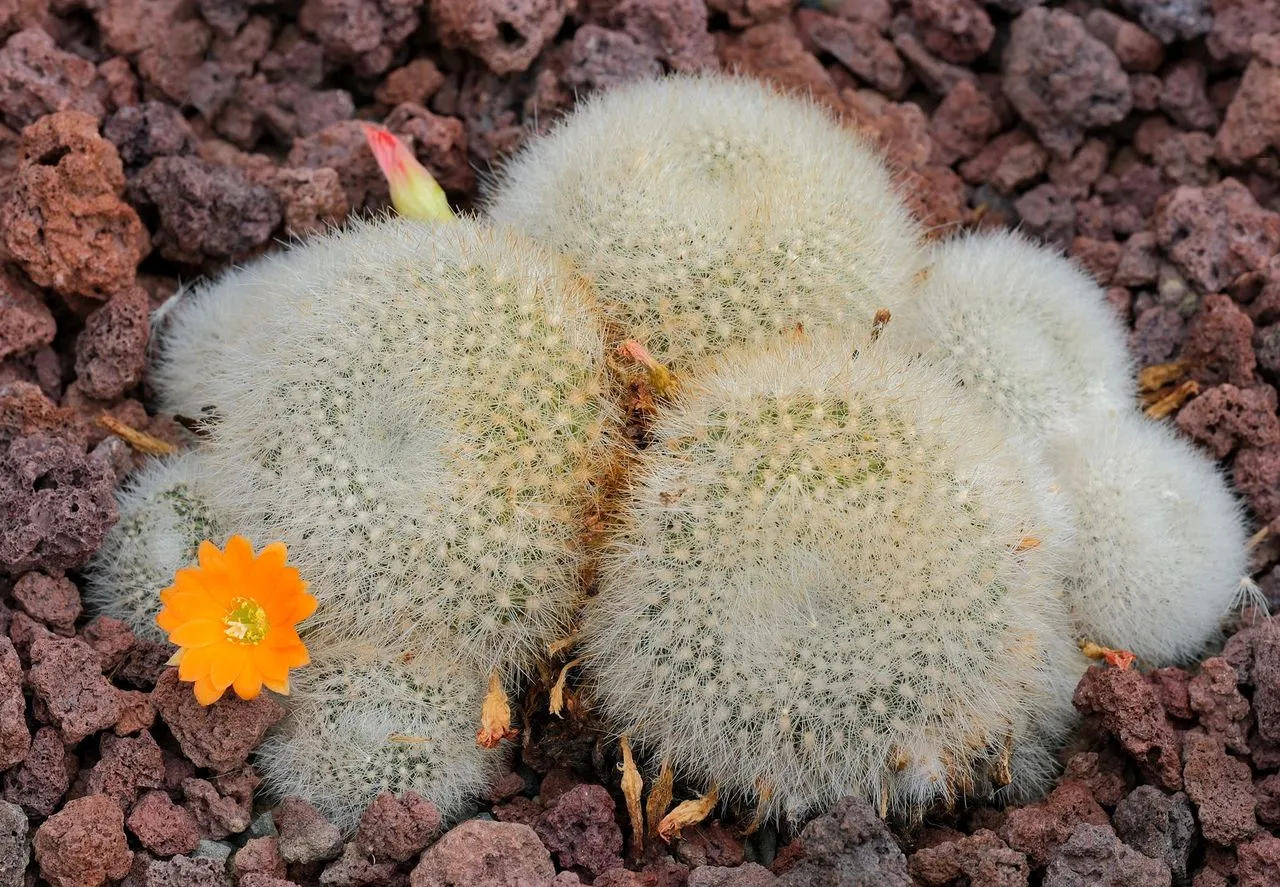
Rebutia minuscula K. Schum. was described by Karl Schumann in 1895, originally as Echinocactus minusculus, and grows on rocky high-elevation slopes between 1,200 and 2,500 m in the northern Argentine provinces of Salta and Tucumán. The diagnostic character is a cluster of 2 to 5 cm flattened-globular heads that throws a ring of bright red-orange flowers around the base of each body rather than from the apex, the lateral-basal flowering pattern that gives the species its red crown trade name.
Habitat is the eastern flank of the Andes in northern Argentina, on open rocky slopes that grade from low Yungas-edge scrub at 1,200 m up into puna grassland near 2,500 m. Plants colonise crevices and shallow gritty pockets in weathered metamorphic and sedimentary rock, often partly buried with only the disc-shaped apex exposed at the substrate line. The climate is cold and seasonally dry, with the rainy season concentrated between November and March and routine winter frosts on the higher slopes. The IUCN Red List rates R. minuscula as Least Concern with stable wild populations, and the genus Rebutia sits on CITES Appendix II, so international shipments require permits even for nursery-propagated stock.
Part of the Complete Cactus Guide.
Identification
R. minuscula is a dwarf cactus. Individual heads stay between 2 and 5 cm across at maturity, flattened-globular when seen from the side and disc-like when viewed from above. The body colour is dark green and only thinly veiled by spines: 15 to 20 short white bristly spines per areole, all radials with no obvious central, each 2 to 5 mm long and soft enough to deflect under a fingernail. The areoles sit in low spirals on roughly 18 to 25 narrow tuberculate ribs, broken into chin-like hummocks rather than continuous vertical edges. Mature plants offset prolifically from the base and form tight cushions of 10 to 30 heads after 4 to 6 years from seed.
Flowers are the diagnostic. Each bud emerges from an areole low on the body, around the basal ring or even at the substrate line, and opens as a 3 to 4 cm bright red-orange funnel with a glossy throat and a circle of yellow stamens. A floriferous plant produces 10 to 30 buds in a single ring around the body in late spring and early summer, often more flower than body visible from above. First flowering arrives at 2 to 3 years from seed, considerably faster than most cacti, and a healthy seedling reaches mature 3 to 4 cm width in roughly 3 to 4 years. The flowering position alone separates the species from most look-alikes in cultivation.
Three genera generate the bulk of the field confusion. Mammillaria dwarf species share the small globular habit and bristly spination, but flowers in Mammillaria always emerge from the apex or sub-apex in a ring of older areoles, never from a basal-lateral position; the moment you see flowers below the equator of the body, you are not looking at Mammillaria. Lobivia is the closer relative and has been repeatedly lumped or split with Rebutia over the last forty years (most modern molecular treatments now return Lobivia species to a broadened Echinopsis). The working field separator is flower size and position: Lobivia species carry larger flowers, often 5 to 9 cm across, that emerge mid-body or near the apex rather than around the base. Aylostera is the trickier case. Several species long sold as Rebutia have been transferred to Aylostera (notably the Aylostera fiebrigii group), and the floral and seed-coat characters used to split them are subtle; R. minuscula itself stays in Rebutia sensu stricto under every modern treatment, but plants labelled Rebutia in the trade are increasingly Aylostera under the new circumscription. Check the receptacle: Aylostera receptacles carry hairy areoles, while R. minuscula receptacles are nearly naked.
Cultivation
Light should be bright and direct for most of the day. A south-facing window in temperate climates, or full sun outdoors with light shading from late June through August in Mediterranean and southern Spanish settings, holds the body colour and triggers reliable bud set. Plants kept in lower light skip flowering and the body etiolates upward into a column rather than holding the disc-shaped silhouette. Outdoors in cool northern European gardens, full sun all day is fine.
Water on a deep-soak and dry cycle through the active season. Saturate the root ball, then wait until the substrate has dried to roughly two-thirds of the pot depth before the next soak; in a warm bright room that runs about 7 to 10 days for an 8 cm pan of clustered heads. Cut watering by mid October and keep the plant cool and dry through winter. The frost limit is around -7 °C dry, considerably colder than most genus relatives because the wild populations sit at elevation in a routinely freezing winter climate. Brief exposure to that range under bone-dry substrate produces no visible damage; the same temperature with damp roots will rot the plant. A cool dry rest at 0 to 8 °C between November and February is what triggers the spring flower flush, and warm winters routinely cost the following season's flowering.
Substrate must be predominantly mineral. A working mix is 70 to 80% pumice, lava grit, and coarse sand at 2 to 5 mm with 20 to 30% loam-based potting soil; the high mineral fraction matches the rocky slopes the species evolved on and prevents the dense cluster from sitting wet at the base where rot starts. Shallow pans suit the species better than deep pots since the root system stays small and lateral. Repot every 3 years in early spring, into a pan only 1 to 2 cm wider than the cluster.
Fertilising is light. A low-nitrogen cactus feed at quarter strength every 4 to 6 weeks during active growth is enough; nitrogen-heavy feeds soften the spines and produce scaly green growth that compromises winter dormancy. The general light, water, and substrate principles map onto the Beginner's Guide to Succulents, with the only adjustment for this species being the cold winter rest required for flowering.
Propagation
Two routes work reliably and a third works occasionally. Seed is the fastest practical method. Fresh R. minuscula seed is small, dark brown to black, and germinates well at 20 to 25 °C on a sterile mineral mix kept under high humidity for the first 7 to 14 days; germination rates above 80% are routine on seed less than two years old. Seedlings reach 1 cm diameter in their first year, flower from 2 to 3 years, and reach mature cluster size in 4 to 5 years.
Offset division is the most useful route once a plant has produced its first ring of pups. Detach a head with a sterile blade flush against the parent, callus the wound for 5 to 7 days in shade, and place the offset on dry mineral substrate; light watering can resume after a further week. Root strike on a healthy pup runs around 2 to 3 weeks at 22 to 25 °C, and a 2 cm offset typically reaches flowering size in 1 to 2 years.
Grafting onto Pereskiopsis spinulosa or Trichocereus pachanoi is occasionally used to compress the seedling stage to a single season, but the route is rarely necessary for a species that already flowers at 2 to 3 years on its own roots; reserve grafting for rescuing a sickly seedling or for bulk seed-grow operations.
Notes
The taxonomy moves under the species name. Recent treatments (notably Hunt and Taylor in the New Cactus Lexicon, and the molecular work of Ritz and colleagues) keep R. minuscula and a small handful of close relatives in Rebutia sensu stricto while transferring most of the larger trade group to Aylostera. Older nursery labels routinely conflate the two, and a plant sold as "Rebutia" with hairy floral tubes is most likely an Aylostera under the current concept. The species name itself is occasionally misspelled "miniscula" in trade lists; that spelling is incorrect, although several botanical databases still carry it as an alternate.
Pet safety is high. The white bristly spines are short and soft, and they will not penetrate skin or paws the way Opuntia glochids or Echinocactus centrals do. The species is non-toxic to cats and dogs, and the small cluster size makes it practical to keep on a high windowsill out of reach.
Cultivar circulation is busy. The wild form has bright red-orange flowers, but the species hybridises freely with other small Rebutia and Aylostera in cultivation, and the trade carries cultivars in pink, lilac, and yellow under the R. minuscula label. If the flower colour matters to you, buy the plant in flower or from a named-grower source.
See also
- The Complete Cactus Guide: genus context for spines, areoles, and the cold dry winter rest that frames Rebutia cultivation.
- A Beginner's Guide to Succulents: the light, water, and substrate basics that scale across a mixed cactus and succulent collection.
- Parodia magnifica — another compact South American globular cactus that benefits from cool dry winter rest and mineral drainage.
Frequently Asked Questions
Where do Rebutia flowers emerge?
Rebutia flowers usually emerge low on the body rather than only at the crown.
What winter rest suits Rebutia?
Many Rebutia prefer a dry rest around 5°C to 10°C when kept bright.
Is Rebutia good for flowers?
Yes. Rebutia are good choices for growers who want flowers without waiting twenty years.
Does Rebutia minuscula stay small?
Yes. It is a small clustering cactus rather than a large barrel or columnar species.