| Question | Short Answer |
|---|---|
| What group is Parodia magnifica in? | It belongs to Parodia, a South American cactus group that includes many former Notocactus species. |
| Where do Parodia flowers appear? | Flowers usually appear near the crown, often in yellow, orange, or red depending on species. |
| Is Parodia magnifica a desert barrel cactus? | No. |
| How should it be watered? | Water in active growth after the pot dries, then keep much drier during cool winter conditions. |
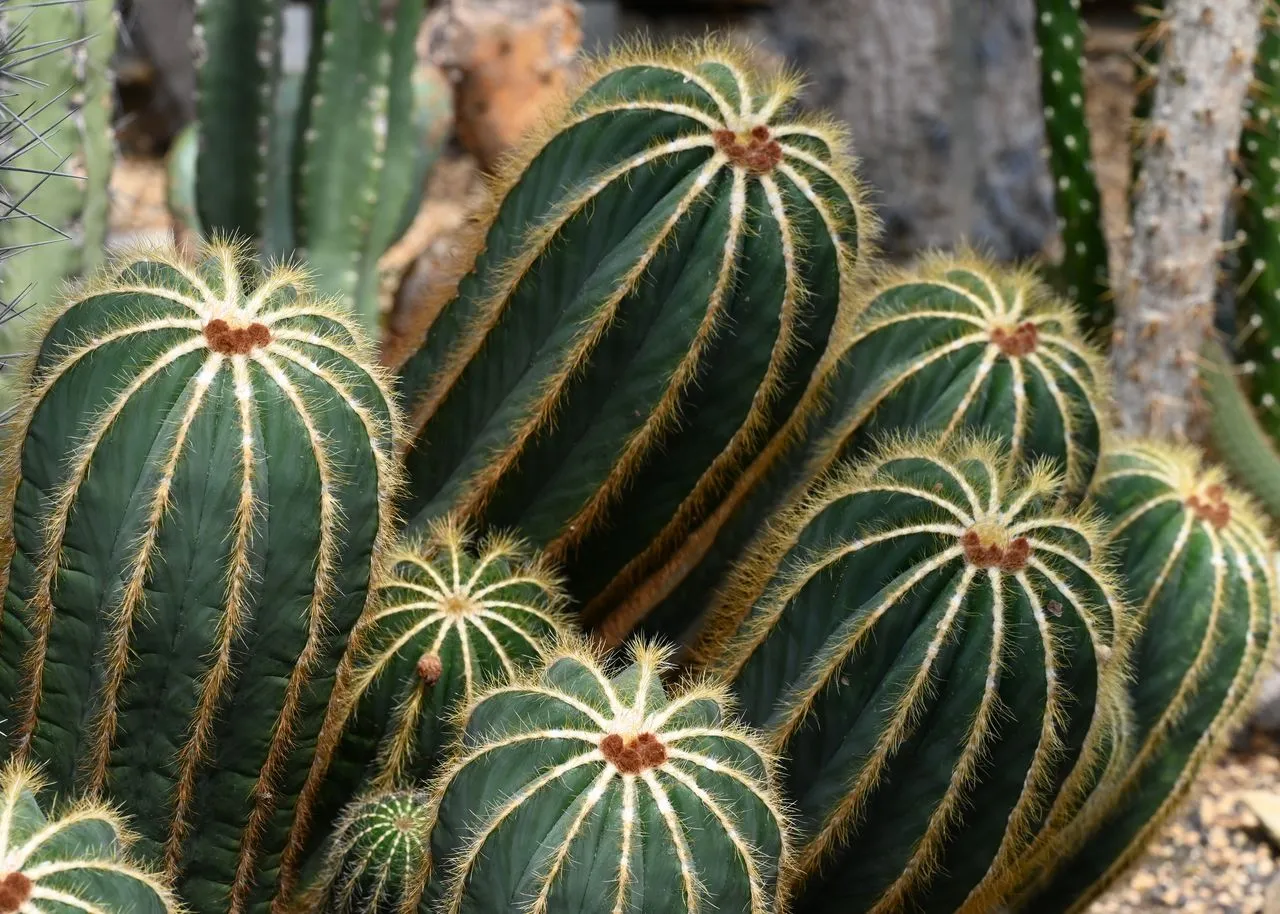
Parodia magnifica (F. Ritter) F.H. Brandt was raised to species rank in 1971, after Friedrich Ritter's earlier collections in southern Brazil; the same plant had previously circulated in the trade as Notocactus magnificus. The species is native to Rio Grande do Sul in southernmost Brazil, with disputed records crossing the border into Uruguay, and grows on grassland slopes and rocky outcrops between roughly 200 and 1,000 m. The diagnostic feature is a short, glaucous blue-green body carrying 11 to 15 prominent vertical ribs whose deep notches give the plant the segmented silhouette behind its trade name, the balloon cactus.
Habitat is open, sun-exposed terrain on the Serra do Sudeste of southern Rio Grande do Sul, with cool wet winters that dip toward freezing and warm humid summers. Plants colonise rock crevices and shallow gritty pockets between fissured gneiss and sandstone, often alongside Frailea species and small terrestrial bromeliads. Rainfall is year-round but roots stay quickly drained because there is little soil column to hold water; the rib geometry pleats and contracts with each wet-dry cycle, an accordion form of drought storage that lets the body shrink when the rock pocket runs dry. The species is not currently flagged as threatened on the IUCN Red List, but the genus Parodia sits on CITES Appendix II, so international shipments require permits even for ordinary trade forms. Wild populations are protected under Brazilian law; nursery-propagated stock is widely available and is the only ethical source for collectors.
Part of the Complete Cactus Guide.
Identification
P. magnifica is globular when juvenile and slowly elongates with age, reaching 30 to 40 cm tall and 8 to 15 cm wide on a mature plant after roughly 12 to 18 years. The body colour is the first thing you notice. A clean glaucous blue-green stem with a slight waxy bloom sets it apart from almost every other Parodia in cultivation, most of which run a flatter green or are concealed under dense spines. The 11 to 15 ribs are sharper and far more prominent than on most species in the genus, deeply notched between rather than rounded; this rib geometry is the single most reliable field character. Areoles sit on the rib crests at intervals of roughly 1 cm, each carrying a small tuft of yellow-white wool and 5 to 7 weak, pale yellow spines that stay short, around 0.5 to 1 cm. The spines are flexible to the touch rather than stiff like Echinocactus centrals, and they do not cover the body in any meaningful sense. The blue-green stem is the visual mass of the plant.
Flowers emerge from the woolly apex throughout summer. Each bud opens as a 3 to 4 cm bright golden-yellow funnel, glossy and broad, often three or four at once around a single ring of areoles. First flowering arrives at about 8 to 10 years from seed, slightly earlier than in P. leninghausii, and the plant continues to bloom in successive flushes from late spring into early autumn under good conditions. Mature plants offset prolifically from the base, producing dense clumps of 5 to 15 heads after 15 to 20 years. This clumping habit is more pronounced than in P. leninghausii, which tends to grow as a tall solitary or sparingly branched column.
The closest look-alike in cultivation is P. leninghausii. The two are easy to separate once you know the cues. P. leninghausii has roughly 30 narrow rounded ribs and a dense soft golden bristle cover that turns the entire body the colour of a ripening lemon; it grows as a tall yellow column to 50 or 80 cm. P. magnifica has 11 to 15 sharply prominent ribs, a glaucous blue-green body that shows clearly between the few short pale spines, and a squat globular habit that rarely climbs past 40 cm. The "Notocactus" trade label is the other source of confusion. The genus Notocactus was largely subsumed into a broadened Parodia in 1987 by Hofacker, so plants labelled Notocactus magnificus in older nurseries are exactly the same species as P. magnifica; no taxonomic change is needed when you bring one home, only a label edit.
Cultivation
Light should be bright with several hours of direct sun, but not the unfiltered noon exposure that the body's wax bloom suggests it can take. A south- or south-east-facing window with light shading from late June through August holds the rib colour and prevents the apex from corking. Outdoors, morning sun and bright afternoon shade is the working compromise. In cool northern European homes, full sun all day is fine; in southern Spain or the southern United States, plan on 30 to 50% shade cloth across midsummer.
Water on a deep-soak and dry cycle through the active season. Saturate the root ball, then wait until the substrate has dried to roughly two-thirds of the pot depth before the next soak; in a warm bright room that runs about 8 to 14 days for a 12 cm pot. Cut watering by mid October and keep the plant cool and dry through winter. Frost limit is around -3 °C dry. Brief exposure to that range under bone-dry substrate produces only cosmetic rib-edge browning, while the same temperature with damp roots reliably triggers basal rot. A cool dry rest at 5 to 10 °C between November and March is what triggers the following season's flower buds; plants kept warm through winter often skip a flowering year altogether.
Substrate must be predominantly mineral. A working mix is 60 to 70% pumice, lava grit, and coarse sand at 3 to 6 mm with 30 to 40% loam-based potting soil; push to 80% mineral if you grow in a humid climate or under glass with poor airflow. Plastic pots suit dry indoor culture. Terracotta is better in humid greenhouses where root drying is slow. Repot every 2 to 3 years in early spring before active growth begins, into a pot only 1 to 2 cm wider than the root ball. P. magnifica dislikes oversized pots and will sulk for a season after a step too large.
Fertilising is light. A low-nitrogen cactus feed at quarter strength every 4 to 6 weeks during active growth is enough; nitrogen-heavy feeds soften the rib geometry and produce a pale apex that compromises winter dormancy. The general light, water, and substrate principles map onto the Beginner's Guide to Succulents, with the only adjustment for this species being a slightly cooler and drier winter rest than the average mixed-collection succulent will need.
Propagation
Two routes work reliably. Seed is the standard method for new plants. Fresh P. magnifica seed is small, glossy black, and germinates well at 22 to 26 °C on a sterile mineral mix kept under high humidity for the first 10 to 14 days. Germination rates above 70% are routine on seed less than two years old; older seed drops sharply. Seedlings grow slowly on their own roots and reach 3 cm diameter in about 2 to 3 years, slightly faster than P. leninghausii under the same conditions. Some growers graft very young seedlings onto Pereskiopsis spinulosa for the first one or two seasons to compress that timeline, then de-graft once the root system is large enough to support the plant unaided.
Offset division is more useful here than in many Parodia because of the prolific clumping habit. Once a basal pup has produced its own areolar circle and reached at least 2 cm across, detach with a sterile blade flush against the parent, callus the wound for 7 to 10 days in shade, and place the offset on dry mineral substrate; light watering can resume after a further week. Root strike on a healthy pup runs around 3 to 4 weeks at 22 to 25 °C, and a 4 cm offset typically reaches flowering size in 3 to 5 years.
Notes
The "Notocactus" label still dominates retail in some markets. Plants imported through European wholesale channels in the 1990s and 2000s often still carry their original Notocactus magnificus tag, and many online sellers reuse the older name because it returns more search hits than the current binomial. The taxonomy is settled: Plants of the World Online, the IOS, and the New Cactus Lexicon all treat N. magnificus as a synonym of P. magnifica. Normalise your collection labels to the current name if you keep records.
Trade pressure on the species sits in an unusual place. Nursery-propagated P. magnifica is one of the most widely available Parodia in the trade, sold cheaply at every garden centre. Wild populations are protected under Brazilian law and CITES Appendix II rules apply to international shipments; field-collected plants surface occasionally in unscrupulous online listings and should be refused. Asking a seller whether stock is seed-grown or vegetatively propagated from a known mother is a reasonable question, and a serious cactus nursery will answer it without hesitation.
Pet safety is moderate. The pale spines are short and weak compared with most cacti, and they will not puncture skin the way Opuntia glochids or Echinocactus centrals do, but a curious cat or dog can still pick up irritating splinters from a rolled body. Keep the plant out of reach in pet-occupied rooms.
See also
- The Complete Cactus Guide: the genus-wide context for ribs, areoles, and the winter-rest rules that frame Parodia cultivation.
- A Beginner's Guide to Succulents: the light, water, and substrate basics that scale across a mixed cactus and succulent collection.
- Parodia leninghausii — the closest look-alike, a tall golden-bristled column contrasting sharply with P. magnifica's squat ribbed globe.
Frequently Asked Questions
What group is Parodia magnifica in?
It belongs to Parodia, a South American cactus group that includes many former Notocactus species.
Where do Parodia flowers appear?
Flowers usually appear near the crown, often in yellow, orange, or red depending on species.
Is Parodia magnifica a desert barrel cactus?
No. It needs bright light but generally appreciates more protection from extreme heat than true desert barrels.
How should it be watered?
Water in active growth after the pot dries, then keep much drier during cool winter conditions.