| Question | Short Answer |
|---|---|
| What was Parodia leninghausii formerly called? | Many Parodia species in cultivation were formerly placed in Notocactus. |
| What flowers does Parodia often produce? | Parodia species often flower young, with yellow, orange, or red blooms near the crown. |
| Does Parodia need extreme desert heat? | No. |
| What is the main winter risk? | Cold wet roots are the main risk and can cause rot. |
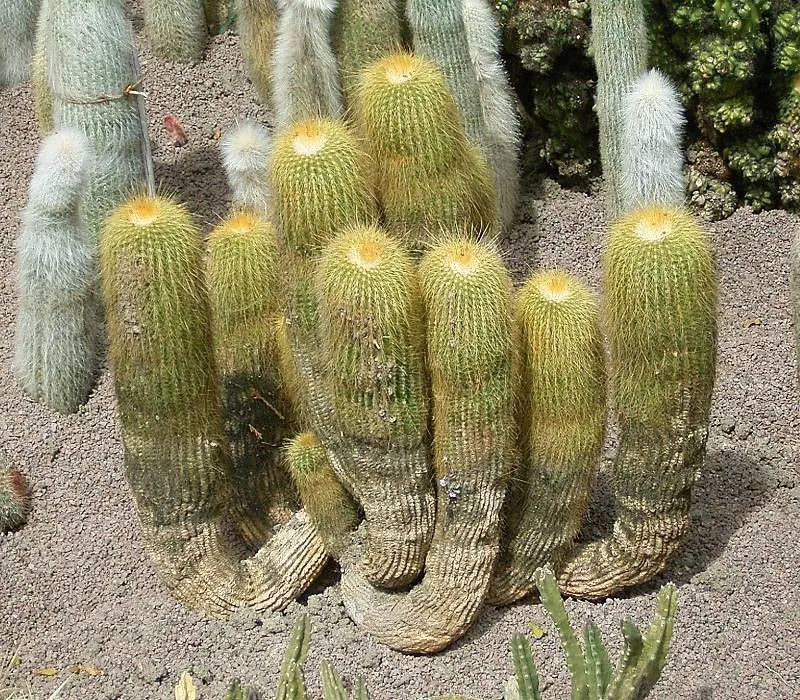
Parodia leninghausii (F. Haage) F.H. Brandt ex Eggli & Hofacker is a southern Brazilian cactus from Rio Grande do Sul, where it grows on rocky outcrops between roughly 200 and 800 m. The species was first described by Friedrich Adolph Haage as Pilocereus leninghausii, transferred to Echinocactus by Karl Schumann, and for decades circulated in the trade as Eriocactus leninghausii and then Notocactus leninghausii before molecular work in the 1990s collapsed Notocactus, Eriocactus, Brasilicactus, and several smaller genera into a broadened Parodia. Garden labels still lag the taxonomy, which is why a young plant bought as "Notocactus leninghausii" is exactly the same species as one sold as "yellow tower". The defining feature is a dense covering of soft, almost golden-yellow bristly spines that turns the entire body the colour of a ripening lemon.
Habitat is open, sun-exposed gneiss and sandstone outcrops in the Pampa biome of southernmost Brazil, with cool wet winters that drop to a few degrees above freezing and warm humid summers. Plants grow lodged in rock fissures with shallow gritty mineral soil, often in the company of Frailea and small terrestrial bromeliads. Rainfall is year-round but well drained at the root, and atmospheric humidity stays high enough that the spine cover takes on a slightly translucent quality when wet. The species is not currently flagged on the IUCN Red List as threatened, though Parodia as a whole sits on CITES Appendix II, so international shipments require paperwork even for ordinary forms.
Part of the Complete Cactus Guide.
Identification
P. leninghausii is globular when young and slowly elongates with age, reaching 50 to 80 cm tall and 10 to 15 cm in diameter on a mature plant after 15 to 20 years; the columnar habit is what earns it the "yellow tower" common name once it climbs past 30 cm. The body bears about 30 narrow ribs, low and rounded, sometimes slightly twisted at the apex of older stems. Each areole carries 8 to 12 fine hair-like radial spines and 3 to 4 stouter centrals; all are flexible to the touch and pale lemon-yellow ageing to a duskier honey colour at the base of the plant. The spine cover is the diagnostic feature. No other commonly grown Parodia combines this density, softness, and golden tone.
Mature plants flower from the apex in late spring through summer. Buds emerge from a tuft of yellow wool at the crown and open as 4 to 5 cm wide, glossy lemon-yellow flowers with a satin sheen, often several at once around a single ring of areoles. First flowering arrives late, around 10 years from seed, and the plant has to be at least 10 to 15 cm tall before the apex matures enough to bloom. Older clumps offset slowly from the base, giving the cluster-forming look that nursery photos rarely show on retail-age stock.
Three look-alikes recur in cultivation. Parodia magnifica (F. Ritter) F.H. Brandt has a strongly bluish-grey body with a sharper white-grey wax bloom and a few stiff yellow spines per areole rather than the dense soft golden cover of P. leninghausii; it also flowers more sparingly and stays squatter in habit. The wider "Notocactus" tag in older nurseries usually points to a Parodia in modern terms, since the old genus Notocactus was largely absorbed into Parodia in 1987 by Hofacker; a plant labelled N. leninghausii is P. leninghausii, but plants labelled N. mammulosus, N. ottonis, N. magnificus, and so on are all now Parodia too. Rebutia species, sometimes shelved next to lemon balls in mixed cactus assortments, stay much smaller (5 to 10 cm globose), have very different brightly coloured flowers low on the body, and never develop the soft golden bristle cover.
The crested form P. leninghausii f. cristata is widely circulated in the trade, recognised by a fan-shaped or convoluted apex carrying the same yellow spine cover. Crests are vegetative selections; they propagate from cuttings, not seed, and are often grafted onto a faster rootstock to stabilise growth.
Cultivation
Light should be bright with some direct sun, though the spine cover does not protect a thin-skinned body from a Mediterranean July as well as it looks like it should. A south-facing window with light shading from late June through August, or an outdoor position with morning sun and bright afternoon shade, holds the gold spine colour without scorching the green tissue underneath. In cool northern European homes, full sun all day is fine; in Andalusia or Texas, plan on shade cloth at the height of summer.
Water on a deep-soak and dry cycle from spring to early autumn. Saturate the root ball, then wait until the substrate has dried to about two-thirds of the pot depth; in a warm bright room that is typically 7 to 12 days for a 12 cm pot. Stop watering by mid October and keep the plant cool and dry through winter. Frost limit is around 0 °C dry; brief exposure to freezing under dry substrate causes only cosmetic spine browning, while wet roots at 2 to 5 °C reliably trigger basal rot. A cool dry rest at 5 to 10 °C between November and March is what triggers the following season's flower buds.
Substrate should be predominantly mineral. A working mix is 60 to 70% pumice, lava grit, and coarse sand at 3 to 6 mm with 30 to 40% loam-based potting soil; push closer to 80% mineral if you grow in a humid climate. Plastic pots suit dry homes; terracotta suits humid greenhouses. Repot every 2 to 3 years in early spring before active growth begins, into a pot only 1 to 2 cm wider than the root ball.
Fertilising is light. A low-nitrogen cactus feed at quarter strength every 4 to 6 weeks during active growth is enough; nitrogen-rich feeds produce a soft pale apex and flabby ribs that compromise winter dormancy. The general light, water, and substrate principles align with the Beginner's Guide to Succulents.
Propagation
Seed is the standard route. Fresh P. leninghausii seed is small, glossy black, and germinates well at 22 to 26 °C on a sterile mineral mix kept under high humidity for the first 10 to 14 days. Germination rates over 70% are routine on seed less than two years old; older seed drops off sharply. Seedlings grow slowly on their own roots and reach 3 cm diameter in about 3 years; some growers graft very young seedlings onto Pereskiopsis spinulosa for the first two seasons to compress that timeline, then de-graft once the root system is large enough to support the plant unaided.
Offset division is possible on older clumps. Where basal pups have produced their own areolar circle and reached at least 2 cm across, detach with a sterile blade, callus the wound for 7 to 10 days in shade, and place the offset on dry mineral substrate; light watering can resume after a further week. Root strike on a healthy pup runs around 3 to 4 weeks at 22 to 25 °C.
The crested form propagates only by graft or by careful removal of a cresting section followed by rooting on its own callus. Graft success on Trichocereus pachanoi runs high; on Hylocereus undatus the same scion grows faster but the rootstock is shorter-lived in dry conditions, so plan on regrafting every 5 to 8 years if you want to keep a particular crest line going long term.
Notes
The "Notocactus" trade label sticks. Plants imported from European nurseries through the 1990s and 2000s often still carry their original Notocactus leninghausii tag, and online sellers reuse the older name because it returns more search hits. The plant is the same. If you are building a labelled collection, it is worth normalising your tags to the current Parodia binomial; the synonymy is fully accepted across major databases (Plants of the World Online, the IOS, the New Cactus Lexicon).
Pet safety is a softer question than for most cacti. The bristle-like spines are not stiff enough to puncture a curious cat or dog the way Opuntia glochids or Echinocactus centrals do, but they will lodge as irritating splinters and can be slow to extract from a furred muzzle. Treat the plant as an out-of-reach subject in cat-occupied rooms even if it looks deceptively soft.
See also
- The Complete Cactus Guide: the genus-wide context for areoles, ribs, and the winter-rest rules that frame Parodia cultivation.
- A Beginner's Guide to Succulents: the light, water, and substrate basics that scale across a mixed cactus and succulent collection.
- Parodia magnifica — compact blue-green relative contrasting sharply with the tall golden column of P. leninghausii.
Frequently Asked Questions
What was Parodia leninghausii formerly called?
Many Parodia species in cultivation were formerly placed in Notocactus.
What flowers does Parodia often produce?
Parodia species often flower young, with yellow, orange, or red blooms near the crown.
Does Parodia need extreme desert heat?
No. It prefers bright light but often needs more protection from extreme heat than true desert barrels.
What is the main winter risk?
Cold wet roots are the main risk and can cause rot.