| Question | Short Answer |
|---|---|
| Where are Gymnocalycium species from? | The genus contains compact South American cacti from Argentina, Paraguay, Bolivia, and Brazil. |
| What bud feature identifies Gymnocalycium? | The flower buds are smooth and scaly rather than woolly, which is a useful genus character. |
| Does Gymnocalycium baldianum need full desert sun? | Not usually. |
| How should it be watered? | Water in active growth after the pot has dried, then reduce water during cool rest. |
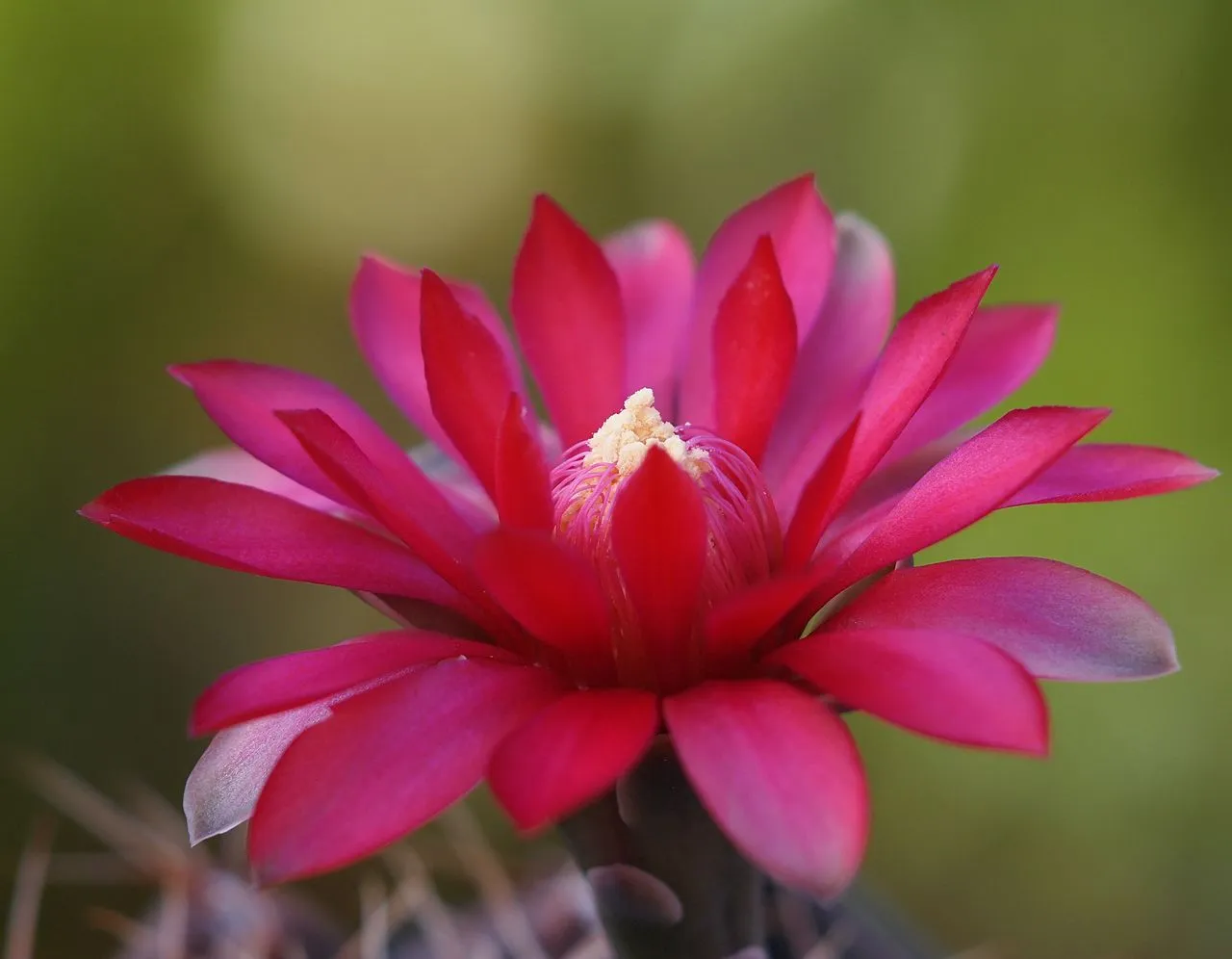
Gymnocalycium baldianum (Speg.) Speg. is a small, flattened-globular cactus from the dry mountain slopes of north-central Argentina, first described by Carlos Luis Spegazzini in 1925 as Echinocactus baldianum and transferred by Spegazzini himself into Gymnocalycium, the genus he had erected six years earlier. The plant is known in the trade as the spider cactus, after the radial-spreading pattern of short curved reddish-brown spines that splay across each rib like crooked legs. Its calling card, though, is the flower: a deep magenta to blood-red purple bloom that opens at the apex in spring and is produced earlier and more reliably than in almost any other Gymnocalycium, often by the third year from seed.
In habitat G. baldianum grows on sunny, granitic slopes in the Argentine provinces of Catamarca and Córdoba, on the Sierras de Córdoba, the Sierra de Ancasti, and adjoining ranges between roughly 500 and 1,500 m. Plants sit wedged between rocks or sheltered by bunchgrasses, on coarse free-draining substrates low in organic matter that stay dry for most of the year. The climate is summer-monsoonal: a brief warm rain pulse from December to February, then a long cold dry winter where night temperatures regularly drop below freezing for short spells. The IUCN Red List rates the species as Least Concern; populations are localised but the species is not under direct collecting pressure, since trade demand is met entirely from nursery seed. Gymnocalycium as a whole sits on CITES Appendix II, so cross-border shipment of plants requires paperwork even for ordinary seed-grown stock.
Part of the Complete Cactus Guide.
Identification
A mature solitary head of G. baldianum is 5 to 10 cm in diameter and 3 to 6 cm tall, broader than it is high, with a slightly depressed apex. The body is dark grey-green to blue-green, sometimes tinged dusky purple in plants grown hard, and carries 9 to 11 broad, low, rounded ribs separated by shallow furrows. Each rib is broken into chin-shaped tubercles below the areoles, the diagnostic Gymnocalycium feature that gives the genus its English name, chin cactus. The skin has a faint waxy bloom, more pronounced on plants kept dry and bright.
Areoles sit on the chin below each tubercle and bear 5 to 7 short, curved, spreading radial spines, typically 4 to 8 mm long, reddish-brown when young and weathering to grey. Central spines are absent. The whole spine cluster lies pressed close to the body and radiates outward, producing the spider-leg pattern that the common name describes. The bud, like all Gymnocalycium, is naked of wool and bristles, with smooth scaly bracts; the genus name itself means "naked calyx", and this character is one of the easiest to use at the bench.
Flowers open in spring, typically late April through early June in the northern hemisphere, often with a second flush in late summer. Each is 3 to 4.5 cm across with a short funnel-shaped tube and a magenta to deep purple-red interior; the colour holds for two to four days per flower and is unmistakeable in a tray of mixed Gymnocalycium. Seed is fine and black, set readily on hand-pollination between two genetically distinct plants. Some clones are partially self-fertile, but cross-pollination produces fuller pods.
Three siblings recur in cultivation. Gymnocalycium mihanovichii (Frič ex Gürke) Britton & Rose has only 8 ribs, paler grey-green to brown-purple skin with horizontal banding, smaller flowers (3 to 4 cm) in white to pale pink, and almost never appears in the houseplant trade in its wild form because its place is taken by chlorophyll-deficient grafted moon cacti. The flower colour alone is decisive: a magenta-red bloom rules out G. mihanovichii. Gymnocalycium friedrichii Pažout, originally described as a variety of G. mihanovichii and treated by some authors as a separate species, sits closer in body to mihanovichii than to baldianum, with stronger horizontal banding, more pronounced ribs, and pale pink to whitish flowers; older European catalogues sometimes muddle the three, and pinning down rib count, spine colour, and flower colour resolves the question on a single plant. Gymnocalycium andreae (Boed.) Backeb. is the only other commonly grown small Gymnocalycium with bright flowers, but its blooms are sulphur-yellow and its body is darker green with longer pale spines.
Cultivation
G. baldianum is one of the more straightforward Gymnocalycium species in cultivation, partly because it is so reliably bloomable and partly because its montane origin gives it real frost tolerance dry. Treat it as a small Argentine highland cactus rather than a hot-desert species and very little goes wrong.
Light should be bright but filtered. Plants grown under unbuffered summer sun in southern Spain or Arizona scorch on the south-facing flank, leaving permanent pale patches that the body cannot heal over. An east-facing window indoors, an unobstructed south-facing window behind a sheer curtain, or outdoor placement with morning sun and afternoon shade gives a balanced 6 to 8 hours of bright light without burn. Bodies grown a touch hard, on slightly leaner light and a tighter water regime, develop a deeper purple-grey flush and tighter spine clusters.
Water on a deep-soak and dry cycle through the growing season. From early April to late September, saturate the root ball, then wait until the lower half of a 9 cm pot is bone dry before watering again; in a warm, bright room that is generally 7 to 12 days. The body firms and rounds visibly within hours of a good soak, and a soft, slightly sunken apex tells you the next watering is overdue. From mid-October through March, keep the plant fully dry in a cool bright spot. G. baldianum tolerates short dry-rooted dips to about minus 5 °C (23 °F) in habitat winters and in unheated alpine houses, well below the limit of G. mihanovichii; flowering is heavier the following spring after a genuine cold dry rest at 2 to 8 °C between November and February. Wet roots below 5 °C, on the other hand, are how plants are lost.
Substrate should be predominantly mineral. A working mix is 65 to 75% pumice and crushed grit at 3 to 6 mm with 25 to 35% loam-based potting soil, moved closer to 80% mineral if your watering hand is heavy or your winters are damp. The pot should be only 1 to 2 cm wider than the root ball; G. baldianum has fine fibrous roots and resents oversized pots, which stay wet too long after each soak. Terracotta dries quickly and suits humid climates; plastic suits hot dry climates if the watering interval is stretched. A drainage hole is non-negotiable.
Feed lightly during active growth. A low-nitrogen cactus fertiliser at quarter strength every 4 to 6 weeks, applied after watering, supports flowering without forcing soft etiolated growth. The general light, water, and substrate principles match those covered in the Beginner's Guide to Succulents.
Propagation
Seed is the standard route, and G. baldianum is one of the kindest Gymnocalycium to raise this way. Fresh seed germinates at 22 to 28 °C on a sterile fine mineral mix kept under high humidity, with cotyledons emerging in 6 to 12 days at typical room conditions. Germination rates of 70 to 85% on fresh seed are normal for the species. Seedlings spike to first true tubercles within four to six weeks, and on their own roots will reach 2.5 to 3 cm and first flower at around three years from sowing, sometimes earlier on temporary Pereskiopsis spinulosa grafts that are removed once the body can root down.
Offset division is occasionally available on older plants. G. baldianum clusters lazily, but established collection specimens 15 cm or more across will sometimes throw basal pups. Detach with a sterile blade once the offset is at least 1.5 cm in diameter, callus the cut for 5 to 7 days in dry shade, then place the pup on dry mineral substrate and begin light watering after a further 7 to 10 days. Rooting takes 4 to 8 weeks; success rates run 70 to 90% on healthy pups.
Crown cuttings are not normally used. The body is small enough that beheading rarely produces a clean recovered apex on the original stock, and seed is so quick that the calculation rarely favours surgery. The exception is rescue: a plant with basal rot can have its healthy crown cut above the damage, callused, and grafted onto a sturdier rootstock such as Trichocereus pachanoi until it can be rooted down again.
Notes
G. baldianum circulates under several form and varietal names: 'albiflorum' for occasional white-flowered selections, 'venturianum' and 'sanguiniflorum' for older synonyms once treated as separate species. Most plants in trade, though, are species-typical magenta-flowered seedlings from European, Czech, and Japanese specialist growers, with no meaningful demand for wild-collected material at commercial volumes.
Pest pressure is unremarkable. Mealybug above the soil line and root mealybug below it are the two issues you will actually see, both controlled by inspecting the rootball at every repot and treating with imidacloprid drench or spirotetramat where local regulations allow. Watch for body scarring on plants moved suddenly into stronger light, since corked patches do not recover. The species is non-toxic to cats and dogs, and the short curved spines are a nuisance rather than a hazard.
See also
- The Complete Cactus Guide: family-wide context for areoles, ribs, mineral substrate, and the cold dry winter rest that triggers flowering in Gymnocalycium.
- Gymnocalycium mihanovichii (Moon / Ruby Ball Cactus): the closest sibling in trade, where chlorophyll-deficient grafted moon cacti dominate the market and the wild type is rarely seen.
- A Beginner's Guide to Succulents: the broader light, water, and substrate framework into which a G. baldianum plant slots.
Frequently Asked Questions
Where are Gymnocalycium species from?
The genus contains compact South American cacti from Argentina, Paraguay, Bolivia, and Brazil.
What bud feature identifies Gymnocalycium?
The flower buds are smooth and scaly rather than woolly, which is a useful genus character.
Does Gymnocalycium baldianum need full desert sun?
Not usually. Many Gymnocalycium tolerate slightly less intense sun, with afternoon shade useful in hot climates.
How should it be watered?
Water in active growth after the pot has dried, then reduce water during cool rest.