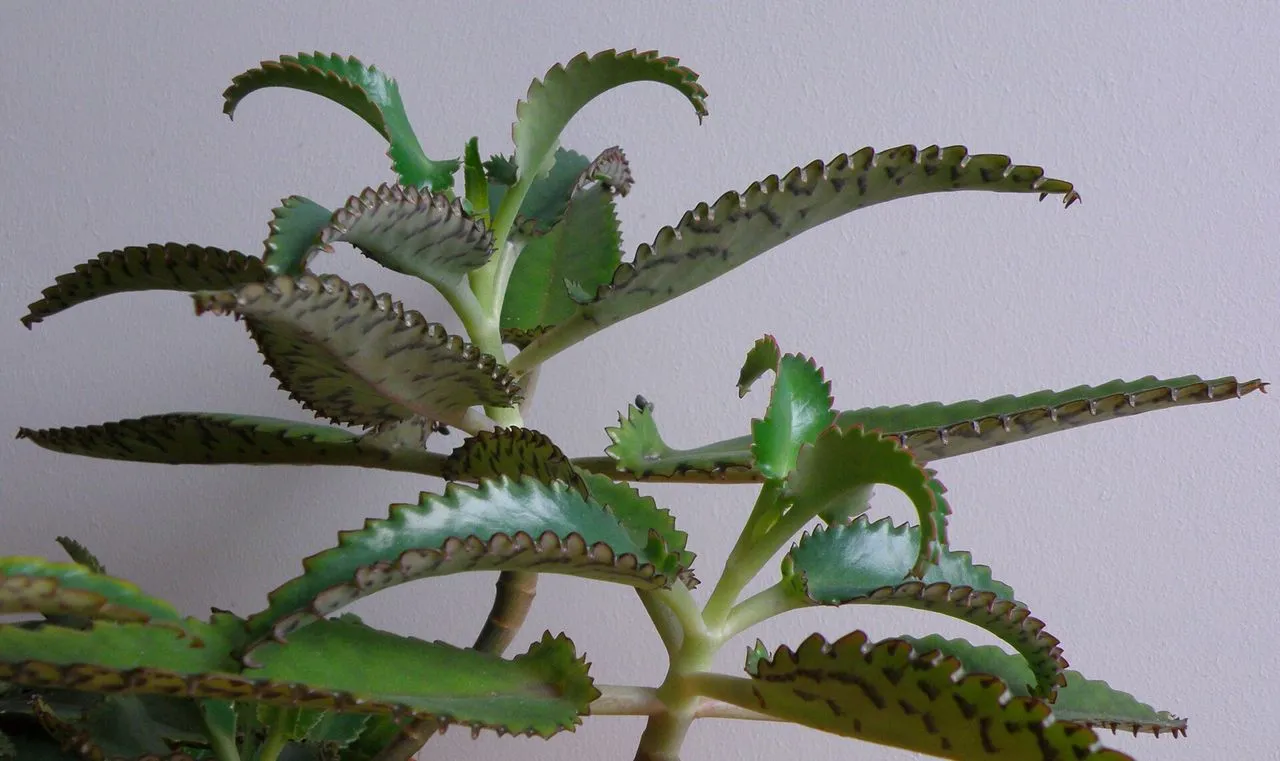
Kalanchoe is a genus of about 125 accepted species of leaf-succulent perennials, subshrubs, and soft-wooded shrubs in the family Crassulaceae. The Plants of the World Online checklist maintained by the Royal Botanic Gardens, Kew accepts the genus Kalanchoe Adans., centred on Madagascar with secondary diversity across tropical Africa and southeast Asia as far as southern China. Two formerly segregated genera, Bryophyllum and Kitchingia, are now sunk into Kalanchoe on the basis of molecular phylogenetic data; you will still see the old names on nursery labels, and knowing the synonymy matters in practice. This guide covers what you need to know to identify, grow, and propagate them, and where to go for species-specific detail.
I'm Dr. Elena Martín, a Certified Advanced Cactus & Succulent Horticulturist and former curator of the succulent collection at the Jardín Botánico de Córdoba. Most of what follows comes directly from what I've seen work (and fail) in cultivation across Mediterranean and temperate climates over the last decade.
Taxonomy and Natural Range
The genus was established by Michel Adanson in 1763. Roughly three-quarters of accepted species are endemic to Madagascar, with a strong secondary centre of diversity in east and southern Africa and outlying species through Arabia, India, and southeast Asia. One species, K. pinnata, has naturalised pantropically and is treated as invasive in parts of Florida, Hawaii, Australia, and the Canary Islands.
The synonymy is worth stating plainly. Bryophyllum Salisb. was described in 1805 for species that produce plantlets on their leaf margins. Kitchingia Baker (1881) covered a small group with pendulous bell-shaped flowers. Both are now embedded within Kalanchoe as subgenera or sections, based on several independent molecular studies since the early 2000s. If a plant is sold as Bryophyllum daigremontianum, it is Kalanchoe daigremontiana. The horticultural trade is slow to update.
Most Kalanchoe in the wild occupy seasonally dry tropical habitats: rocky outcrops, open scrub, and thin-soil slopes with a pronounced wet-dry cycle. They are not true desert plants. The majority flower in response to shortening day length, a photoperiodic trait that has major consequences for cultivation (see Light, below).
Identification and Morphology
Kalanchoe share several diagnostic features that separate them from the other common Crassulaceae genera you will meet in collections.
- Leaf arrangement. Leaves are opposite and decussate (each pair rotated 90° from the last). This is the single most useful field character. Echeveria, Sedum, and Crassula do not share it reliably. A young Kalanchoe seedling with two pairs of leaves at right angles is immediately recognisable.
- Leaf form. Varies enormously. Flat and fleshy in K. blossfeldiana; densely tomentose and silver in K. tomentosa; paddle-shaped in K. thyrsiflora and K. luciae; tubular and chandelier-like in K. delagoensis; pinnate in K. pinnata.
- Inflorescence. A terminal corymbose panicle (sometimes a thyrse) bearing four-merous flowers. Corolla is tubular or urceolate, with four lobes. This four-part flower plan separates Kalanchoe from the five-parted Echeveria, Sedum, and Sempervivum.
- Bulbiliferous leaves. Species in the old Bryophyllum group (K. daigremontiana, K. delagoensis, K. pinnata, K. laetivirens) produce asexual plantlets (bulbils) along the leaf margins or at the notches between leaflets. When these drop, they root on contact with moist substrate. This is diagnostic for that group and has no equivalent in other Crassulaceae.
For species-level identification, see the cultivar pages linked later.
Cultivation
Light
Kalanchoe want bright light. For most species, 4–6 hours of direct sun daily plus bright ambient light is adequate; they will take full sun outdoors after hardening off. K. tomentosa and K. orgyalis colour best with several hours of direct sun. K. blossfeldiana under chronic low light stretches, flowers poorly, and drops buds.
There is a second light consideration specific to this genus: photoperiod. Kalanchoe blossfeldiana and a number of other species are obligate short-day plants. They initiate flower buds only when the uninterrupted dark period exceeds roughly 13–14 hours per 24 hours. In practical terms, to rebloom a K. blossfeldiana at home you need to give it 14 hours of complete darkness per night for 6–8 consecutive weeks, typically in autumn. A bedroom closet or a cupboard works; a room where a light switches on briefly at 11pm does not. This is why commercial florist kalanchoes bloom once and then never again in most homes, and why that failure is not your cultivation fault. See Kalanchoe blossfeldiana for the full reblooming protocol.
Substrate
A free-draining mineral-rich mix. My working recipe is 40% pumice or perlite, 30% coarse grit (3–5 mm), and 30% peat-free loam-based compost (John Innes No. 2 or equivalent). Kalanchoe tolerate slightly richer substrate than most other succulents because many come from habitats with thin but organic-influenced soils on rocky slopes. Straight pure-mineral mixes work but will require more frequent feeding.
pH preference is neutral to slightly alkaline (6.5–7.5). Hard tap water is generally tolerated better here than in Echeveria or Aloe.
Water
Water thoroughly when the top 2–3 cm of substrate reads dry on a moisture meter. In active summer growth that may be every 7–10 days outdoors; in cool winter conditions it can stretch to every 4–6 weeks. Always water until it exits the drainage holes, then discard any saucer runoff within 30 minutes.
Kalanchoe are somewhat more forgiving of occasional overwatering than Echeveria, but persistently wet substrate still kills them. The failure mode is a soft rot at the stem base that advances upward faster than you would expect, often within 5–7 days from first visible symptom to plant loss.
Do not water the foliage of K. tomentosa or other tomentose species. Water trapped in the leaf hairs encourages a characteristic black fungal spotting that does not come off.
Temperature
Most cultivated species thrive between 15°C and 30°C. They are not frost-hardy. K. blossfeldiana shows chilling injury below about 7°C; other species vary, but treat 5°C as a floor for all of them. Above 32°C growth slows and flowering may abort. A brief exposure to −1°C is fatal for most of the genus.
Humidity
Ambient humidity of 40%–60% is ideal. Higher humidity combined with poor air movement is the primary driver of powdery mildew in cultivation (see Common Problems). Do not mist these plants. The waxy or tomentose leaf surfaces shed applied water, which then collects and rots tissue at leaf axils.
Propagation
Kalanchoe are among the most easily propagated succulents in cultivation. Three methods cover virtually the whole genus.
Stem cuttings
The default method for shrubby and upright species (K. blossfeldiana, K. fedtschenkoi, K. tomentosa, K. thyrsiflora, K. luciae). Take a 5–10 cm tip cutting with 2–4 pairs of leaves using a sterile blade. Strip the lower pair. Callus the cut for 2–4 days in shade. Pot into the standard substrate, water sparingly, and keep warm (20°C–25°C) and bright but out of direct sun. Roots form within 10–21 days. Established plants flower the following season.
Leaf cuttings
Works reliably for K. tomentosa, K. fedtschenkoi, K. blossfeldiana, and others. Detach a mature leaf cleanly including the full base. Callus for 3–5 days. Lay on damp substrate, base not touching. Warmth and bright indirect light. Expect a new plantlet in 3–6 weeks. Success rate is lower than with Echeveria but adequate.
Leaf-margin bulbils (Bryophyllum group only)
For K. daigremontiana, K. delagoensis, K. pinnata, and K. laetivirens, propagation is effectively automatic. Mature leaves produce rows of small plantlets along their margins (or at leaflet notches in K. pinnata). When they detach naturally and fall onto any moist substrate within range, they root. A single parent plant can produce thousands of viable offspring per year. This is also why these species are listed as invasive in frost-free regions. If you grow them, catch fallen bulbils.
Seed
Possible but unnecessary. Germination of fresh seed is reliable at 20°C–25°C under light humidity, but seedlings take 2–3 years to reach flowering size and most cultivated Kalanchoe are cultivars or hybrids that will not come true. Use seed only for wild species breeding work.
Pruning and Maintenance
Kalanchoe benefit from more active pruning than most succulent genera. Three tasks matter.
Deadheading. This is essential for K. blossfeldiana and other repeat-flowering species. Once the corymb finishes blooming, cut the whole inflorescence back to the nearest pair of healthy leaves with sterile secateurs. Leaving the dead stalk in place suppresses new vegetative growth and encourages aphids. Combined with the short-day protocol described under Light, consistent deadheading is what produces a reblooming plant in year two.
Pinching for compactness. Upright shrubby species like K. blossfeldiana and K. fedtschenkoi leggify over time. Pinch the growing tips after flowering to force branching from the pairs of axillary buds below. Each pinch doubles the number of flowering stems in the next cycle.
Dead leaf removal. Pull off papery dry leaves with a gentle downward tug. Do not cut leaves that still feel firm; they are storing photosynthate.
Common Problems
| Symptom | Likely cause | Fix |
|---|---|---|
| White cottony tufts in leaf axils | Mealybug (Planococcus citri) | Cotton swab dipped in 70% isopropyl; recheck weekly for three weeks |
| White powdery coating on leaves | Powdery mildew (Oidium spp.) in humid stagnant conditions | Improve airflow; reduce humidity; potassium bicarbonate spray at 5 g/L |
| Healthy florist kalanchoe never reblooms | Wrong photoperiod (insufficient uninterrupted darkness) | Apply the 14-hour dark treatment for 6–8 weeks in autumn |
| Flowers brown and drop within days of purchase | Ethylene exposure (transport, ripening fruit) | Keep away from fruit bowls and gas cookers; not recoverable once dropped |
| Soft brown rot at stem base, spreading upward | Stem rot from overwatering | Cut stem well above affected tissue, re-root the healthy top, discard the base |
| Black spotting on fuzzy leaves (K. tomentosa) | Water trapped in trichomes | Water substrate only; improve ventilation |
| Aphid colonies on flower stalks | Aphis spp. | Strong water rinse; repeat every 3 days until clear |
| Long internodes, pale new leaves | Etiolation from low light | Move to brighter position; behead and reroot if severe |
Toxicity
This genus is toxic. Most Kalanchoe contain bufadienolides, a class of cardiac glycosides chemically related to compounds found in toad secretions and in Digitalis. They disrupt Na⁺/K⁺-ATPase function in cardiac muscle. Toxicity is documented across the genus but concentrated in the flowers and in species of the old Bryophyllum group (K. daigremontiana, K. delagoensis, K. pinnata). Livestock poisoning cases, particularly in cattle and sheep grazing naturalised K. delagoensis in Australia, are well documented in the veterinary literature.
For pet owners: the ASPCA lists Kalanchoe as toxic to dogs, cats, and horses. Ingestion typically causes vomiting, diarrhoea, and in severe cases cardiac arrhythmia. Keep plants out of reach of animals that chew foliage, and do not grow bulbiliferous species in gardens accessible to pets or children. If ingestion is suspected, contact a veterinarian immediately; do not wait for symptoms to develop.
Cut flowers of K. blossfeldiana are generally low-risk to handle but should not be composted where livestock can access the heap.
Notable Species and Cultivars
The genus is too large to cover in one guide. These are the ones most worth knowing.
- Kalanchoe blossfeldiana — the "flaming Katy"; the commercial florist kalanchoe, short-day photoperiodic.
- Kalanchoe daigremontiana — "mother of thousands"; leaf-margin bulbils, invasive in frost-free regions.
- Kalanchoe pinnata — "air plant" or "miracle leaf"; pinnate leaves that root from fallen foliage.
- Kalanchoe tomentosa — "panda plant"; fuzzy silver leaves with chocolate-brown margins.
- Kalanchoe thyrsiflora — "paddle plant" or "flapjacks"; stacked paddle-shaped leaves, yellow flowers.
- Kalanchoe delagoensis — "chandelier plant"; tubular leaves with bulbils at the tips, formerly K. tubiflora.
- Kalanchoe fedtschenkoi — "lavender scallops"; scalloped variegated leaves in pink-cream-blue.
- Kalanchoe luciae — "desert cabbage"; paddle-shaped, commonly confused with K. thyrsiflora, distinguished by glabrous leaves and white-flowered inflorescence.
Closing
Kalanchoe are the genus most people have encountered without realising it: the supermarket florist plant covered in red flowers is almost always K. blossfeldiana, and the fuzzy silver plant your grandmother grew on a windowsill is almost certainly K. tomentosa. Beyond those two, the genus offers some of the most structurally distinctive foliage in all of Crassulaceae. They are forgiving, easy to propagate, and rewarding once you understand the photoperiod requirement for rebloom.
If you are new to the genus, start with K. tomentosa. It is tough, distinctive, propagates from a single leaf, and carries no expectation of reflowering. Everything you learn on it transfers.
If you are arriving at succulents for the first time, the beginner's guide to succulents covers the cross-genus basics — light, water, substrate, and the common early mistakes — and is the right starting point before any single-genus deep dive.
Frequently Asked Questions
How many species of Kalanchoe are there?
The guide uses about 125 accepted species, with diversity centred on Madagascar and secondary diversity across tropical Africa and southeast Asia.
How much light do Kalanchoe need?
Most species need 4–6 hours of direct sun plus bright ambient light. K. blossfeldiana also needs long uninterrupted nights to initiate flower buds.
How often should Kalanchoe be watered?
Water thoroughly when the top 2–3 cm of substrate reads dry, then discard saucer runoff within 30 minutes. In cool winter conditions, intervals can stretch to 4–6 weeks.
Are Kalanchoe toxic to pets?
Yes. The genus contains bufadienolide cardiac glycosides and is toxic to dogs, cats, horses, and livestock.