| Question | Short Answer |
|---|---|
| Why should Kalanchoe tomentosa not be watered from above? | Water droplets cling to the leaf hairs and encourage black fungal spotting. |
| How much sun does Kalanchoe tomentosa need? | Five to six hours of direct sun gives deeper brown margins, denser felt, and compact spacing. |
| How cold can Kalanchoe tomentosa get? | Treat 5 °C as the floor. |
| How do you propagate Kalanchoe tomentosa? | Leaf cuttings work at about 60% success after a 5–7 day callus, but stem cuttings are more reliable and root within about 14 days. |
Kalanchoe tomentosa Baker (panda plant, pussy ears, chocolate soldier) was described by the English botanist John Gilbert Baker in 1882 from specimens collected in central Madagascar. The specific epithet refers to the dense felt-like trichome covering on every aerial part of the plant, which is the species' defining feature.
It is an upright, sparingly branched subshrub of rocky exposed slopes in the central Madagascan highlands between 1,200 and 2,000 m elevation, where the thick pubescence functions as both reflective insulation and dew-trapping surface.
Part of the Complete Kalanchoe Guide.
Identification
- Habit. Erect, slowly branching subshrub, 40–80 cm tall in cultivation, occasionally to 1 m with age. Stems semi-woody at the base.
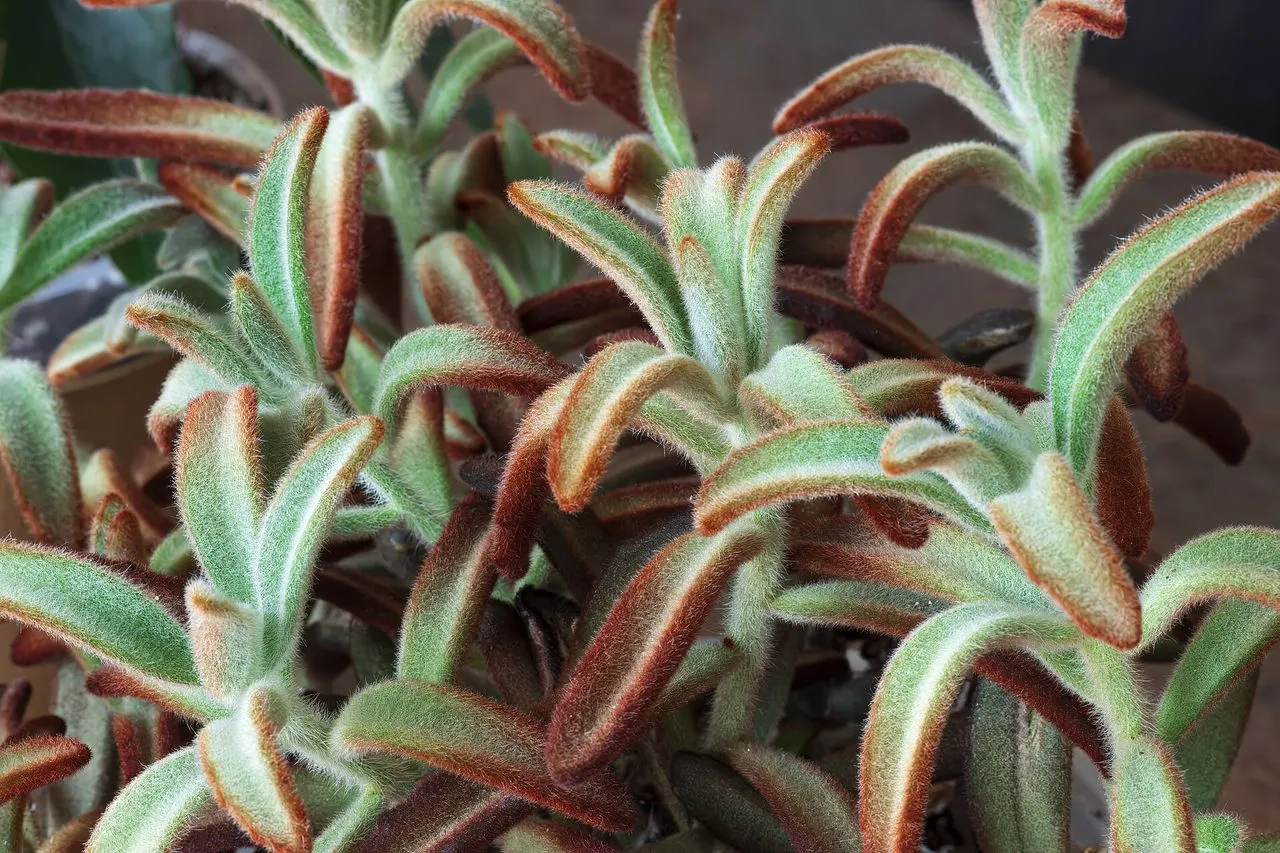
- Leaves. Opposite-decussate, obovate to oblanceolate, 3–8 cm long, entirely covered in dense silver-white tomentum. Leaf tips carry 4–10 coarse marginal teeth, each teeth-tip tipped in a rust-brown to chocolate-brown fringe of denser trichomes. The tooth colouring is what reads as the "panda face" pattern.
- Inflorescence. A terminal corymb, rare in cultivation, produced only on mature outdoor specimens. Flowers four-merous, tubular, yellowish-green with purple markings, 1 cm long.
- Cultivar 'Chocolate Soldier'. A widely grown selection with more extensive chocolate-brown edging across the leaf tip, not a separate species. Some nurseries label variegated forms as K. tomentosa f. nigromarginatus.
The combination of thick silver felt plus brown-edged leaf teeth is diagnostic. No other Kalanchoe matches it.
Cultivation
Standard Kalanchoe conditions with two species-specific divergences.
Water the substrate, never the foliage. This is the most important cultivation point for the species. Water droplets cling to the leaf trichomes, and any trapped moisture breeds a characteristic black fungal spot (Alternaria or Cladosporium spp.) that does not come off. Bottom-water or water directly onto the substrate surface, never from above. In outdoor cultivation, site the plant under a porch or eave so that rain cannot wet the leaves.
Strong direct sun intensifies the colouring. Plants grown in partial shade stay a muted silver-green with thin brown margins. Plants given 5–6 hours of direct sun produce deeper brown margins, denser felt, and more compact leaf spacing. The species tolerates full Mediterranean summer sun once hardened off.
Cold tolerance is limited; treat 5°C as a floor. At colder temperatures the fuzz traps cold moisture and rot follows. Winter the plant dry and bright above 10°C for reliable results.
Propagation
Leaf cuttings work and are the most common method. Detach a fully mature lower leaf with a clean gentle pull, callus for 5–7 days in shade (longer than most succulents because the fuzzy base traps moisture), then lay on dry substrate and mist the substrate lightly every 5–7 days. A plantlet emerges in 4–8 weeks. Success rate around 60%, adequate for hobby propagation but lower than a smooth-leaved Kalanchoe.
Stem cuttings are more reliable: a 5–8 cm tip cutting with 2–3 leaf pairs, stripped at the base, callused 3–5 days, roots within 14 days. This is the preferred method for established collectors.
Notes
K. tomentosa is my recommended starter Kalanchoe for anyone without experience. It is slow, forgiving, tolerant of erratic watering, distinctive, and carries no photoperiod expectation. Toxicity is lower than the Bryophyllum group, but bufadienolides are still present in tissue; keep out of reach of cats that chew foliage.
Plants sold as K. eriophylla (snow white) are a close relative with pure-white felt and smaller leaves; the two are sometimes hybridised and the hybrids are often misidentified as K. tomentosa 'Albino'.
See also
- Kalanchoe blossfeldiana
- Kalanchoe fedtschenkoi
- The Complete Kalanchoe Guide
- Kalanchoe eriophylla — the snow white panda plant, a smaller high-altitude Madagascan relative with pure-white trichomes and no dark margin markings.
Frequently Asked Questions
Why should Kalanchoe tomentosa not be watered from above?
Water droplets cling to the leaf hairs and encourage black fungal spotting. Bottom-water or pour directly onto the substrate surface instead.
How much sun does Kalanchoe tomentosa need?
Five to six hours of direct sun gives deeper brown margins, denser felt, and compact spacing. Partial shade leaves the plant silver-green with weaker markings.
How cold can Kalanchoe tomentosa get?
Treat 5 °C as the floor. Below that, the fuzz traps cold moisture and rot follows.
How do you propagate Kalanchoe tomentosa?
Leaf cuttings work at about 60% success after a 5–7 day callus, but stem cuttings are more reliable and root within about 14 days.