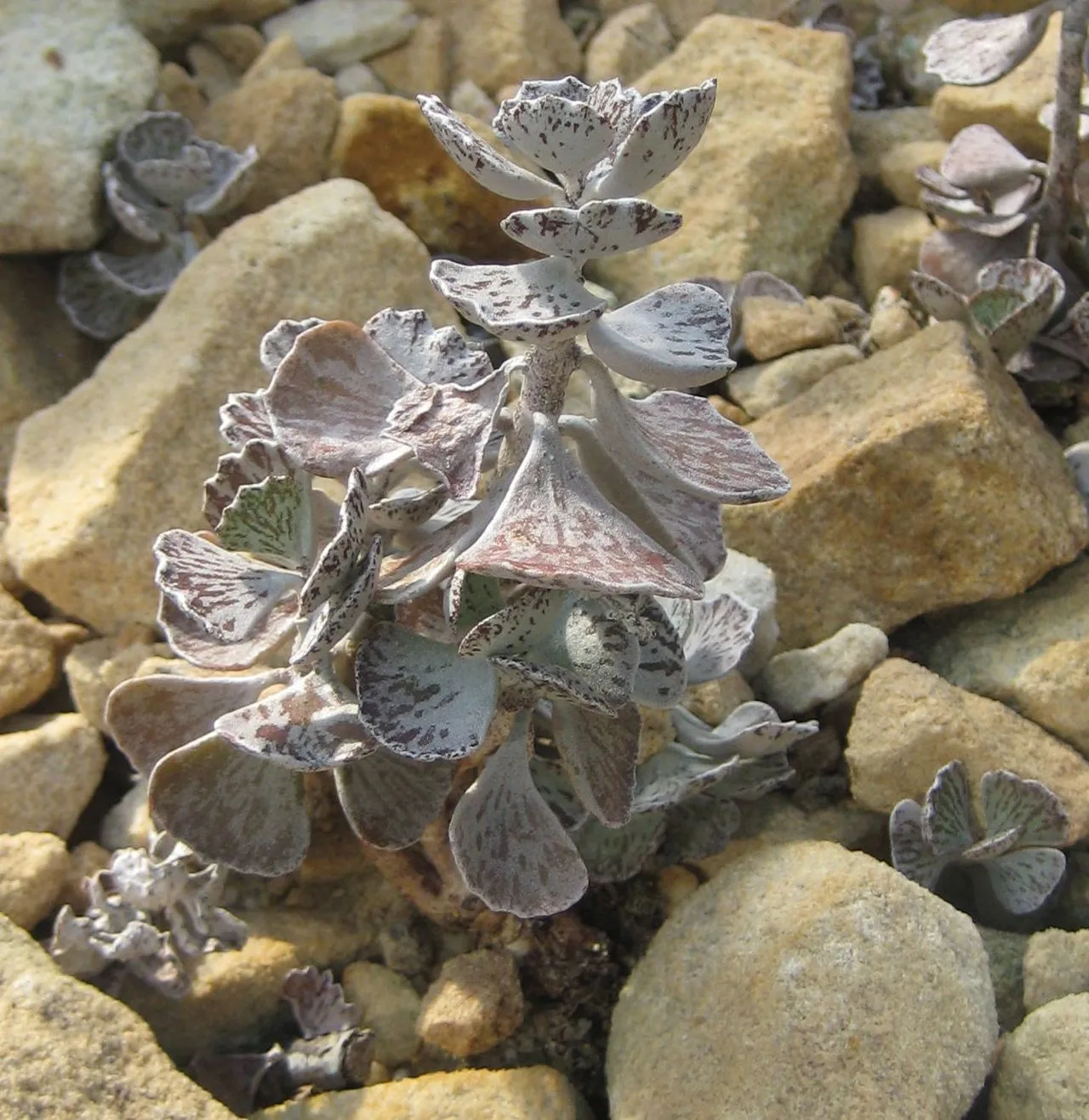
Yellow leaves on Kalanchoe follow the same diagnostic logic as yellow leaves on any succulent, but the genus's specific biology adds a few wrinkles. Kalanchoe blossfeldiana and its close relatives are CAM plants — they open stomata at night rather than during the day — which makes them more drought-tolerant than most houseplants but does not make them immune to overwatering. The most dangerous yellow is the soft, translucent yellow of overwatered tissue, and it is also the most commonly misidentified as drought.
Part of the Complete Kalanchoe Guide.
Normal basal senescence
Every Kalanchoe stem sheds its oldest leaves from the base as it grows upward. Yellowing in this pattern is predictable and harmless. A few diagnostic characteristics:
- Only the lowest one or two leaves on a stem are affected.
- Leaves yellow then dry to tan-brown rather than becoming mushy.
- The upper portion of the stem and any new growth remains firm and correctly coloured.
- No smell from the pot.
Remove fully desiccated leaves to avoid them trapping moisture against the stem. No further action is needed.
Overwatering and root damage
The most common pathological cause of yellow kalanchoe leaves. Kalanchoe roots need an oxygenated wet-dry cycle — the same principle that applies to most succulents. In a peat-heavy mix, an oversized pot, a decorative cache-pot without drainage, or a position with low light and cool temperatures, the substrate can remain wet for 2–4 weeks between waterings. Fine roots die in anaerobic conditions; the plant loses its ability to regulate water uptake; leaves fill with excess water and turn yellow, translucent, and eventually mushy.
The yellow from overwatering starts at the lower leaves and progresses upward. Affected leaves feel soft or inflated before they collapse. They may be yellow-green, then yellow, then translucent or glassy. A sour smell from the root zone at this stage indicates root rot has established. The substrate may feel wet or compacted.
Do not add more water. Remove the plant from its pot, clear away old substrate, and inspect roots. Healthy kalanchoe roots are firm and pale tan to white. Dead roots are black, hollow, slimy, or foul-smelling. Cut all dead root tissue with a sterile blade. Dry the plant bare-root in shade with good airflow for 3–5 days. Repot into fresh, dry mineral mix and withhold watering for 7 days.
Under-watering and drought stress
Drought causes a different pattern of yellowing. Dehydrated leaves lose turgor and turn dull yellow-green, wrinkling and curling slightly as internal water pressure drops. Unlike overwatering, the texture is soft-flexible rather than mushy, and the pot is light and dry through the full depth. Kalanchoe is relatively drought-tolerant, but a plant in a small terracotta pot in summer heat can dry out in 4–6 days.
A single thorough soak — slow, steady watering until water exits the drainage holes, then full drainage — rehydrates the plant within 24–48 hours. Do not follow with daily light waterings; resume the standard dry-down cycle, watering again only when the top 3–4 cm of substrate is dry.
Low light and chlorophyll insufficiency
New growth that emerges pale lime-yellow rather than rich green indicates the plant is not receiving enough light to produce adequate chlorophyll. In low light, Kalanchoe also tends to produce thinner, more widely spaced leaves, and stems begin to etiolate over time. The yellowing from low light is firmest in new growth and most visible at stem tips rather than the base.
Increase light progressively — move to an east or south window, or add supplemental grow lighting for 12–14 hours per day. Avoid moving directly from deep shade to full south-facing summer sun in one step; sunburn on previously shade-adapted leaves is common and causes a different kind of discolouration.
Nutrient deficiency
A Kalanchoe grown in the same exhausted substrate for more than two years, or one that has been heavily flowering and had significant leaf turnover, can develop nutrient deficiency visible as interveinal chlorosis (veins remain green while tissue between yellows) on new growth. Nitrogen deficiency shows as a more uniform pale yellowing starting with older leaves. These patterns are firm in texture and the roots, if inspected, are healthy.
Do not diagnose nutrient deficiency until root damage is excluded. A dilute balanced liquid fertiliser at one-quarter strength applied once per month during active growth periods is usually sufficient to prevent deficiency in a correctly-sized, recently-repotted plant. Avoid high-nitrogen feeds on a plant that is also being managed for flowering — they promote vegetative growth at the expense of bud set.
How to identify the cause
| Pattern | Texture | Location | Most likely cause |
|---|---|---|---|
| Yellow-brown, drying papery | Thin and crisp | Oldest basal leaves | Normal senescence |
| Yellow, translucent, soft or mushy | Wet, collapsed | Lower to mid stem | Overwatering or root rot |
| Yellow-green, wrinkling, curling | Soft-flexible, not wet | Lower leaves first | Under-watering |
| Pale lime-yellow, thin leaves | Firm but thin | New growth at stem tips | Low light |
| Yellow with green veins (interveinal) | Firm | New growth | Nutrient deficiency |
Risk and severity
Normal senescence and low light require no urgent action. Overwatering-driven yellowing that has reached the root zone needs same-day intervention. Drought yellowing is low-risk and self-correcting with one watering. Nutrient deficiency takes weeks to develop and weeks to reverse — it is not an emergency.
Act immediately if yellow leaves are mushy, wet, or accompanied by a sour smell from the pot, or if the yellowing is spreading upward rather than staying confined to the lowest leaves.
Solutions
Papery lower leaves
Remove once fully dry and detached. Continue normal care.
Mushy or translucent yellow leaves
Stop watering. Unpot, inspect roots, cut dead root tissue with sterile blade. Dry bare-root 3–5 days. Repot into dry mineral mix. Wait 7 days before first cautious watering.
Wrinkled, dry yellow-green leaves
Water thoroughly once. Allow full drainage. Resume dry-down cycle. Check the plant in 48 hours — if wrinkles have not resolved, inspect roots for damage.
Pale yellow new growth
Increase light progressively. Refresh substrate if more than 2 years since last repotting. Feed at one-quarter strength with balanced fertiliser during active growth.
Prevention
Use a pot only 2–4 cm wider than the root ball, with drainage holes and no saucer standing water. A mineral-dominant mix (50–60% pumice or perlite) prevents the saturation that causes most kalanchoe root rot. Water only when the top 3–4 cm of substrate is dry. Maintain bright indirect light — this also keeps the plant's metabolism high enough to use water between waterings, reducing rot risk. Check the wet-dry cycle explained guide for the mechanics of watering correctly in different pot and substrate combinations.
See also
- Root rot diagnosis — the full root inspection and recovery procedure when overwatering has progressed to rot.
- Kalanchoe blossfeldiana — the most commonly grown species and the one most often overwatered when in flower.
- Beginner's guide to succulents — substrate, drainage, and watering fundamentals that prevent yellowing before it starts.
Frequently Asked Questions
Why are my Kalanchoe leaves yellow and falling off?
Most commonly overwatering. Yellow, soft leaves that detach easily are losing turgor because the roots are failing to regulate uptake — a sign of root rot. Unpot and inspect roots before adding more water.
Can yellow Kalanchoe leaves turn green again?
No. A fully yellowed leaf has lost its chlorophyll and will not recover. Correct the underlying cause so new growth from the stem tips emerges compact and green.
Is it normal for lower Kalanchoe leaves to turn yellow?
One or two oldest basal leaves yellowing and drying off is normal senescence. Multiple leaves yellowing simultaneously, especially if they are soft rather than papery, indicates a watering or root problem.
Why are the new leaves on my Kalanchoe pale yellow?
Pale, lime-yellow new growth on an otherwise healthy plant usually indicates low light or an exhausted substrate. Move to brighter indirect light and consider a dilute balanced feed during active growth.