| Question | Short Answer |
|---|---|
| How do you make Kalanchoe blossfeldiana rebloom? | Give it at least 14 hours of complete darkness every night for 6–8 consecutive weeks, then return it to normal daylight once bud primordia are visible. |
| How cold can Kalanchoe blossfeldiana get? | Treat 7 °C as the chilling threshold. |
| How long do the flowers last indoors? | Flowers last 6–8 weeks indoors at 18–22 °C. |
| What is the best way to propagate Kalanchoe blossfeldiana? | Use 5–8 cm non-flowering stem tips with 2–3 leaf pairs. |
Kalanchoe blossfeldiana Poelln. (flaming Katy, Christmas kalanchoe, florist kalanchoe) is the single most commercially important species in the genus and the plant almost every supermarket sells at the autumn and winter checkouts. Named by the German botanist Karl von Poellnitz in 1934 in honour of the nurseryman Robert Blossfeld, who introduced it from Madagascar to European horticulture in 1932.
It is a compact, evergreen subshrub endemic to the rocky slopes of the Tsaratanana Massif in northern Madagascar, where it grows at around 1,600 m among granite outcrops. In cultivation it barely resembles the wild form: almost every plant sold today is a Blossfeldiana-group tetraploid hybrid, selected for tight habit, broad flower colour range, and compact flowering heads.
Part of the Complete Kalanchoe Guide.
Identification
- Habit. Branching subshrub, 20–45 cm tall in cultivation, shorter in flowering specimens.
- Leaves. Opposite-decussate, glabrous, ovate to oblong, 5–10 cm long, margins crenate to scalloped. Leaf colour a glossy mid-green, often with red margins when grown in strong light.
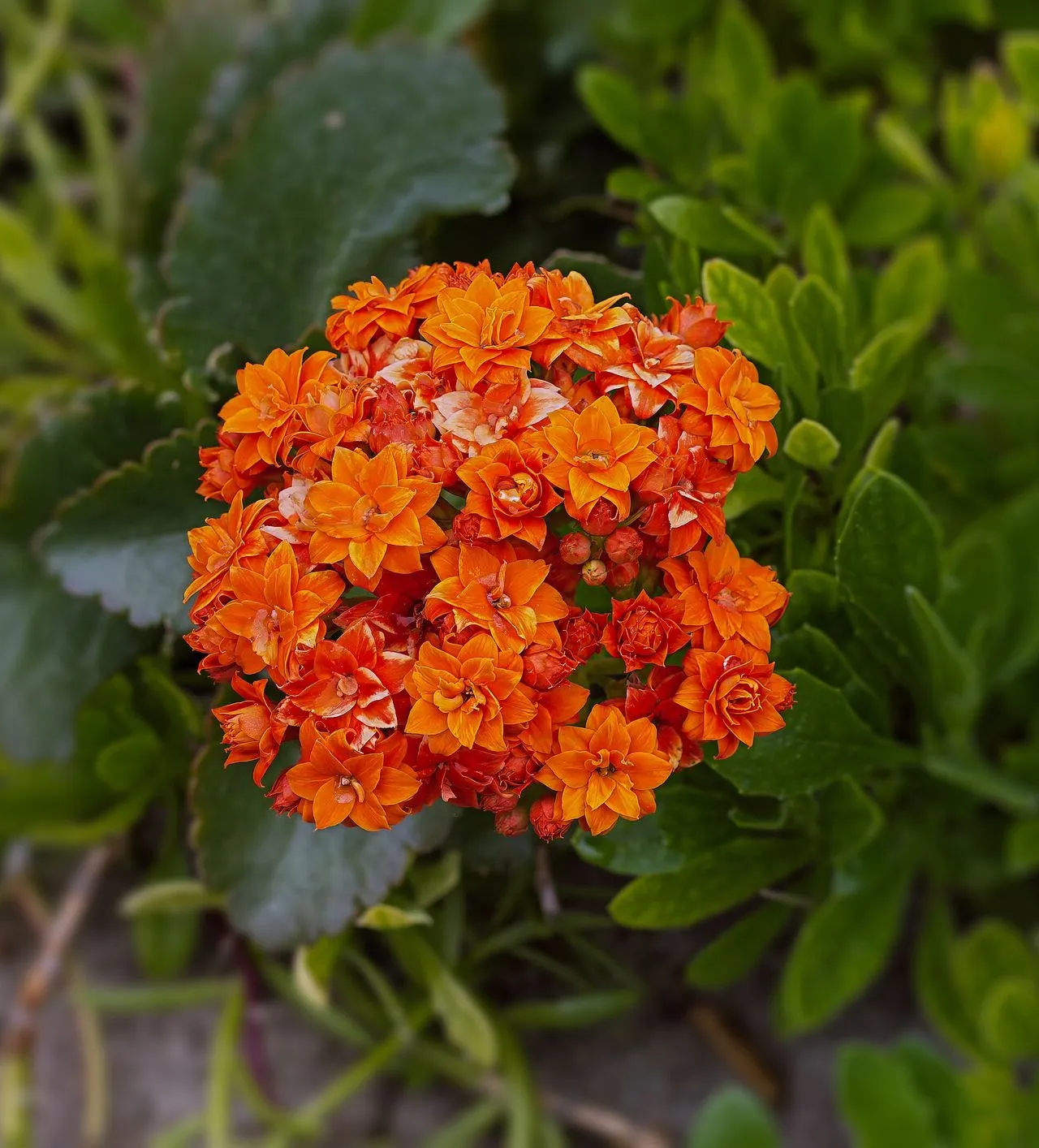
- Inflorescence. Terminal corymb of 20 to several hundred four-merous tubular flowers. Wild-type flower is scarlet; cultivated forms span red, orange, pink, yellow, salmon, and white. Doubled cultivars (the Calandiva series) have 30-plus petals per flower and dominate the current florist trade.
- Bloom timing. Initiates buds under short days; in the northern hemisphere that means natural flowering from late winter to early spring.
The leaves are the fastest field character: glossy, scalloped-margined, opposite, and with none of the leaf-margin bulbils of the Bryophyllum species.
Cultivation
Standard Kalanchoe care applies: free-draining mineral-rich substrate, bright light with 4–6 hours of direct sun, water when the top 2–3 cm of substrate reads dry. The species is more cold-sensitive than average for the genus; treat 7°C as a chilling threshold below which leaves show purpling and flower buds abort.
Feed weakly through active growth (quarter-strength balanced liquid fertiliser every 3–4 weeks) and stop feeding entirely from bud initiation onward. Flowers last 6–8 weeks indoors at 18°C–22°C; cooler rooms extend bloom, warm rooms shorten it. Keep plants well away from ripening fruit: ethylene exposure causes flower drop within 48 hours and is not recoverable.
Rebloom protocol (photoperiod)
This is the one thing everyone wants and almost no-one gets right. K. blossfeldiana is an obligate quantitative short-day plant. Flower initiation requires an uninterrupted dark period of at least 14 hours per 24 for 6–8 consecutive weeks.
The practical protocol, starting in early autumn:
- Move the plant into a closet or cupboard at 6 pm each evening.
- Return it to a bright windowsill at 8 am each morning.
- Do not open the closet during the dark period, even briefly. A few seconds of light at midnight resets the clock.
- Maintain 15°C–20°C during both phases.
- After 6 weeks, check for visible bud primordia in the leaf axils. Once present, return the plant to normal daylight.
Plants rebloom 10–12 weeks after bud initiation. A room where a light switches on at 11 pm does not work, which is why a healthy plant on a windowsill never reflowers.
Propagation
Stem cuttings are the default. Take a 5–8 cm non-flowering tip with 2–3 leaf pairs, strip the lower pair, callus for 2–4 days, and pot into standard substrate. Roots form in 10–14 days at 22°C. Leaf cuttings also work, though they take 4–6 weeks to produce a viable plantlet. Taken from a flowering specimen, a cutting will usually skip its first year of bloom while it establishes vegetative structure.
Notes
Almost all plants sold are patented cultivars and vegetative propagation for resale may be restricted by Plant Breeders' Rights; private propagation is unaffected. The species is toxic: corolla and stamens carry the highest bufadienolide load. Keep spent flowers out of reach of cats and dogs, and do not compost them where livestock have access.
See also
- Kalanchoe fedtschenkoi
- Kalanchoe tomentosa
- Kalanchoe luciae
- Kalanchoe not blooming — the full dark-period protocol for triggering bud initiation, companion reference to the rebloom section above.
Frequently Asked Questions
How do you make Kalanchoe blossfeldiana rebloom?
Give it at least 14 hours of complete darkness every night for 6–8 consecutive weeks, then return it to normal daylight once bud primordia are visible. Plants usually rebloom 10–12 weeks after bud initiation.
How cold can Kalanchoe blossfeldiana get?
Treat 7 °C as the chilling threshold. Below that point leaves purple and flower buds may abort.
How long do the flowers last indoors?
Flowers last 6–8 weeks indoors at 18–22 °C. Cooler rooms extend bloom, while warmer rooms shorten it.
What is the best way to propagate Kalanchoe blossfeldiana?
Use 5–8 cm non-flowering stem tips with 2–3 leaf pairs. Callus for 2–4 days and root at about 22 °C, where roots form in 10–14 days.