| Question | Short Answer |
|---|---|
| Does Kalanchoe fedtschenkoi make leaf-margin bulbils? | No. |
| Why is my Kalanchoe fedtschenkoi green instead of lavender? | Warm, shady cultivation produces plain green growth. |
| How do you propagate Kalanchoe fedtschenkoi? | Stem cuttings are easiest: take a 5–8 cm tip, callus for 2–3 days, and root in standard substrate. |
| How large does Kalanchoe fedtschenkoi get? | Mature plants form dense mats about 30–45 cm tall and 60 cm or more across. |
Kalanchoe fedtschenkoi Raym.-Hamet & H.Perrier (lavender scallops, grey Sedum, south American air plant) was described in 1915 from specimens collected in southern Madagascar. The specific epithet honours the Russian botanist Boris Fedtschenko. The species is endemic to arid limestone outcrops and dry spiny forest understorey in the Androy region at elevations below 500 m.
It is a branching subshrub that spreads horizontally as much as it grows upward, forming dense mats 30–45 cm tall by 60 cm or more across in mature specimens. In cultivation, the variegated cultivar 'Aurora Borealis' (sometimes sold as 'Variegata' or 'Tricolor') is commoner than the straight species.
Part of the Complete Kalanchoe Guide.
Identification
- Habit. Low-growing branching subshrub, stems reddish, readily producing aerial roots at nodes that touch substrate.
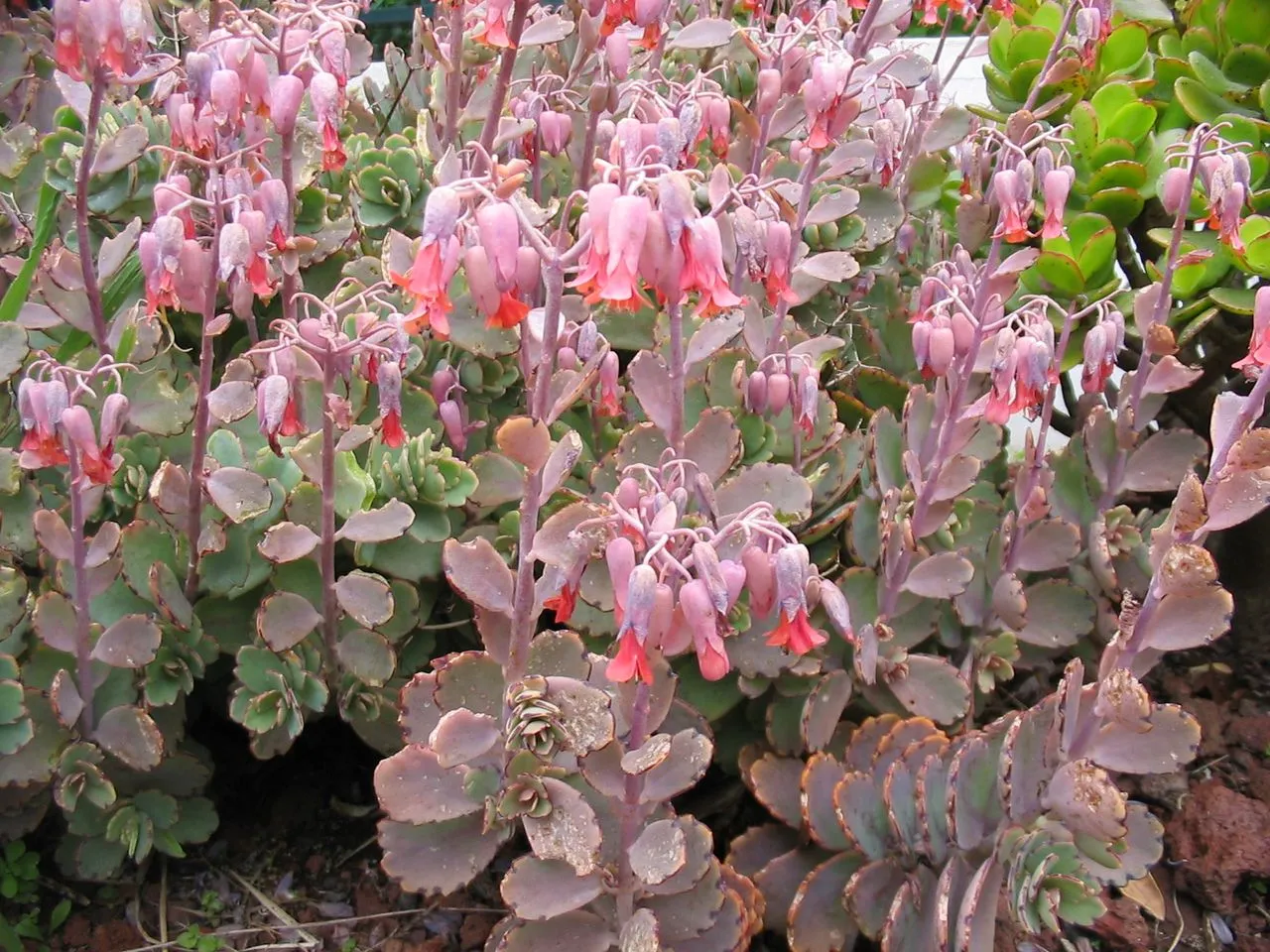
- Leaves. Opposite-decussate, obovate to oblong, 2.5–5 cm long, distinctly scalloped (crenate) along the upper third of each margin. Colour a cool lavender-grey in summer, deepening to pinkish-purple with a rosy flush in cool bright winter conditions. The variegated cultivar 'Aurora Borealis' adds cream and pink marginal bands.
- Inflorescence. A lax terminal panicle 20–40 cm tall bearing pendulous tubular bell-shaped flowers, each 1.5–2 cm long, in soft coral-pink to salmon-orange. Flowers in late winter to spring, photoperiod-sensitive.
- Absence of marginal bulbils. Unlike the closely allied Bryophyllum-group species, K. fedtschenkoi does not produce bulbils on intact leaves. Propagation is vegetative from cuttings, not from leaf-margin plantlets.
The combination of scalloped lavender-grey leaves and aerial rooting at the nodes is diagnostic.
Cultivation
Standard Kalanchoe conditions apply with two species-specific notes.
Cool-season colour. The distinctive lavender-pink colouring develops only under bright, cool conditions (10°C–15°C day, 5°C–10°C night) with strong direct light. Warm, shady cultivation gives a plain green plant. For best colour, winter the plant outdoors in a frost-free cold frame or on a bright unheated sill.
Scrambling habit. K. fedtschenkoi is one of the few Kalanchoe that spreads laterally by stem layering. Stems that fall over and touch substrate root at the nodes and produce independent plants. This is useful in a trough or rock garden, inconvenient in a tight container. Pinch the growing tips after flowering to force compactness; this also doubles the number of inflorescences in the next cycle.
The variegated 'Aurora Borealis' is slower, smaller, and slightly less cold-tolerant than the straight species. It also reverts readily; remove any all-green shoots at the base as soon as they appear.
Propagation
Stem cuttings are the default and almost trivial. Take a 5–8 cm tip with 2–3 leaf pairs, strip the lower pair, callus for 2–3 days, pot into standard substrate. Roots form in 7–14 days. Plants flower within the following season.
Leaf cuttings also work but less reliably; success rate around 50%, compared with near 100% from stem cuttings. Stick to stem cuttings unless leaf material is all you have.
Layering happens on its own. If you want deliberately layered plants, peg a low stem onto the substrate surface with a paperclip; roots form at the nodes within 3 weeks.
Notes
Toxicity is present but lower than the Bryophyllum group; the species is still on the ASPCA toxic-to-pets list. Keep out of reach of cats and dogs that chew foliage.
The species is easily confused with K. marnieriana, which has smaller, rounder, unscalloped leaves and a tighter habit. Some nurseries swap the labels; in doubt, check for scallops on the upper third of the leaf margin.
See also
- Kalanchoe tomentosa
- Kalanchoe blossfeldiana
- The Complete Kalanchoe Guide
- Kalanchoe leggy after flowering — pruning and recovery notes relevant to K. fedtschenkoi, which shares the post-bloom stretching tendency of upright Madagascan species.
Frequently Asked Questions
Does Kalanchoe fedtschenkoi make leaf-margin bulbils?
No. Unlike Bryophyllum-group species, it does not produce bulbils on intact leaves; propagation is mainly from cuttings and layering.
Why is my Kalanchoe fedtschenkoi green instead of lavender?
Warm, shady cultivation produces plain green growth. Bright cool conditions around 10–15 °C by day and 5–10 °C by night develop the lavender-pink colour.
How do you propagate Kalanchoe fedtschenkoi?
Stem cuttings are easiest: take a 5–8 cm tip, callus for 2–3 days, and root in standard substrate. Layered stems also root at nodes within about 3 weeks.
How large does Kalanchoe fedtschenkoi get?
Mature plants form dense mats about 30–45 cm tall and 60 cm or more across. The scrambling habit is useful in troughs but inconvenient in tight pots.