| Question | Short Answer |
|---|---|
| How do you identify Kalanchoe pinnata? | Mature plants produce pinnately compound leaves with 3–5 leaflets, and no other commonly cultivated Kalanchoe has that foliage. |
| How is Kalanchoe pinnata different from mother of thousands? | K. |
| How do you propagate Kalanchoe pinnata? | Lay a mature leaf on moist substrate at 22–25 °C. |
| Is Kalanchoe pinnata safe to eat? | No. |
Kalanchoe pinnata (Lam.) Pers. (air plant, miracle leaf, cathedral bells, life plant) was first described as Cotyledon pinnata by Lamarck in 1786 and transferred to Kalanchoe by Persoon in 1805. For much of the twentieth century it was known as Bryophyllum pinnatum (Lam.) Oken, and that combination is still the one seen most often in pharmacological and ethnobotanical literature. Bryophyllum is now sunk into Kalanchoe.
Originally endemic to Madagascar, K. pinnata has naturalised across every tropical and subtropical region with sufficient rainfall: the Caribbean, central and south America, west Africa, south and southeast Asia, Australia, and many Pacific islands. Its spread is driven entirely by the species' capacity to root and regenerate from detached leaves, described below.
Part of the Complete Kalanchoe Guide.
Identification
- Habit. Erect, branching perennial herb to subshrub, 40–150 cm tall, usually unbranched until flowering.
- Leaves. Opposite-decussate. On young plants simple, ovate, scallop-margined. On mature plants pinnately compound with 3–5 leaflets, the terminal leaflet larger than the laterals. Both leaf forms occur on the same individual. Texture thick and rubbery, leaves 10–25 cm long overall.
- Regeneration. The leaflet margins produce plantlets at the notches between crenations when the leaf is detached and laid on damp substrate, or sometimes while still attached under stress. Unlike K. daigremontiana, these plantlets are not pre-formed on the intact leaf — they develop only after injury or detachment.
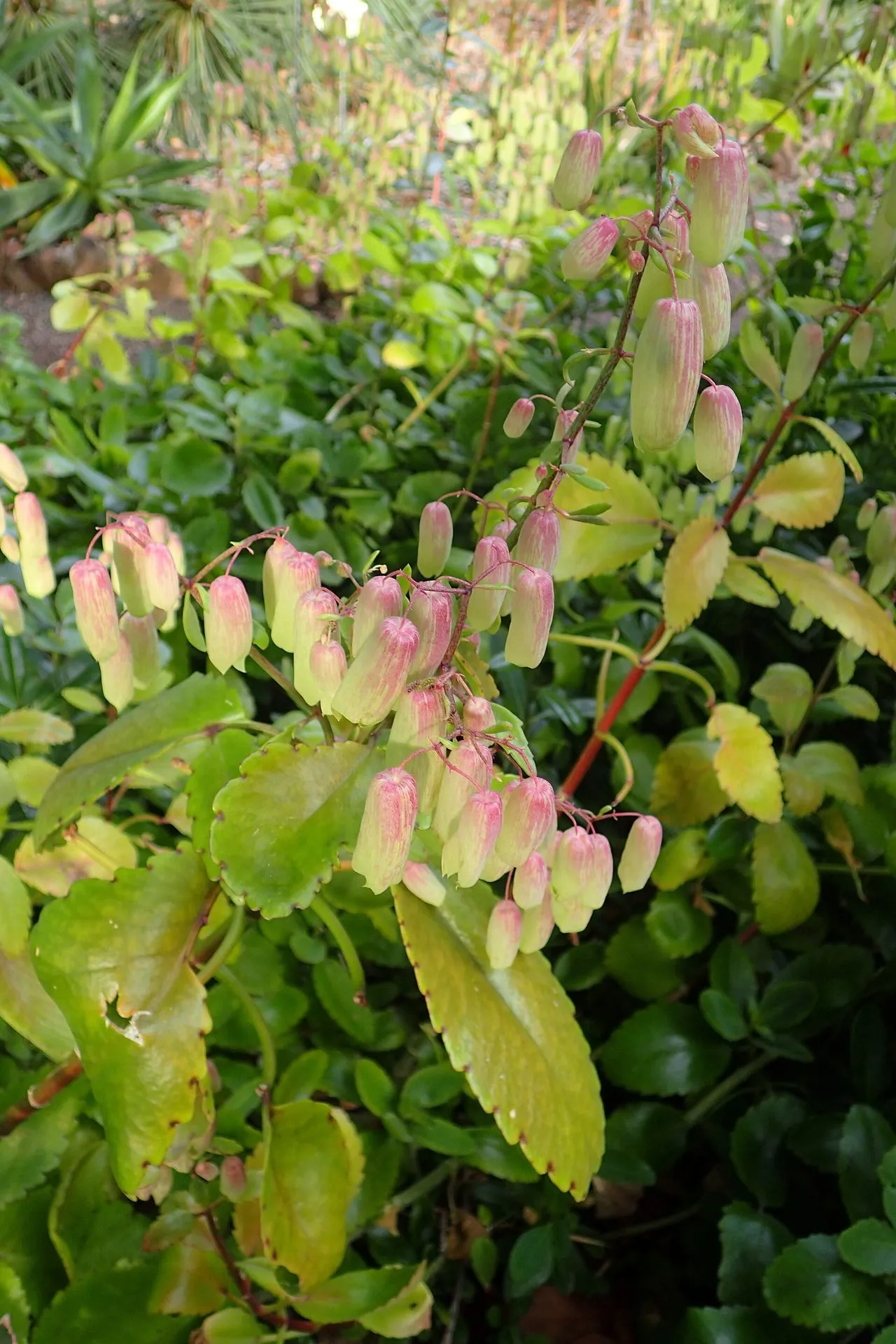
- Inflorescence. Terminal panicle 30–80 cm tall. Flowers pendulous, tubular, inflated, 3–5 cm long, greenish-yellow to reddish-purple with the outer calyx forming a characteristic inflated papery bell. This feature gives the plant its "cathedral bells" common name.
The pinnate mature leaves are the quickest distinguishing feature. No other commonly cultivated Kalanchoe produces compound foliage.
Cultivation
Standard Kalanchoe conditions apply. K. pinnata is slightly more moisture-tolerant than average for the genus, reflecting its origin in wetter-tropical habitat: substrate moisture can stay higher without triggering rot. In a container it tolerates weekly watering even in winter at 18°C.
Light requirement is moderate to high; the species flowers poorly under 3 hours daily direct sun. Cold tolerance is limited: treat 5°C as a floor. Frost kills above-ground tissue outright. In frost-free regions outdoors the species will self-seed aggressively through vegetative propagation from dropped leaves; check local invasive species status before planting out, and use container cultivation where that status is Category 1 or 2.
Propagation
Detach a healthy mature leaf with a clean cut at the petiole. Lay the leaf flat on moist substrate at 22°C–25°C under bright indirect light. Within 10–14 days plantlets emerge at each marginal notch. Separate once each plantlet has 2–3 true leaves of its own; pot individually in standard Kalanchoe substrate. A single leaf typically yields 8–20 viable plantlets.
Stem cuttings also root readily but are rarely used because leaf propagation is both easier and more productive.
Notes
K. pinnata has one of the longest and best-documented ethnobotanical histories of any succulent. Its leaves are used in traditional medicine across the tropics for wound healing, inflammation, and kidney complaints; contemporary pharmacological work has isolated bufadienolides including bryophyllin A with documented cytotoxic and antiviral activity in vitro. None of this makes the plant safe to ingest: the same bufadienolides are cardiotoxic, and livestock poisoning from naturalised populations is documented in Brazil, Australia, and west Africa. Treat the plant as ornamental only.
See also
- Kalanchoe daigremontiana
- Kalanchoe delagoensis
- The Complete Kalanchoe Guide
- Kalanchoe prolifera — a taller cane-forming Madagascan species with compound pinnate leaves and a similar bulbil-based invasive profile.
Frequently Asked Questions
How do you identify Kalanchoe pinnata?
Mature plants produce pinnately compound leaves with 3–5 leaflets, and no other commonly cultivated Kalanchoe has that foliage. The inflated cathedral-bell flowers add confirmation.
How is Kalanchoe pinnata different from mother of thousands?
K. pinnata forms plantlets after a leaf is detached or injured. K. daigremontiana carries pre-formed bulbils along intact leaf margins.
How do you propagate Kalanchoe pinnata?
Lay a mature leaf on moist substrate at 22–25 °C. Plantlets appear at marginal notches within 10–14 days, and one leaf usually yields 8–20 viable plantlets.
Is Kalanchoe pinnata safe to eat?
No. The post treats it as ornamental only because bufadienolides are cardiotoxic, despite the species' long ethnobotanical history.