| Question | Short Answer |
|---|---|
| How do you identify Kalanchoe prolifera? | Look for a robust cane-forming plant over 1 m with pinnate compound leaves carrying 5–9 smooth leaflets and modest bulbils along older leaflet margins. |
| Is Kalanchoe prolifera invasive? | It can naturalise in tropical climates because dropped bulbils root in warm damp soil. |
| How do you propagate Kalanchoe prolifera? | Mature bulbils are fastest and root in 7–14 days at 22–28 °C. |
| How cold can Kalanchoe prolifera tolerate? | The practical lower limit is about 4 °C. |
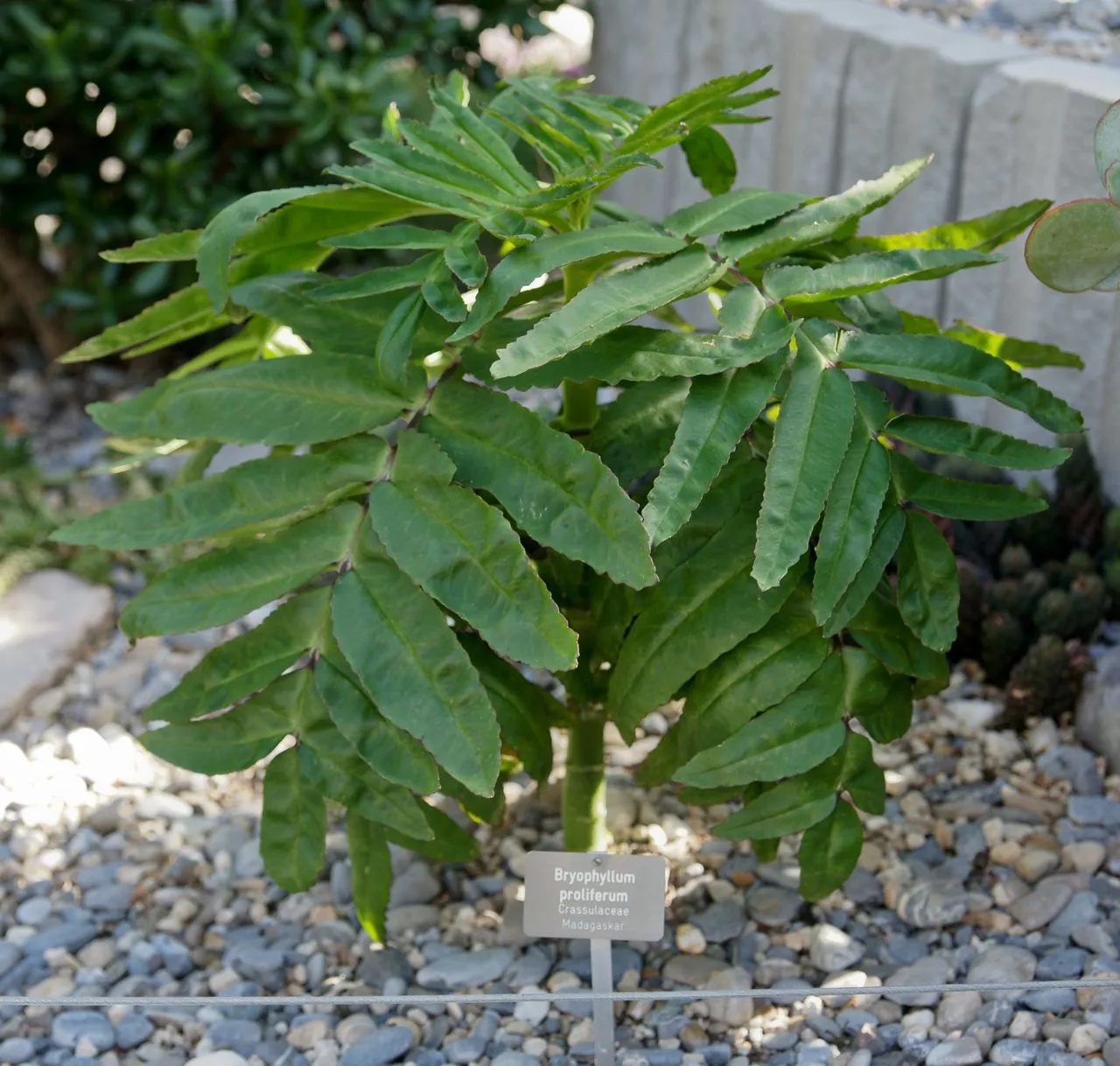
Kalanchoe prolifera (Bow.) Raym.-Hamet, the blooming kalanchoe, is a tall Madagascan shrub described by Raymond Hamet and Joseph Marie Henri Alfred Perrier de la Bâthie in 1908, originally placed in Bryophyllum as Bryophyllum proliferum. It grows on rocky savanna slopes and dry scrub on Madagascar from near sea level up to about 800 m. Mature plants reach 1 to 2 m, with thick erect canes and pinnate compound leaves carrying 5 to 9 leaflets each. Older leaves produce small bulbils along the leaflet margins, and that habit gave the species its epithet.
In habitat, K. prolifera is a plant of open, seasonally dry country. Roots work into thin gravelly pockets between rocks and grasses, water arrives in pulses tied to the wet season, and drainage is fast. The same habit that suits a bare Madagascan slope makes the species a confident colonist anywhere frost stays away. K. prolifera and several of its bulbil-producing relatives are listed as invasive in parts of Hawaii, Florida, and eastern Australia, where dropped plantlets root in pavement cracks, garden beds, and disturbed roadsides. Outside its native range, plant it only in containers, and never compost prunings if you live in a tropical or subtropical zone.
Part of the Complete Kalanchoe Guide.
Identification
K. prolifera grows as an erect, robust shrub with a single dominant cane that branches sparingly when young and more freely after flowering. A potted plant typically reaches 60 to 120 cm; in a frost-free bed with good light it can pass 1.5 m and approach 2 m. The lower stem becomes woody, somewhat resembling a young tree trunk, and old leaves drop to leave clean leaf scars.
The leaves are the strongest field character. They are pinnate compound, 20 to 40 cm long including the rachis, and carry 5 to 9 ovate to elliptic leaflets in opposite pairs along the central stalk, with a single terminal leaflet. Each leaflet is glabrous, meaning smooth and hairless, with a shallow toothed margin and a rounded to slightly pointed tip. Background colour is mid green; leaflet bases and the rachis often flush maroon to purple under bright light, and the petiole sheath at the cane is similarly tinged. The flushing strengthens with sun and cool nights and softens in shade, so a uniformly green plant is still the correct species if leaf shape is right.
The diagnostic trait sits along the leaflet margins. On older or stressed leaves, small green plantlets (bulbils) form in the notches between marginal teeth. Each bulbil carries a tiny rosette of leaves and a cluster of root primordia, ready to drop and root on contact with damp ground. Production is moderate compared with the prolific K. daigremontiana, but it is reliable enough to call by name. On a healthy mature plant you will find at least a handful of bulbils on the lower leaves at any time.
Flowers appear in winter to spring on a tall terminal panicle that rises above the leafy canes and can reach 60 cm. The flowers are pale yellow-green, tubular, pendant, and four-parted, packed in branched clusters at the panicle's tips. After flowering, the upper cane usually dies back to a side branch, and lateral shoots take over leadership.
Two close relatives cause most of the confusion in cultivation. Kalanchoe pinnata (the air plant or miracle leaf) is smaller, usually 0.5 to 1 m, with simple oval leaves on young growth and only the upper, larger leaves becoming pinnate with 3 to 5 leaflets. Its bulbil production is far more reliable than K. prolifera, with plantlets forming readily on detached leaves laid on damp substrate. Kalanchoe daigremontiana (now placed by some authors in Bryophyllum as Bryophyllum daigremontianum) is also smaller, with narrow triangular to lanceolate simple leaves carrying reddish blotches on the lower surface, and continuous, very dense bulbil production along the leaf margins. It is the textbook "mother of thousands". If the plant is over a metre tall with pinnate compound leaves of 5 or more glabrous leaflets and only modest bulbil production, K. prolifera is the right name.
Cultivation
Give K. prolifera bright light with several hours of direct sun. Indoors in a temperate climate, a south or west window suits it; an east window will keep it alive but produces leggy canes that lean toward the glass. Outdoors in a Mediterranean or subtropical climate, morning sun with light afternoon shade is safer in hot inland summers; in cooler maritime gardens, a hardened plant tolerates longer exposure. Aim for 4 to 6 hours of direct sun in the active season. Acclimate over 10 to 14 days when moving from shaded conditions, because the smooth leaflets sunburn into pale tan patches that do not heal.
Water by dryness, not by calendar. In active spring and summer growth, soak the pot thoroughly, then wait until the upper 3 to 4 cm of mix is dry and the pot feels light. In a 15 cm terracotta pot under warm light, that may be every 7 to 10 days. In a 20 cm plastic pot indoors, every 2 to 3 weeks is closer. With a moisture probe, water when the upper 3 cm reads below 15 percent and the lower stem stays firm.
Winter watering should be restrained. When nights drop below 12 °C and days are short, give only enough water to keep the lower stem from deep shrivelling, often once every 4 to 6 weeks in a mineral mix. The species is frost intolerant, with a practical lower limit of about 4 °C. Below that, leaflets mark and stems can collapse from internal ice damage. In USDA terms, treat it as Zone 10b outdoors and bring containers under cover well before first frost.
Use a fast, mineral-leaning substrate. A practical range is 60 to 75 percent mineral material (pumice, fine lava rock, coarse grit, expanded shale) with the remainder peat-free or low-peat organic matter. The plant grows large, so pot size follows the root ball, not the canopy. Move up one nursery size when roots hold the mix together and water runs through too quickly. Tall canes get top-heavy, so a wide, shallow pot reduces tipping in wind. Heavy terracotta or a glazed pot with a generous footprint is more stable than a tall plastic cylinder.
Feed lightly. During active growth, apply a balanced low-nitrogen succulent fertiliser at one-quarter to one-half label strength every 4 to 6 weeks after a normal watering. Heavy nitrogen produces softer, greener leaves, blunts the maroon flush at the leaflet bases, and can encourage runaway height with weak stems. For broader watering and light principles across mixed collections, use the Beginner's Guide to Succulents, then keep K. prolifera's 4 °C limit and bulbil habit in your species notes.
Propagation
The fastest method is bulbils. Detach a marginal plantlet with a fingernail when its first roots are visible, or pick up the plantlets that have already fallen onto the bench, and press the base lightly into a barely damp mineral-leaning mix. Keep at 22 to 28 °C in bright shade. New roots establish in 7 to 14 days, and a recognisable young rosette follows within a month. Success rates with mature bulbils sit above 80 percent in warm rooms.
Stem cuttings are also reliable. Take a firm, non-flowering tip 10 to 15 cm long in late spring or summer, strip the lowest leaflet pair, and let the cut surface dry in bright shade for 3 to 5 days. Set the cutting upright in dry pumice or in a mix that is at least 70 percent mineral. At 22 to 28 °C, stem cuttings root in 2 to 3 weeks; the first watering can come once the cutting resists a gentle nudge.
Seed is feasible but uncommon outside botanical collections. Pollination is fiddly indoors, capsules release fine dust-like seed, and seedlings vary in vigour. For replicating a strong-flushing or large-leafleted clone, bulbils and stem cuttings are faster and more predictable.
Notes
Toxicity is the most important household consideration. Like the rest of the genus, K. prolifera contains cardiac glycosides (bufadienolides) in stems, leaves, and flowers. Cats, dogs, rabbits, and grazing livestock can develop vomiting, arrhythmia, and weakness after ingestion, and chronic intake produces lasting cardiac damage. Keep cuttings, fallen leaves, and dropped bulbils away from animals, and do not place this plant on a low shelf where pets can sample the foliage.
Invasive status sits next to toxicity. K. prolifera, K. pinnata, and Bryophyllum daigremontianum (K. daigremontiana) all naturalise readily in tropical climates because dropped bulbils root anywhere they touch warm damp soil. The three are formally listed as invasive in parts of Hawaii, Florida, and eastern Australia. If you garden in any of these regions, grow the plant only in containers placed where dropped bulbils can be swept up, and bag prunings for landfill rather than composting them on site. In cool temperate areas, frost limits the species to indoor or greenhouse cultivation, so the wild-spread risk is much lower; the toxicity concern still applies.
In trade, K. prolifera is sold under both Kalanchoe and Bryophyllum labels. Recent treatments by some authors split the bulbil-producing species back into Bryophyllum, so Bryophyllum proliferum and Bryophyllum daigremontianum, while others keep them inside a broadly defined Kalanchoe. Both names refer to the same plant. A label that reads "Bryophyllum proliferum" is not a different species; it is the older, currently revived combination.
Mealybugs occasionally settle in leaf axils and along the rachis of pinnate leaves. Inspect node joints every few weeks and lift small colonies with a cotton bud dipped in 70 percent isopropyl alcohol, then keep the plant out of direct sun until treated spots dry. Tall canes can tip after wind or careless watering, especially in light plastic pots. Cut back to a firm node, allow the wound to seal for several days, and let the cut piece serve as a stem cutting.
See also
- Complete Kalanchoe Guide
- Beginner's Guide to Succulents
- Kalanchoe pinnata, the smaller air plant relative with simple oval leaves and far more reliable plantlet production from detached leaves.
- Kalanchoe daigremontiana (Bryophyllum daigremontianum), the narrower triangular-leaved sibling whose continuous dense bulbil production sets the textbook example for "mother of thousands".
- Kalanchoe delagoensis — the chandelier plant, a tubular-leaved bulbil-bearer with a similarly invasive profile in frost-free regions.
Frequently Asked Questions
How do you identify Kalanchoe prolifera?
Look for a robust cane-forming plant over 1 m with pinnate compound leaves carrying 5–9 smooth leaflets and modest bulbils along older leaflet margins.
Is Kalanchoe prolifera invasive?
It can naturalise in tropical climates because dropped bulbils root in warm damp soil. Grow it only in containers where frost does not limit spread.
How do you propagate Kalanchoe prolifera?
Mature bulbils are fastest and root in 7–14 days at 22–28 °C. Stem cuttings also root in 2–3 weeks after a 3–5 day callus.
How cold can Kalanchoe prolifera tolerate?
The practical lower limit is about 4 °C. Treat it as USDA Zone 10b outdoors and bring containers under cover before frost.