| Question | Short Answer |
|---|---|
| How do you identify Kalanchoe daigremontiana? | Look for narrow triangular leaves, purple-mottled undersides, serrated margins, and complete plantlets forming along the marginal teeth. |
| Is Kalanchoe daigremontiana invasive? | Yes in many frost-free regions. |
| How cold can Kalanchoe daigremontiana tolerate? | Frost is the reliable killer. |
| Is Kalanchoe daigremontiana toxic? | Yes. |
Kalanchoe daigremontiana Raym.-Hamet & H.Perrier (mother of thousands, alligator plant, devil's backbone) was described in 1914 from specimens collected in the Fiherenana River valley of southwestern Madagascar. For most of the twentieth century it was placed in the segregate genus Bryophyllum, and the combination Bryophyllum daigremontianum still circulates on older labels and in older literature. Molecular work since 2000 confirmed its position inside Kalanchoe; the name used here is the current accepted one.
It is a single-stemmed erect succulent of dry deciduous scrubland on limestone, endemic to Madagascar but now naturalised across virtually every frost-free region on Earth. The driver is the species' extraordinary leaf-margin bulbil production, described below.
Part of the Complete Kalanchoe Guide.
Identification
- Habit. Upright, usually unbranched, 60–120 cm tall at flowering. The main stem becomes semi-woody with age.
- Leaves. Opposite-decussate, narrowly triangular to lanceolate, 10–20 cm long, channelled in cross-section with the upper surface greyish-green and the underside mottled purple. Margins strongly serrate.
- Bulbils. A row of asexual plantlets forms in the notches between the marginal teeth of every mature leaf. Each plantlet is a complete miniature plant with roots already initiated before it detaches. This is diagnostic for the species and the single most useful field character.
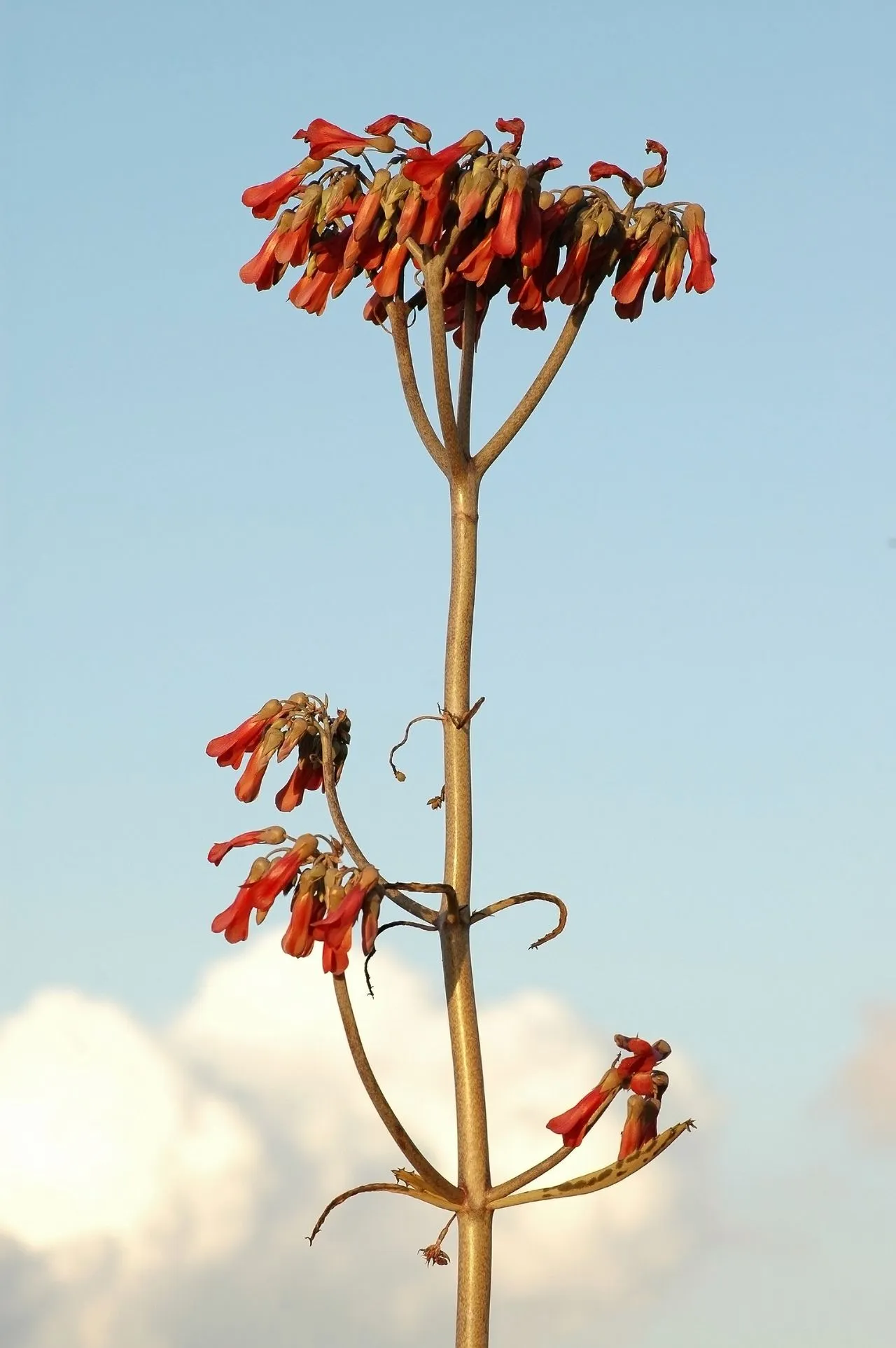
- Inflorescence. A terminal panicle 10–40 cm tall bearing pendulous tubular flowers in pinkish-purple to greyish-lavender. Flowering at 3–4 years old; the stem typically dies after flowering and is replaced by basal offsets.
The common confusion is with K. delagoensis (chandelier plant), which has tubular rather than flat leaves and bears its bulbils at the leaf tips rather than along the margins. See Kalanchoe delagoensis. Hybrids between the two are widely cultivated as K. × houghtonii.
Cultivation
Almost trivially easy. Tolerant of bright shade through full sun, any free-draining substrate, and any watering regime that does not leave the roots standing in water. The species survives neglect that would kill every Echeveria in a collection. Frost is the one reliable killer: leaves collapse at around 0°C, stems at −2°C.
In outdoor cultivation in frost-free regions, do not grow this plant without containment. Fallen bulbils root into lawn, paving cracks, and neighbouring containers. Australia, the Canary Islands, Florida, and South Africa all list it as an invasive environmental weed, and its bufadienolide content has caused documented cattle and dog fatalities.
Propagation
Effectively automatic. A single leaf left on damp substrate will produce dozens of rooted plantlets within two weeks. For intentional propagation, detach a mature leaf, lay it on moist substrate in a warm (20°C–25°C) bright spot, and wait. No callusing is needed; the bulbils are already rooted.
For responsible cultivation the task is the reverse: preventing propagation. Collect fallen bulbils weekly during summer, bag and bin them (do not compost), and sweep around the pot. A gravel topdressing makes fallen bulbils easier to spot and lift.
Notes
All parts are toxic. The bufadienolide daigremontianin and related cardiac glycosides concentrate in leaves and flowers; LD values for cattle sit around 7 g fresh plant per kg body weight. Human poisoning is rare but documented in paediatric cases of leaf ingestion. Wear gloves when handling broken foliage, and keep the plant well out of reach of pets and children.
Despite the name, the related K. pinnata is separate: it roots from whole fallen leaves rather than producing pre-formed marginal bulbils. See Kalanchoe pinnata for that distinction. A third species, K. laetivirens, produces similar but green (not purple-mottled) foliage and is frequently mislabelled as K. daigremontiana in the trade.
See also
Frequently Asked Questions
How do you identify Kalanchoe daigremontiana?
Look for narrow triangular leaves, purple-mottled undersides, serrated margins, and complete plantlets forming along the marginal teeth. That continuous leaf-edge bulbil row is diagnostic.
Is Kalanchoe daigremontiana invasive?
Yes in many frost-free regions. Fallen bulbils root into lawns, paving cracks, and neighbouring containers, so outdoor plants need strict containment.
How cold can Kalanchoe daigremontiana tolerate?
Frost is the reliable killer. Leaves collapse around 0 °C, and stems are lost around −2 °C.
Is Kalanchoe daigremontiana toxic?
Yes. Leaves and flowers contain bufadienolide cardiac glycosides, including daigremontianin, and the post notes documented cattle, dog, and paediatric poisoning concerns.