| Question | Short Answer |
|---|---|
| How is Kalanchoe delagoensis different from Kalanchoe daigremontiana? | K. |
| How cold can Kalanchoe delagoensis get? | Leaves are killed by frost around 0 °C, and stems are lost below −2 °C. |
| How fast do Kalanchoe delagoensis bulbils root? | Leaf-tip bulbils root on contact with moist substrate within days. |
| Is Kalanchoe delagoensis poisonous? | Yes. |
Kalanchoe delagoensis Eckl. & Zeyh. (chandelier plant, mother of millions) was first collected from Delagoa Bay in Mozambique and described in 1837. For most of the twentieth century it circulated under the names K. tubiflora (Harv.) Raym.-Hamet and Bryophyllum tubiflorum; both are now treated as synonyms of K. delagoensis under priority rules. The Bryophyllum genus is sunk into Kalanchoe.
It is a slender upright succulent of dry scrubland in southeastern Africa and Madagascar, where it grows on sandy and rocky slopes with a pronounced dry season. Like its close relatives K. daigremontiana and K. pinnata, it has escaped cultivation and is naturalised across every frost-free region where it has been introduced. Australia, South Africa, Florida, and several Pacific islands list it as an invasive environmental weed with documented livestock fatalities.
Part of the Complete Kalanchoe Guide.
Identification
- Habit. Erect, usually unbranched to 1.2 m tall. The single main stem becomes semi-woody at the base with age.
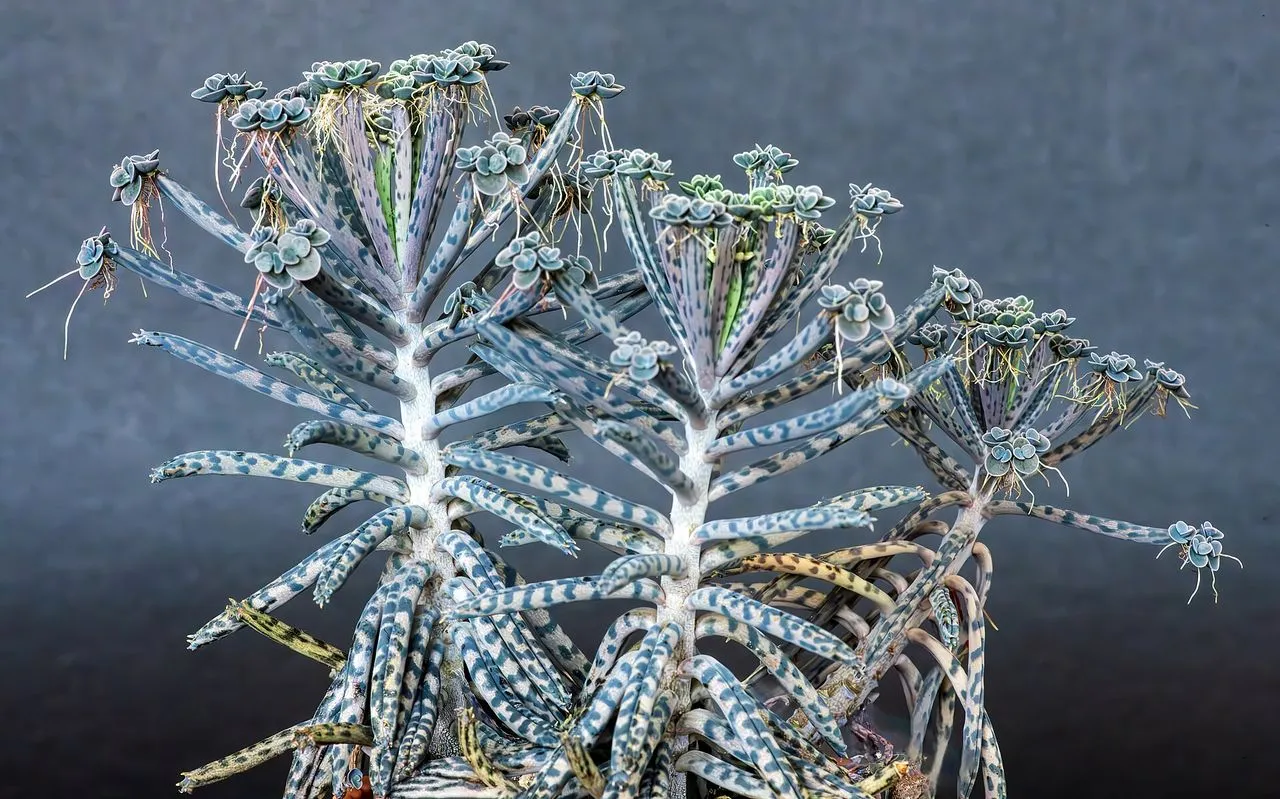
- Leaves. Opposite-decussate, tubular (cylindrical in cross-section) rather than flat, 5–15 cm long, channelled on the upper surface, grey-green mottled with purple-brown blotches.
- Bulbils. A small cluster of 3–9 asexual plantlets forms at the leaf tip, rather than along the leaf margin. Each plantlet has roots already initiated before detachment. This is diagnostic: K. daigremontiana produces bulbils along its marginal teeth; K. delagoensis produces them at the apex of tubular leaves.
- Inflorescence. A terminal panicle 10–30 cm tall bearing pendulous tubular red-orange to coral-red flowers, each 2.5–3 cm long. Flowers in winter to early spring in the northern hemisphere.
The hybrid K. × houghtonii (D.B.Ward) crosses K. daigremontiana with K. delagoensis and shows intermediate leaves: shallowly channelled, margin-toothed but with bulbils at both margins and tips. It is more vigorous and more invasive than either parent.
Cultivation
Among the easiest succulents in cultivation. Any free-draining substrate, any watering regime that does not leave the roots standing in water, and bright light. Tolerates bright shade through full sun. Frost at 0°C kills leaves; below −2°C stems are lost. In frost-free regions outdoors, container cultivation is the only responsible option.
The one deliberate cultivation consideration is bulbil containment. A mature plant can shed several hundred rooted plantlets per week during summer. Stand the pot on a saucer or gravel tray, sweep or hoover around the plant weekly, and bin (do not compost) collected bulbils.
Propagation
Automatic. Leaf-tip bulbils root on contact with moist substrate within days. For intentional propagation, shake a few bulbils into a seed tray of damp substrate, cover lightly, keep at 22°C, and pot on once the plantlets reach 3 cm. Stem cuttings also root easily but are rarely needed.
Notes
Toxicity is significant. K. delagoensis is implicated in more documented livestock poisoning events than any other Kalanchoe, with major cattle loss events recorded on Australian pastoral land through the 1980s and 1990s. The bufadienolide load is highest in flowers; grazing animals that avoid the leaves will sometimes browse on the inflorescence and die from cardiac arrhythmia within 24–48 hours. Human and pet ingestion cases are rare but published. Do not grow this species outdoors where pets, children, or livestock have access.
See also
- Kalanchoe daigremontiana
- Kalanchoe pinnata
- The Complete Kalanchoe Guide
- Kalanchoe prolifera — a tall cane-forming relative with pinnate compound leaves and comparable bulbil production in frost-free regions.
Frequently Asked Questions
How is Kalanchoe delagoensis different from Kalanchoe daigremontiana?
K. delagoensis has tubular leaves with bulbils clustered at the tips. K. daigremontiana has flat triangular leaves with bulbils along the marginal teeth.
How cold can Kalanchoe delagoensis get?
Leaves are killed by frost around 0 °C, and stems are lost below −2 °C. Container cultivation is the responsible option in frost-free regions.
How fast do Kalanchoe delagoensis bulbils root?
Leaf-tip bulbils root on contact with moist substrate within days. Plantlets can be potted on once they reach about 3 cm.
Is Kalanchoe delagoensis poisonous?
Yes. The post flags significant toxicity, especially in flowers, with livestock deaths from cardiac arrhythmia within 24–48 hours after browsing inflorescences.