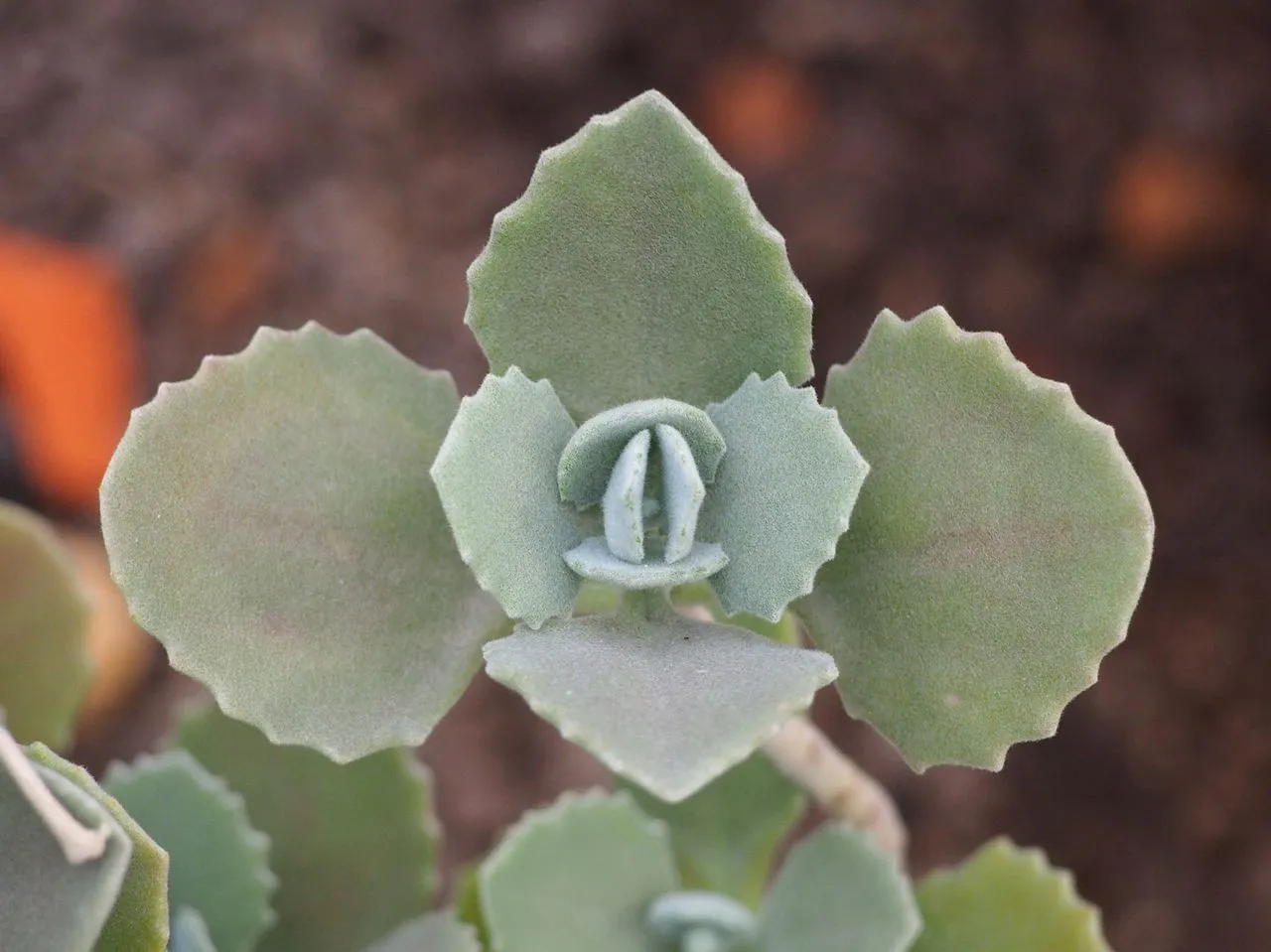
Every Kalanchoe blossfeldiana grower recognises the post-flowering sprawl: stems elongate, leaves space apart, and the tidy flowering mound from the nursery becomes a loose, leafy tangle. This is not disease — it is the plant's natural post-reproductive growth pattern combined with the wrong environment. Left unmanaged, it produces a woody, increasingly bare-stemmed plant that flowers sparsely or not at all in subsequent cycles.
The fix is pruning, and timing matters more than technique. Part of the Complete Kalanchoe Guide.
Natural post-bloom stem extension
Kalanchoe blossfeldiana produces flower stalks from the tips of its stems. After those stalks finish flowering, the stem continues growing from the tip. Without intervention, it extends upward or outward with leaves that are progressively more widely spaced than pre-flowering leaves. The stem is essentially channelling resources into new vegetative growth at its existing tip rather than producing new compact branching lower down.
This pattern is normal, but it is not desirable for a compact houseplant. Commercial growers address it by pinching or pruning at precise stages during production. At home, the equivalent is prompt pruning of spent flower stalks, which removes the apical dominance signal at the stem tip and releases lateral buds below the cut into active growth. Those lateral buds produce new, compact side shoots that will carry the next flowering cycle.
A plant where pruning is delayed by weeks or months after flowering has already sent significant resources into the extended stem. The result is visibly leggy — long sections of bare or widely-leaved stem below a small tuft of new growth at the tip. The good news is that this is fully correctable at any stage.
Insufficient light accelerating the stretch
Low light is the second major driver of post-flowering legginess. In bright indirect light, the new vegetative growth that emerges after flowering is compact and firmly leaved. In dim conditions — a north-facing windowsill, a position 2 m or more from any window — new growth is thinner, with longer internodes and more widely spaced leaves. The plant stretches toward the light source.
Kalanchoe needs significantly more light during its vegetative growth phase than most growers provide. A minimum of 4–6 hours of bright indirect light (east or south window), or 12–14 hours of grow light at 150–250 µmol/m²/s PAR, keeps growth compact. A plant moved to a dim spot to "recover" after flowering will become progressively leggier despite any amount of pruning. Move the plant to its brightest position immediately after pruning — not after it has already stretched.
Failure to remove spent flower stalks promptly
An often-overlooked cause of post-flowering legginess is the continued presence of the spent flower stalks themselves. After the petals have dropped, the stalk continues to exert apical dominance — the hormonal suppression of lower lateral buds — even though it is no longer producing flowers. Leaving spent stalks for 4–6 weeks while "waiting to see if more flowers come" suppresses new side-shoot formation during that window. By the time the stalk is finally removed, the plant has missed 4–6 weeks of potential compact re-growth.
Cut spent stalks promptly, cutting just above a healthy leaf node. Use sterile scissors or a clean blade — jagged or dirty cuts on Kalanchoe can introduce fungal infection in humid conditions.
How to prune a moderately leggy Kalanchoe
For a plant that is mildly to moderately leggy — stems elongated by 3–8 cm with a few widely-spaced leaves:
- Identify the point on each stem where leaf spacing starts to tighten, or where you want to encourage new branching.
- Cut the stem just above a leaf node at that point, using clean scissors or a blade sterilised with isopropyl alcohol.
- Remove all spent or faded flower stalks at the same time, cutting them back to the first healthy leaf node below the stalk base.
- Do not remove more than one-third to one-half of the plant's total height in a single session if the plant is weakened. A vigorous, well-rooted plant tolerates a harder cut.
- Place the plant in the brightest available indirect light immediately.
- Water normally. Do not fertilise for 2–3 weeks to allow cut sites to seal before pushing new growth.
New side shoots emerge from the cut nodes within 10–21 days in bright conditions. After 4–6 weeks, the plant should have a noticeably bushier appearance.
How to recover a severely leggy plant
A plant where stems are 15 cm or more of bare woody growth with leaves only at the tips can be cut back hard:
- Cut each stem back to 5–8 cm above the soil level, choosing a point that has at least one leaf node or a visible bud scar.
- The cut stems — if at least 8 cm long with a leaf node — can be rooted as cuttings in dry mineral mix. Allow the cut end to callus for 24–48 hours before inserting into substrate.
- Place both the cut-back mother plant and the cuttings in bright indirect light at 18–22 °C.
- Water the mother plant sparingly until new growth emerges from the nodes; then resume normal care.
Hard-cut plants resprout reliably in good light within 3–5 weeks. The result is a shorter, branched, compact plant ready for the next flowering cycle.
Preventing legginess between cycles
The post-flowering management sequence that prevents progressive legginess:
- Prune — cut spent stalks immediately, cut back any extended stems by one-third at the same time.
- Light — move to brightest available position, or supplement with a grow light.
- Moderate feed — balanced fertiliser at one-quarter strength monthly during the vegetative phase. Avoid high nitrogen, which drives stem elongation.
- Dark treatment — 4–6 weeks of 14-hour darkness to initiate the next bud cycle (see kalanchoe not blooming for the full procedure).
- Repeat — two flowering cycles per year is achievable with good management.
Risk and severity
Legginess is an aesthetic problem rather than a health threat. A leggy kalanchoe is not dying. However, severe legginess combined with low light progressively weakens the plant — longer stems are more prone to toppling, and sparse leaf cover reduces photosynthetic capacity. A plant left unmanaged for 2–3 years can become a spindly, barely-flowering shadow of its nursery form. Prompt pruning after each flowering cycle prevents this accumulation.
Solutions summary
| Severity | Action |
|---|---|
| Mildly leggy (stems +3–5 cm) | Cut back by one-third, move to bright light |
| Moderately leggy (stems +8–15 cm) | Cut to above first healthy node, remove all spent stalks |
| Severely leggy (mostly bare stem) | Hard prune to 5–8 cm stubs, root the cuttings |
See also
- Kalanchoe not blooming — the dark-period treatment to initiate the next flowering cycle after pruning and recovery.
- Kalanchoe blossfeldiana — the species most affected by post-bloom legginess and the one most commonly sold as a reflowerable houseplant.
- Indoor succulent care — managing light levels to prevent etiolation between flowering cycles.
Frequently Asked Questions
When should I prune my Kalanchoe after flowering?
As soon as the last flowers on a stalk fade and the petals drop. Do not wait for the whole plant to finish — prune each stem as its flower cluster completes. Early pruning triggers new branching sooner.
How far back should I cut a leggy Kalanchoe?
Cut each stem back by one-third to one-half, always cutting just above a leaf node (the point where a leaf attaches). Cutting to a node ensures new side shoots emerge from that point.
Can a very leggy Kalanchoe be saved?
Yes. Even a severely leggy plant can be cut back to 5–8 cm stubs with at least one leaf node each, placed in bright indirect light, and it will resprout. The cut stems can also be rooted as cuttings.
Why does my Kalanchoe get leggy every time after flowering?
Almost always a combination of: not pruning immediately after flowering, insufficient light, and sometimes high nitrogen feeding that drives vegetative growth. Address all three between flowering cycles.