| Question | Short Answer |
|---|---|
| What separates Kalanchoe thyrsiflora from Kalanchoe luciae? | K. |
| Does Kalanchoe thyrsiflora die after flowering? | Yes. |
| How cold can Kalanchoe thyrsiflora tolerate? | Short exposure to −2 °C is survivable on dry plants. |
| Can Kalanchoe thyrsiflora grow from leaf cuttings? | Yes. |
Kalanchoe thyrsiflora Harv. (paddle plant, flapjacks, desert cabbage) was described by the Irish botanist William Henry Harvey in 1862 from specimens collected in the eastern Cape and Natal provinces of South Africa. It is native to rocky grassland slopes and mountain escarpments across eastern South Africa, Lesotho, and parts of Eswatini, at elevations between 600 and 2,000 m.
The plant most gardeners actually buy labelled "paddle plant" or "flapjacks" is K. luciae, not K. thyrsiflora. The two are regularly confused in commerce; the distinction matters and this page explains why.
Part of the Complete Kalanchoe Guide.
Identification
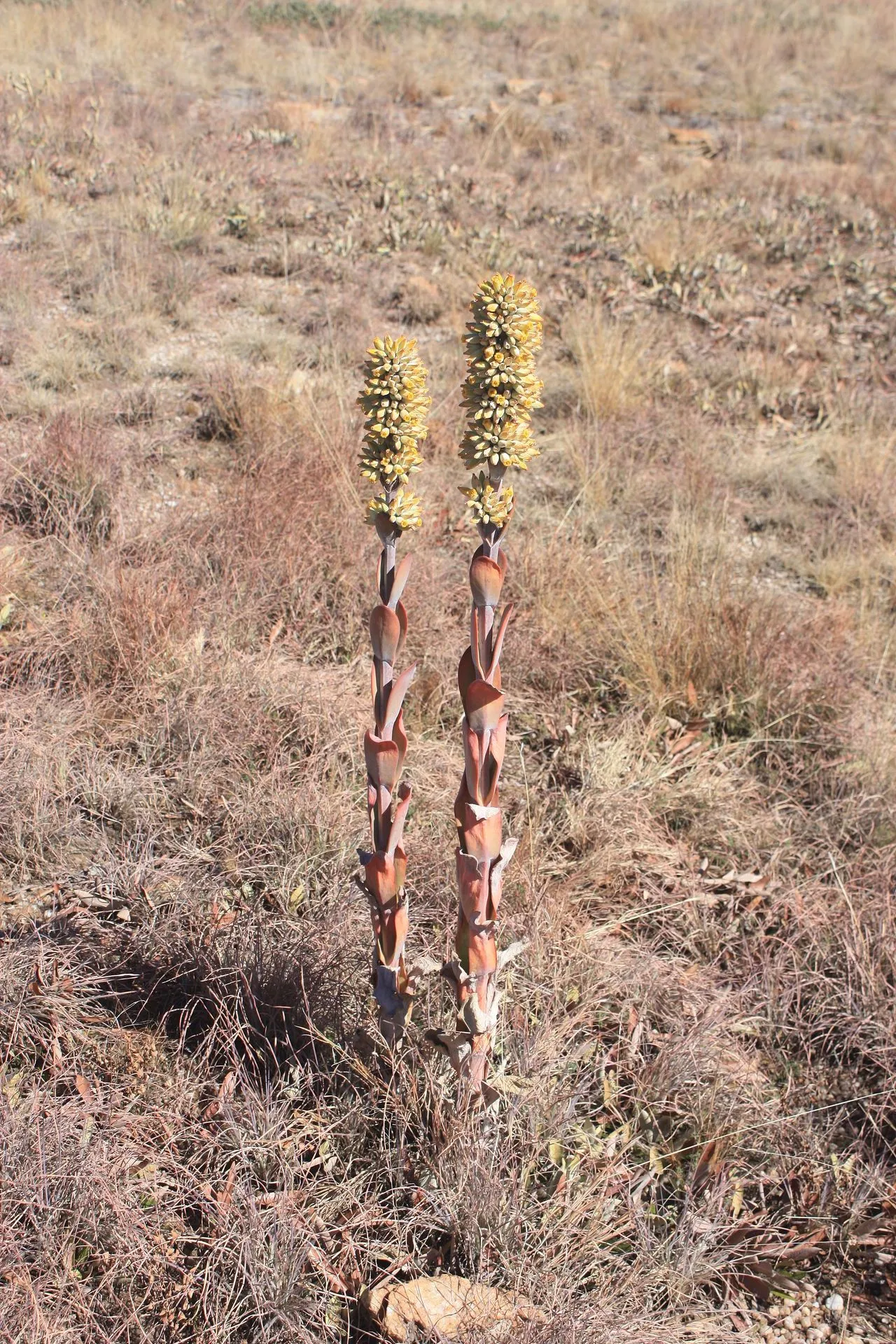
- Habit. Monocarpic biennial to short-lived perennial. Basal rosette for the first 1–2 years, then bolts into a single 60–90 cm inflorescence stem, flowers once, and dies. Offsets typically appear at the base before flowering.
- Leaves. Stacked in an opposite-decussate rosette, but the leaf pairs sit so close together that the rosette appears columnar. Leaves 10–20 cm long, obovate-spatulate, broadly rounded at the tip, heavily glaucous with a thick blue-grey farina coating that rubs off permanently.
- Colouring. Leaves are silvery blue-grey in strong light, sometimes with a subtle reddish flush at the margins in cold weather. They do not turn scarlet red. This is the key character separating the species from K. luciae.
- Inflorescence. A dense terminal thyrse (not a corymb), 30–60 cm tall, bearing numerous small four-merous tubular yellow flowers. The inflorescence is strongly scented, a feature K. luciae lacks.
The three diagnostic characters together: pronounced glaucous farina that rubs off, non-reddening leaves, and yellow fragrant flowers. If a plant shows scarlet leaf edges in winter or bears white flowers, it is K. luciae. See Kalanchoe luciae for the full comparison.
Cultivation
Standard Kalanchoe conditions apply. The species tolerates more cold than average for the genus: short exposure to −2°C is survivable on dry plants, reflecting the altitude of its native range. Grow in full sun outdoors in Mediterranean climates; in temperate indoor cultivation, the brightest south-facing window you have.
Substrate should be mineral-heavy and free-draining. K. thyrsiflora is more sensitive to wet feet than most of the genus; in cool winter conditions, reduce watering to once every 5–6 weeks and keep the crown dry. Never water onto the upper surface of the rosette; the farina reads water like glass and any standing liquid rots the growth point overnight.
Once the plant bolts into flower, the main rosette is finished. Remove the flowering stem at the base once the bloom cycle is complete to encourage the basal offsets. If offsets are absent before flowering, propagate a replacement from leaf cuttings well before the bolt.
Propagation
Leaf cuttings work reliably. Detach a mature lower leaf, callus for 3–5 days, lay on dry substrate, mist weekly. A plantlet develops in 4–6 weeks. Stem cuttings from the pre-bolt rosette are difficult because the rosette has almost no visible internode; wait for offsets instead.
Seed from a flowering plant germinates readily at 22°C under light humidity. Seedlings reach saleable size in 18 months but flowering-size plants take 3 years.
Notes
Much of the K. thyrsiflora in the European and North American trade is in fact K. luciae. A confident identification requires seeing the flower colour, which most nursery plants have not yet produced. The practical rule: if you bought a paddle plant with red leaf margins from a garden centre, it is almost certainly K. luciae. A plant with uniformly blue-grey leaves and a strong sweet scent when it finally flowers is the real K. thyrsiflora.
Toxic like the rest of the genus; keep out of reach of pets and livestock.
See also
Frequently Asked Questions
What separates Kalanchoe thyrsiflora from Kalanchoe luciae?
K. thyrsiflora has heavy blue-grey farina, leaves that do not turn scarlet, and fragrant yellow flowers. K. luciae has glabrous red-flushing leaves and unscented whitish flowers.
Does Kalanchoe thyrsiflora die after flowering?
Yes. It is monocarpic, bolting after 1–2 years, flowering once, and then dying while basal offsets carry the plant forward.
How cold can Kalanchoe thyrsiflora tolerate?
Short exposure to −2 °C is survivable on dry plants. Cool wet substrate is the greater risk in winter.
Can Kalanchoe thyrsiflora grow from leaf cuttings?
Yes. Callus a mature lower leaf for 3–5 days, lay it on dry substrate, and mist weekly; a plantlet develops in 4–6 weeks.