| Question | Short Answer |
|---|---|
| How do you tell Kalanchoe luciae from Kalanchoe thyrsiflora? | K. |
| Does Kalanchoe luciae die after flowering? | Yes. |
| How cold-hardy is Kalanchoe luciae? | Dry plants can survive short exposure to about −1 °C. |
| How do you propagate Kalanchoe luciae? | Use leaf cuttings or basal offsets. |
Kalanchoe luciae Raym.-Hamet (red pancake, flapjacks, desert cabbage, dog tongue) was described in 1908 from specimens collected in eastern South Africa, but for most of the twentieth century it was lumped under K. thyrsiflora. Raymond-Hamet's original separation was reinstated by Toelken in 1985 and confirmed by subsequent morphological and molecular work. The species is native to the grasslands and mountain escarpments of eastern South Africa, Eswatini, southern Mozambique, and Zimbabwe.
In the ornamental trade K. luciae is hugely more common than K. thyrsiflora, and most plants sold as "paddle plant" in garden centres are this species. The two are separable on sight once you know the characters to look for.
Part of the Complete Kalanchoe Guide.
Identification
- Habit. Monocarpic biennial to short-lived perennial. Single rosette for 1–3 years, then bolts into a 60–120 cm inflorescence, flowers once, and dies. Offsets often form at the base before flowering.
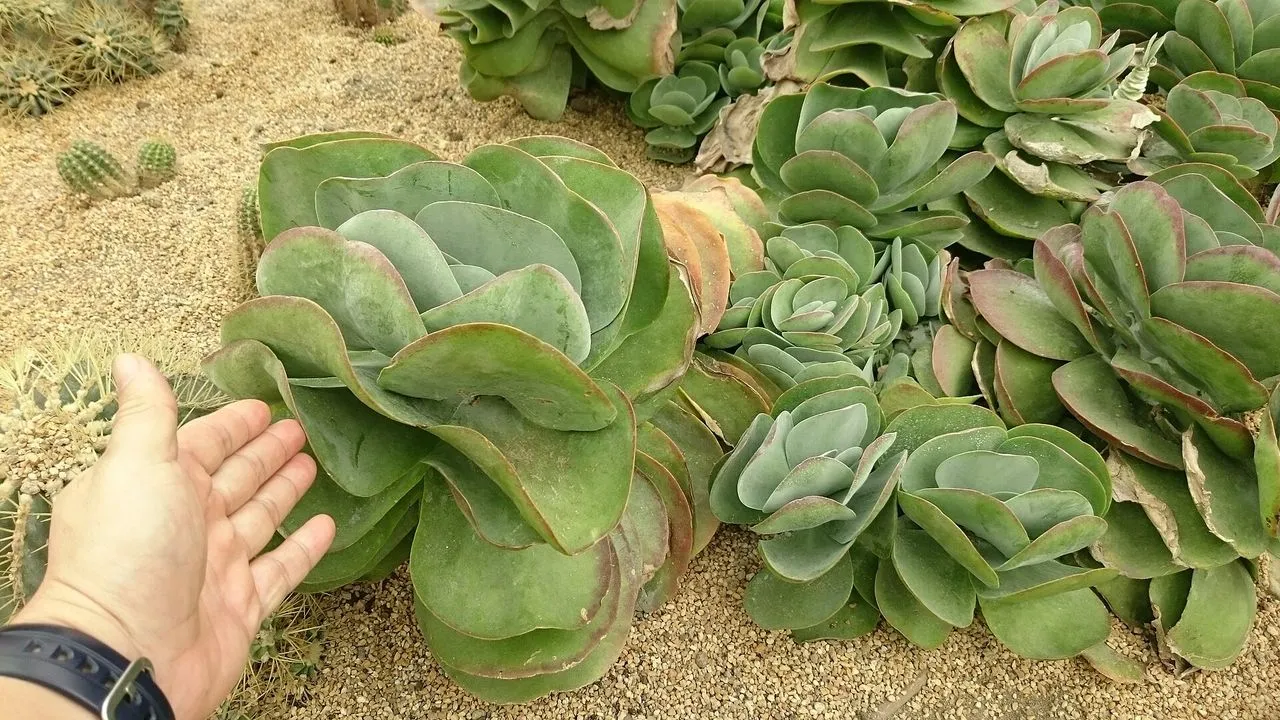
- Leaves. Opposite-decussate, stacked in a compact rosette, 10–18 cm long, obovate and broadly rounded at the tip. Surface glabrous, not waxy-farinose. Colour a fresh mid-green flushing to bright scarlet red on the sun-exposed faces and margins under cool bright conditions. This reddening is the diagnostic feature.
- Inflorescence. A dense terminal thyrse bearing many small four-merous urn-shaped flowers in greenish-white to cream. The flowers are not fragrant. Pollen sterile in most garden populations; seed rare.
- Contrast with K. thyrsiflora. K. thyrsiflora has heavily farinose blue-grey leaves that do not redden, and strongly scented yellow flowers. K. luciae has glabrous leaves that flush scarlet, and unscented whitish flowers. Either species may be labelled "paddle plant" in commerce; the red-leaf character, visible at point of sale in any cool-grown specimen, is definitive. See Kalanchoe thyrsiflora.
Cultivation
Standard Kalanchoe conditions apply. The species is slightly more sun-demanding than the genus average: the scarlet leaf colouring develops only under 5–6 hours of direct sun daily combined with cool nights (below 12°C). Shaded or warm-grown plants stay green and look unremarkable.
Cold tolerance extends slightly below genus-average. Short exposure to −1°C is survivable on dry plants, reflecting the high-altitude origin of wild populations in the Drakensberg. Winter watering should drop to once every 5–6 weeks; keep the crown dry and the substrate free-draining.
The cultivar 'Fantastic' is an unstable variegated form with irregular cream and pink sectors; it is slower, smaller, and more cold-sensitive than the straight species. Revert shoots should be removed at the base as soon as noticed, as in all variegated succulents.
Propagation
Leaf cuttings and offsets both work. For leaves, detach a mature lower leaf, callus for 5–7 days, lay on dry substrate, mist weekly. A plantlet appears in 4–8 weeks; success rate around 50%. For offsets, wait until the basal pup reaches a third the size of the parent rosette, sever at the base with a sharp sterile blade, callus for 3–5 days, pot in standard substrate. Offsets establish within 3 weeks.
Once a rosette has bolted into flower it will not produce leaves again; propagate from the spent plant's basal offsets rather than from the inflorescence itself.
Notes
Mislabelling is pervasive: the species is sold as K. thyrsiflora in most European and North American garden centres. A purchase of "paddle plant" almost certainly yields K. luciae. This matters for identification accuracy, not for cultivation: both species take near-identical care.
Toxicity is typical for the genus. Keep cut flower stalks and spent plants out of reach of pets and livestock.
See also
Frequently Asked Questions
How do you tell Kalanchoe luciae from Kalanchoe thyrsiflora?
K. luciae has glabrous leaves that flush scarlet and unscented whitish flowers. K. thyrsiflora has farinose blue-grey leaves, no scarlet flush, and fragrant yellow flowers.
Does Kalanchoe luciae die after flowering?
Yes. It is monocarpic: the rosette bolts, flowers once, and dies, usually after producing basal offsets.
How cold-hardy is Kalanchoe luciae?
Dry plants can survive short exposure to about −1 °C. Winter watering should drop to once every 5–6 weeks and the crown should stay dry.
How do you propagate Kalanchoe luciae?
Use leaf cuttings or basal offsets. Leaves produce plantlets in 4–8 weeks at about 50% success, while offsets establish within 3 weeks after callusing.