| Question | Short Answer |
|---|---|
| How do you identify Kalanchoe rotundifolia? | Look for small smooth pale glaucous round to obovate leaves, red-purple margins under sun, and bright orange to red-orange tubular flowers. |
| How cold can Kalanchoe rotundifolia tolerate? | Its practical lower limit is about 4 °C when dry and dormant. |
| How often should Kalanchoe rotundifolia be watered? | In active growth, water after the upper 3–4 cm dries. |
| Is Kalanchoe rotundifolia pet-safe? | No. |
Kalanchoe rotundifolia (Haw.) Haw., the common kalanchoe, is a southern and eastern African subshrub described by Adrian Hardy Haworth in 1825. It grows in South Africa, Botswana, Namibia, Zimbabwe, and Mozambique, mostly on rocky hillsides and open bushveld at about 200 to 1,800 m. The species is usually 20 to 60 cm tall, with opposite round to obovate pale glaucous-green leaves 1.5 to 4 cm wide, which is the source of the name "rotundifolia".
The species name suggests a circular blade, but the leaf is broadly obovate to nearly orbicular, sometimes spathulate. The label reflects how broad the leaves look against the narrow foliage of many other kalanchoes, not a precise round outline. In habitat, K. rotundifolia is not a forest plant. It belongs to dry, open ground where roots work into gravelly pockets between grasses and acacia scrub. Rain arrives in pulses, drainage is fast, and flowering falls in the winter to spring window when local pollinators are active. In cultivation, that origin translates into strong light, a mineral substrate, restrained winter watering, and protection from frost.
Part of the Complete Kalanchoe Guide.
Identification
K. rotundifolia grows as an erect to spreading subshrub rather than a flat rosette. Young plants in a 9 or 10 cm pot may look compact, but mature stems lengthen and branch from the base, and the lower stems become woody with age. A potted plant commonly settles at 20 to 40 cm; in a frost-free bed with good light it can reach 60 cm.
The leaves are opposite, fleshy, and round to obovate or spathulate, with a wavy or coarsely toothed margin near the tip. They are usually 1.5 to 4 cm wide and a similar length, carried on short petioles that hold the blade close to the stem. The surface is glabrous, meaning smooth and not felted. The background colour is a pale glaucous green, often with a fine waxy bloom that lifts off slightly under a thumb. Under sun stress, the margins turn red to red-purple, and the whole blade can take a warm flush. This margin colour is a stress signal, not a constant feature, so a shaded plant can read uniformly green and still be the correct species.
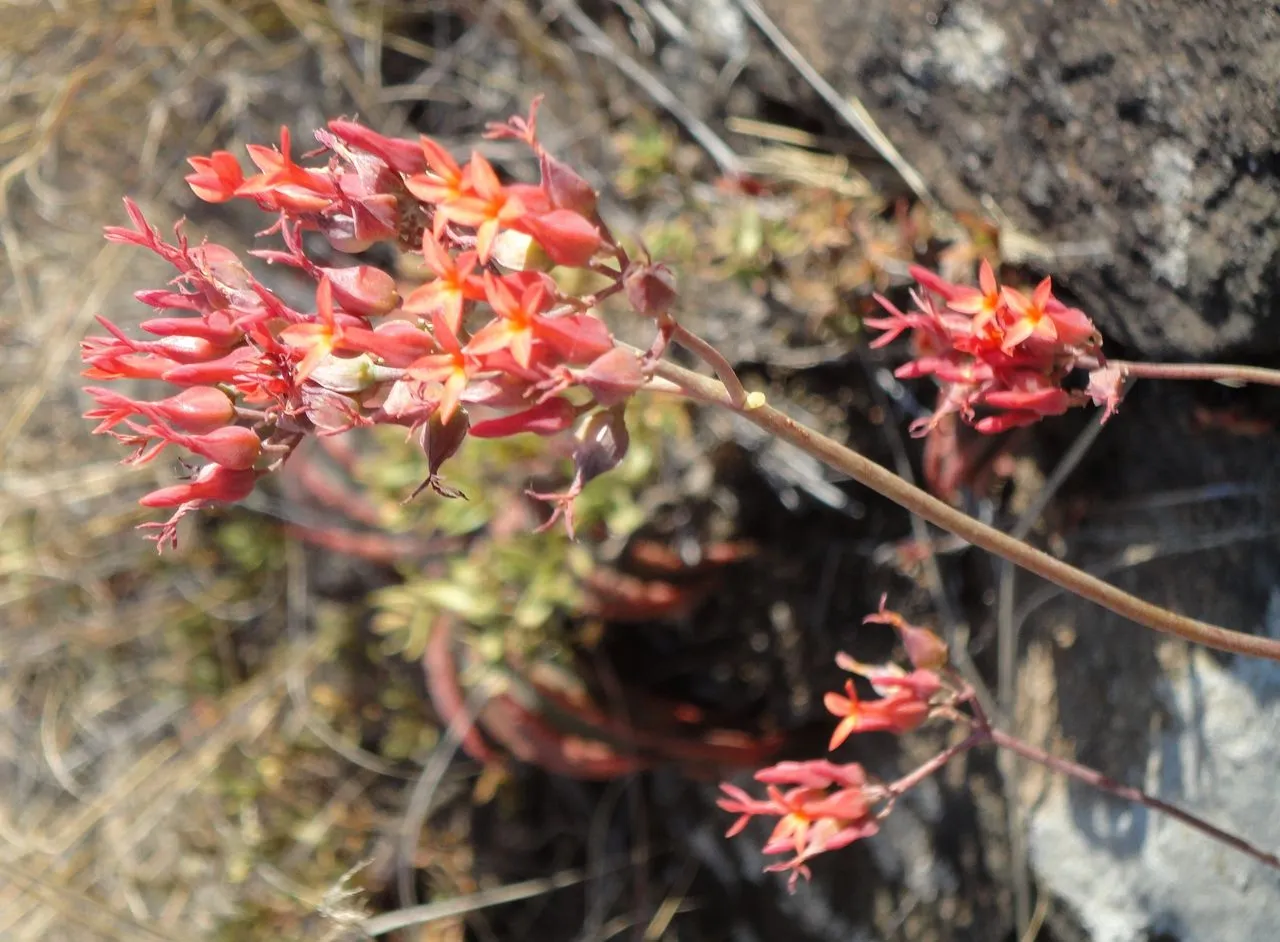
Flowers appear from late autumn into spring, depending on day length and warmth. The inflorescence is a branched cyme above the foliage, carrying small tubular flowers that flare open into a four-parted star. Colour is bright orange to red-orange, sometimes with a yellow throat. Indoor plants may not flower every year if light is marginal, but the round leaf shape and glaucous bloom are distinctive enough that flowering is not required for an identification.
The most common confusions are with three sibling kalanchoes. Kalanchoe blossfeldiana is the florist plant sold every winter in supermarket trolleys; it has dark green felted leaves with rounded teeth, a dense panicle of small pink, red, orange, white, or yellow flowers, and is far more widely circulated in the trade than K. rotundifolia. Kalanchoe fedtschenkoi has notched, pale grey-green to lavender-pink leaves and pendant lavender-pink bell flowers, an entirely different palette and outline. Kalanchoe marmorata has much larger smooth leaves carrying irregular dark purple-brown blotches across both surfaces. If the plant has small, smooth, pale glaucous, round-edged leaves with red-purple margins under sun and bright orange flowers in winter to spring, K. rotundifolia is the right name.
Cultivation
Give K. rotundifolia bright light with at least some direct sun. Indoors in a temperate climate, a south or west window suits it; an east window will keep it alive, but the stems often lean and the leaves widen. Outdoors, morning sun with light afternoon shade is safer in hot inland summers, while a hardened plant takes longer exposure in mild coastal gardens. Aim for 4 to 6 hours of direct sun in the active season. Acclimate gradually over 10 to 14 days if the plant has come from a shaded bench, because the smooth leaf surface lacks protective felt and sunburn appears as pale tan patches that do not heal.
Water by dryness, not by a fixed weekly habit. In active spring and summer growth, soak the pot thoroughly, then wait until the upper 3 to 4 cm of mix is dry and the pot feels light. In a 10 cm terracotta pot under warm light, that may be every 7 to 10 days. In a 13 cm plastic pot indoors, every 2 to 3 weeks is more typical. With a moisture probe, water when the upper 3 cm reads below 15 percent and the lower stem is still firm.
Winter watering should be restrained. When nights are below 12 °C and days are short, give only enough water to prevent deep shrivelling, often once every 4 to 6 weeks in a mineral mix. Keep K. rotundifolia drier than the blossfeldiana cousin sold as a winter pot plant, because the round-leaved species is closer to its dryland habit and resents prolonged damp roots in cool air.
Use a fast, mineral-leaning substrate. A practical range is 60 to 75 percent mineral material, such as pumice, fine lava rock, coarse grit, or expanded shale, with the remainder peat-free or low-peat organic matter. Push toward 75 percent mineral in humid rooms; a hot dry greenhouse can carry a little more organic matter to soften the dry-down between waterings.
Temperature is the hard boundary. K. rotundifolia is frost-sensitive, with a practical lower limit of about 4 °C if the plant is dry and dormant. Below that, leaves mark and stems can collapse from internal ice damage. Treat 5 °C as the working winter floor, and keep young cuttings warmer at 10 °C or above. In USDA terms, this is roughly Zone 10b outdoors.
Match the pot to the root ball, not to the height of the shoots. Young plants do better in a 9 to 10 cm pot than in a wide decorative bowl that holds damp at the edges. Move up one size when roots hold the mix together and water runs through too quickly. Terracotta helps in cool or humid homes; plastic is workable in bright warm rooms but should be paired with a more mineral mix.
Feed lightly. During active growth, apply a balanced low-nitrogen succulent fertiliser at one-quarter to one-half label strength every 4 to 6 weeks after a normal watering. Heavy nitrogen produces softer, greener leaves, blunts the red margin colour, and can reduce flowering. For broader watering and light principles across mixed collections, use the Beginner's Guide to Succulents, then keep K. rotundifolia's 4 °C limit and orange-flowered habit in your species notes.
Propagation
Stem cuttings are the most reliable route. Take a firm, non-flowering shoot 5 to 8 cm long in late spring or summer, when warmth is steady. Strip the lowest pair of leaves and let the cutting sit in bright shade for 3 to 5 days, until the cut surface is fully dry. Do not push a fresh kalanchoe cutting into damp mix. Set it upright in dry pumice or in a mix that is at least 70 percent mineral. At 22 to 28 °C, stem cuttings usually root in 2 to 3 weeks. Nudge the stem to test; resistance means new roots have started. Give the first light watering after that point, then move toward a normal soak-and-dry rhythm.
Leaf cuttings work but are uneven. Detach a healthy mature leaf with the base intact, dry it for 2 to 3 days, then lay it on barely damp mineral substrate in warm shade. A small shoot may appear in 6 to 10 weeks, but many leaves root without forming a plantlet or dry away first. For preserving a particular flower colour or strong margin colour, stem cuttings are faster and more predictable.
Seed is feasible but uncommon in domestic cultivation. Ripe capsules release fine dust-like seed. Sow on the surface of a sterile fine mineral mix, mist lightly, and keep at 22 to 25 °C in bright shade. Germination is often within 7 to 14 days, but seedlings are variable in habit and flower colour, so seed is more useful for breeding than for replicating a known clone.
Notes
K. rotundifolia, like the rest of the genus, contains cardiac glycosides and should be treated as unsafe for cats, dogs, rabbits, livestock, and grazing wildlife. In southern Africa it is one of several species implicated in chronic stock poisoning, known locally as krimpsiekte, where repeated ingestion produces neuromuscular weakness in sheep and goats. In a household, the practical risk is a curious pet chewing fallen leaves or pruned stems. Keep cuttings, dropped leaves, and rooted offsets away from animals, and do not place this plant on a low shelf where it can be sampled.
The common name "common kalanchoe" is misleading. The most commonly sold kalanchoe in florist shops is K. blossfeldiana, not K. rotundifolia. Specialist nurseries do offer K. rotundifolia, sometimes under the South African vernacular nentabos or nentakalanchoe, but the round-leaved orange-flowered species is uncommon in mass retail. If a plant labelled "Kalanchoe rotundifolia" has felted dark green leaves and a dense panicle of pink or red flowers, it is almost certainly a mislabelled K. blossfeldiana.
Mealybugs settle in leaf axils and along young stems, especially during slow indoor winter growth. Inspect node joints every few weeks and lift small colonies with a cotton bud dipped in 70 percent isopropyl alcohol, then keep the plant out of direct sun until treated spots dry.
Pruning is safe in warm weather. Cut back to a firm node if the shrub becomes tall or leans strongly toward the window. Hold off watering for several days afterwards, then resume normal care once the wound has sealed. Avoid hard pruning in winter, when callusing is slow and the lower stem is more vulnerable to rot in cool damp air.
See also
- Complete Kalanchoe Guide
- Beginner's Guide to Succulents
- Kalanchoe blossfeldiana, the felted florist kalanchoe with dense panicles of small pink, red, or orange flowers and far wider mass-market circulation.
- Kalanchoe fedtschenkoi, the notched lavender-leaved sibling whose pendant flowers and grey-pink foliage do not match the round green leaves and orange flowers of K. rotundifolia.
- Kalanchoe marmorata — a larger smooth-leaved East African sibling with purple-brown penwiper blotches, for comparison within the glabrous kalanchoe group.
Frequently Asked Questions
How do you identify Kalanchoe rotundifolia?
Look for small smooth pale glaucous round to obovate leaves, red-purple margins under sun, and bright orange to red-orange tubular flowers.
How cold can Kalanchoe rotundifolia tolerate?
Its practical lower limit is about 4 °C when dry and dormant. Treat 5 °C as the working winter floor and keep young cuttings above 10 °C.
How often should Kalanchoe rotundifolia be watered?
In active growth, water after the upper 3–4 cm dries. In cool short days, give only enough water to prevent deep shrivelling, often every 4–6 weeks.
Is Kalanchoe rotundifolia pet-safe?
No. Like the rest of the genus, it contains cardiac glycosides and should be kept away from pets, livestock, and grazing wildlife.