| Question | Short Answer |
|---|---|
| How do you identify Kalanchoe marmorata? | The leaves are smooth, opposite, 4–10 cm long, and marked with irregular purple-brown blotches across both surfaces. |
| How cold can Kalanchoe marmorata get? | Protect it before nights approach 4 °C and treat 5 °C as the practical lower limit. |
| How should Kalanchoe marmorata be watered? | Soak during active growth, then wait until the upper 3–4 cm dries and the pot feels light. |
| Can Kalanchoe marmorata grow from leaf cuttings? | Leaf cuttings are possible but uneven. |
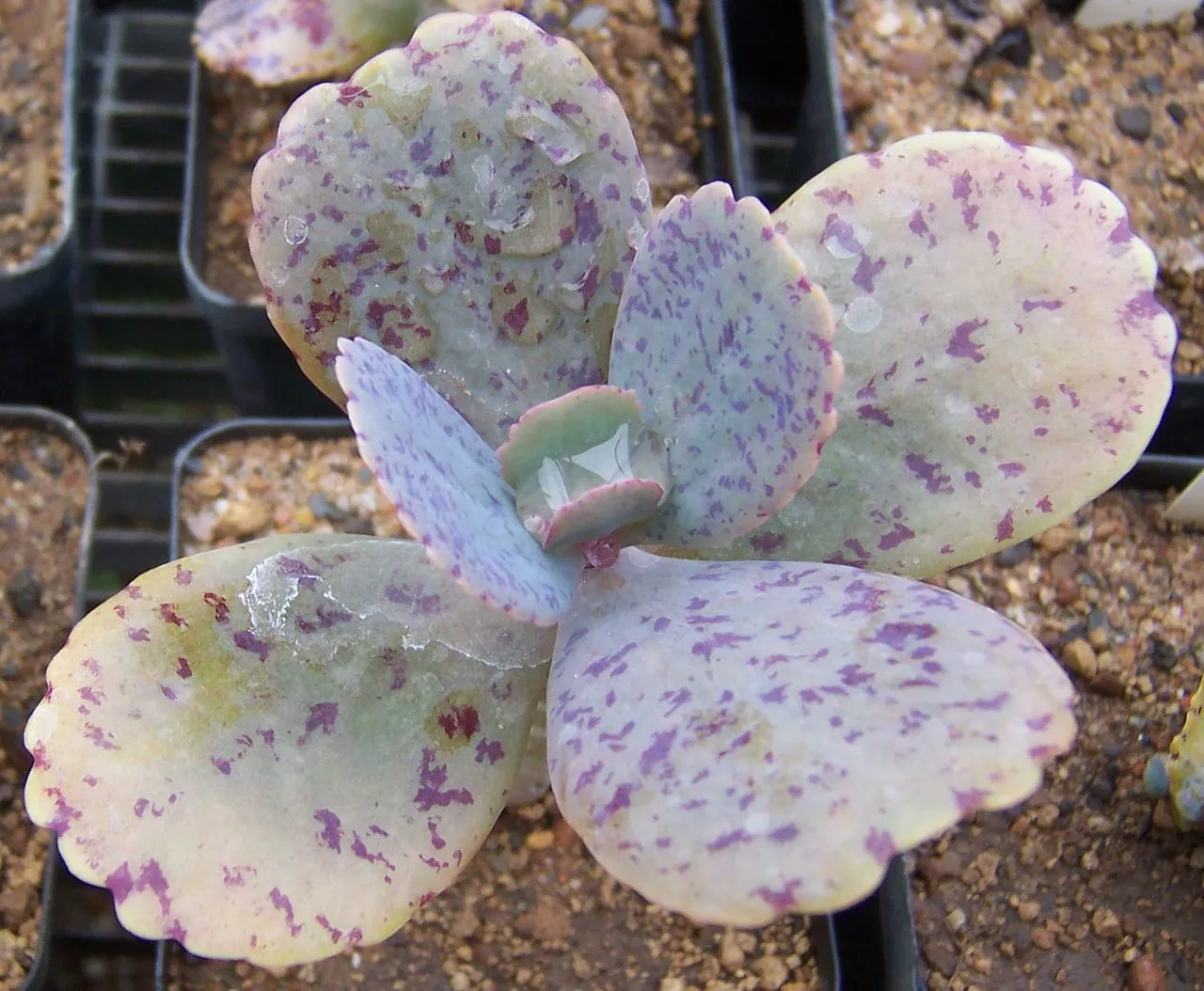
Kalanchoe marmorata Pax ex Engl., the penwiper plant, is an East African shrub described by Ferdinand Albin Pax in Adolf Engler's treatment in 1894. It grows from Ethiopia, Sudan, Kenya, Tanzania, the Democratic Republic of the Congo, and Somalia, mostly on rocky bushveld and acacia savanna at about 600 to 2,000 m. The species is usually 30 to 90 cm tall, with opposite blue-grey-green leaves 4 to 10 cm long and irregular dark purple-brown blotches on both leaf surfaces.
Those markings are the reason for the common name. A penwiper was the cloth or pad used to clean ink from a quill or dip pen, and the leaf surface can look as if it has been touched with diluted brown ink. In habitat, K. marmorata is not a forest plant. It belongs to open, seasonally dry ground where roots work into gravelly pockets between rocks, shrubs, and grasses. Rain arrives in pulses, drainage is quick, and dry air follows storms. In cultivation, that origin translates into strong light, a mineral substrate, careful winter watering, and protection from frost.
Part of the Complete Kalanchoe Guide.
Identification
K. marmorata grows as an erect to leaning shrub rather than a tight rosette. Young plants may look compact in a 9 or 10 cm pot, but mature stems lengthen and branch, especially after flowering or pruning. The lower stems become woody with age. A potted plant commonly reaches 30 to 60 cm; in warm frost-free beds it can approach the upper end of the 90 cm range.
The leaves are opposite, ovate to elliptic, and usually 4 to 10 cm long. Their surface is glabrous, meaning smooth and not felted. This point matters more than leaf colour, because light and nutrition can shift the background from blue-grey-green to greener or paler grey. The diagnostic character is the dark purple-brown marbling on both surfaces of the leaf. The blotches are irregular, not a neat row of edge spots, and they often become stronger under bright light.
Flowers appear from late winter into spring when the plant has had enough light and a seasonal shift in day length. The inflorescence is a terminal cyme above the foliage, carrying white to pale yellow tubular flowers. Each flower opens with a four-parted, cross-shaped mouth typical of many kalanchoes. Indoor plants may not flower every year, but the leaves are distinctive enough that flowering is not required for identification.
The main confusion is with other shrubby kalanchoes. Kalanchoe tomentosa has densely felted grey leaves, usually with brown markings at the tips or margins, not smooth leaves with broad blotches across both surfaces. Kalanchoe orgyalis has copper to bronze trichomes on young leaves and a spoon-shaped blade; it reads furry and metallic rather than ink-spotted. Kalanchoe beharensis is much larger, with coarse triangular to peltate leaves and a heavy felted surface. K. marmorata is smoother, smaller, and more openly blotched.
The paddle kalanchoes, Kalanchoe luciae and Kalanchoe thyrsiflora, are different in outline. They form broad rounded paddles, often stacked in a basal rosette or short stem, and they lack the penwiper blotches. Red margins from sun stress on a paddle plant should not be read as marbling. If the plant has opposite smooth blue-grey-green leaves with irregular purple-brown marks on both sides, K. marmorata is the better fit.
Cultivation
Give K. marmorata bright light and enough direct sun to keep the stems firm. Indoors in a temperate climate, a south or west window is usually best. An east window can maintain the plant, but the stems often lean and the blotches fade. Outdoors, morning sun with light afternoon shade is safer in hot inland summers. In mild coastal gardens, a hardened plant can take longer sun exposure if air movement is good.
Acclimation is worth the patience. Leaves grown under nursery shade can scorch if moved straight against hot glass or into full midday sun. Increase exposure over 10 to 14 days. The smooth leaf surface does not have the dense protective felt of K. tomentosa or K. orgyalis, so sunburn shows as pale tan patches that do not heal.
Water by dryness, not by a fixed weekly habit. In active spring and summer growth, soak the pot thoroughly, then wait until the upper 3 to 4 cm of mix is dry and the pot feels light. In a 10 cm terracotta pot under warm light, that may be every 10 to 14 days. In a 13 cm plastic pot indoors, it may be closer to every 2 to 3 weeks. If you use a moisture probe, water when the upper 3 cm reads below 15 percent and the lower stem remains firm.
Winter watering should be restrained. When nights sit below 12 °C and days are short, give only enough water to prevent deep shrivelling, often once every 4 to 6 weeks in a mineral mix. Do not keep K. marmorata evenly moist through a cool winter. Damp roots plus low temperature are much more dangerous than a month of slightly soft leaves.
Use a fast, mineral-leaning substrate. A practical range is 60 to 75 percent mineral material, such as pumice, fine lava rock, coarse grit, expanded shale, or sharp sand, with the remainder low-peat or peat-free organic matter. In humid rooms, move closer to 75 percent mineral. In a hot dry greenhouse, a little more organic matter can help prevent repeated leaf collapse between waterings.
Temperature is the hard boundary. K. marmorata is frost-intolerant and should be protected before nights approach 4 °C. A dry, established plant may survive a brief dip near that level with leaf marking or leaf drop, but a wet plant can rot quickly. Treat 5 °C as the practical lower limit, and keep young cuttings warmer. Do not group it with cold-tolerant succulents and assume the whole bench can take the same winter night.
Pot size should follow the root ball. A young plant is usually better in a 9 to 10 cm pot than in a wide bowl that stays damp at the edges. Move up one size when roots hold the mix together and water runs through too quickly. Terracotta helps in cool or humid homes. Plastic is workable in bright warm rooms, but it lengthens drying time and calls for a more mineral mix.
Feed lightly during active growth. Use a balanced low-nitrogen succulent fertiliser at one-quarter to one-half label strength every 4 to 6 weeks after a normal watering. Heavy nitrogen gives softer, greener stems and can dilute the blotched pattern. For broader watering and light principles across mixed collections, use the Beginner's Guide to Succulents, then keep K. marmorata's frost limit and smooth-leaf sun sensitivity in your species notes.
Propagation
Stem cuttings are the cleanest method. Take a firm, non-flowering shoot 6 to 10 cm long in late spring or summer, when warmth is steady. Remove the lowest pair of leaves and set the cutting in bright shade for 3 to 5 days, until the cut surface is dry and sealed. Do not push a fresh kalanchoe cutting into damp mix. The base can rot before roots start.
Place the cutting upright in dry pumice or in a mix that is at least 70 percent mineral. Hold water until the stem resists a gentle nudge, usually after 2 to 3 weeks at 22 to 28 °C. Give the first light watering after that point, then move gradually toward the normal soak-and-dry rhythm. In cooler rooms, rooting may take 4 weeks or more.
Leaf cuttings are possible but uneven. Choose a mature healthy leaf, detach it cleanly with the base intact, and let it dry for 2 to 3 days. Lay it on barely damp mineral substrate in warm shade. Some leaves root and form a small shoot after 6 to 10 weeks, but others root without making a plantlet or dry away. If you want to preserve a well-marked clone, stem cuttings are more reliable.
Seed is rarely used by home growers. The flowers are small, pollination is fiddly, and seedlings vary in strength of spotting. Seed-grown plants can be interesting, but they are slower than cuttings and not the best route if the goal is to keep the same leaf pattern.
Notes
Trade labels around spotted and fuzzy kalanchoes are often loose. The safest way to check a plant is to touch the leaf surface lightly and look at the pattern. K. marmorata should feel smooth, not plush, and the marks should sit as irregular blotches across the blade. A fuzzy plant with brown-tipped leaves points toward K. tomentosa. A copper-furred plant points toward K. orgyalis. A large felted plant with triangular leaves points toward K. beharensis.
Mealybugs can settle at the leaf bases and along young stems. Inspect branch joints every few weeks, especially in winter when growth is slow and air movement indoors is poor. Remove small colonies with a cotton bud dipped in 70 percent isopropyl alcohol, then keep the plant out of direct sun until treated spots dry. Recheck after 7 to 10 days, because crawlers can hide in tight nodes.
Like the rest of the genus, K. marmorata should be treated as pet-toxic. Kalanchoes contain cardiac glycosides, and chewing can be risky for cats, dogs, rabbits, and other pets. Keep pruned stems, fallen leaves, and rooted cuttings away from animals. This is not a plant to place on a low shelf where a curious pet can sample the foliage.
Pruning is safe in warm weather. Cut back to a firm node if the shrub becomes too tall or leans strongly toward the window. Keep the plant dry for several days after cutting, then resume normal care once the wound has sealed. Avoid hard pruning in winter, when callusing is slow and the lower stem is more vulnerable to rot.
See also
- Complete Kalanchoe Guide
- Beginner's Guide to Succulents
- Kalanchoe tomentosa, the felted panda plant lookalike without broad smooth-leaf blotches.
- Kalanchoe orgyalis, the copper-furred shrub whose young leaves are bronzed rather than ink-spotted.
- Kalanchoe rotundifolia — a smaller round-leaved southern African sibling with glaucous leaves and no blotching, for comparison within the smooth-leaved kalanchoe group.
Frequently Asked Questions
How do you identify Kalanchoe marmorata?
The leaves are smooth, opposite, 4–10 cm long, and marked with irregular purple-brown blotches across both surfaces. The blotches are broad, not edge spots.
How cold can Kalanchoe marmorata get?
Protect it before nights approach 4 °C and treat 5 °C as the practical lower limit. Wet plants can rot quickly at low temperature.
How should Kalanchoe marmorata be watered?
Soak during active growth, then wait until the upper 3–4 cm dries and the pot feels light. In winter, water only every 4–6 weeks if needed.
Can Kalanchoe marmorata grow from leaf cuttings?
Leaf cuttings are possible but uneven. Stem cuttings taken in late spring or summer are cleaner and more reliable for preserving a well-marked clone.