| Question | Short Answer |
|---|---|
| How do you identify Kalanchoe rhombopilosa? | Look for small soft-diamond leaves with wavy margins, grey-silver felt, and darker brown ridges along the main veins. |
| How cold can Kalanchoe rhombopilosa tolerate? | Treat 5 °C as the practical lower limit for a dry established plant. |
| How do you propagate Kalanchoe rhombopilosa? | Use 4–7 cm stem cuttings in late spring or early summer. |
| Why is Kalanchoe rhombopilosa getting dark patches? | The silver-and-brown surface records damage clearly. |
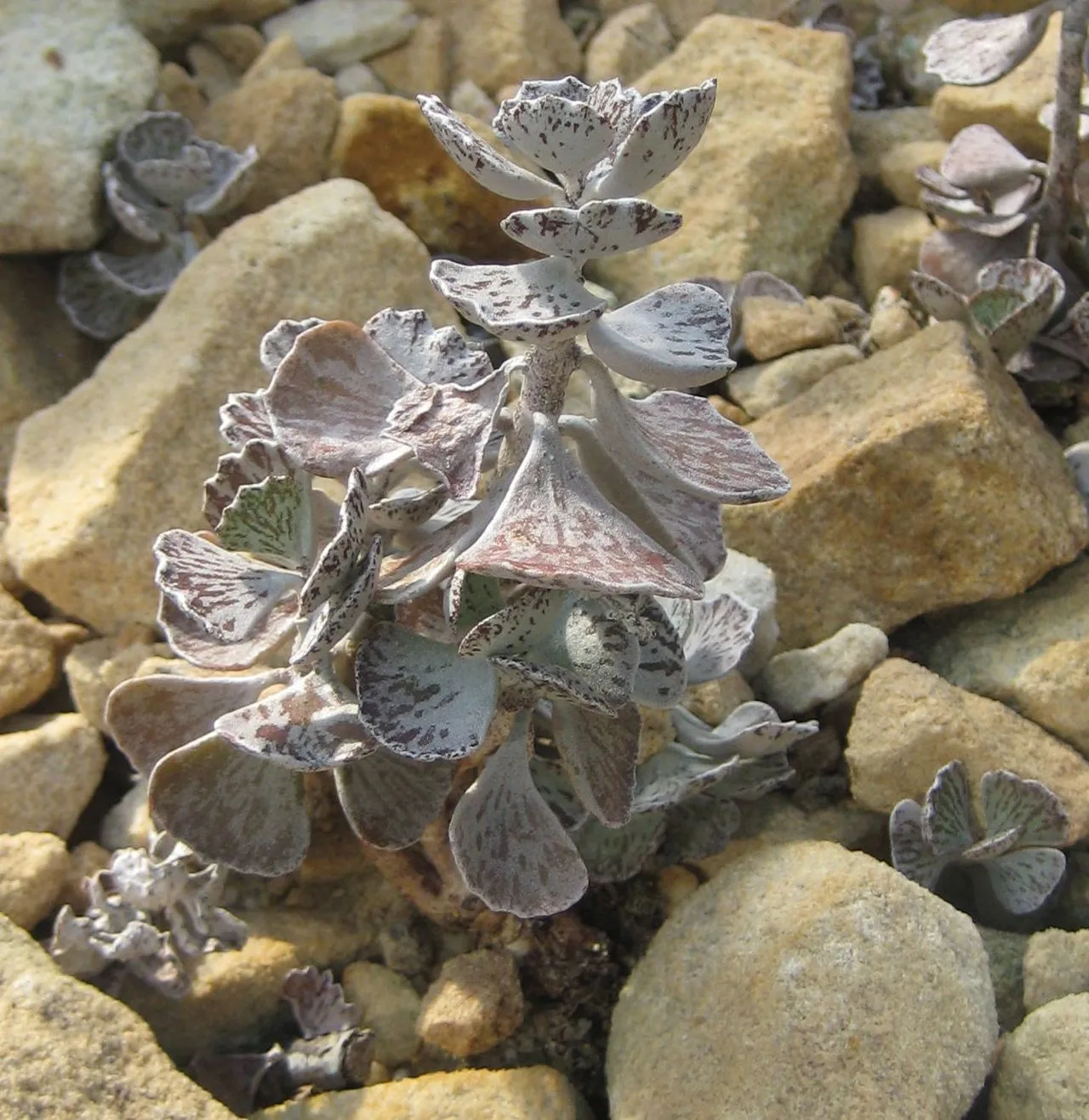
Kalanchoe rhombopilosa Mannoni & Boiteau, the pies from heaven succulent of the European trade, was described by Octave Mannoni and Pierre Boiteau in 1947 from the dry southwest of Madagascar. It is endemic to rocky outcrops in the old Toliara (Tuléar) province, at roughly 200 to 1,000 m elevation. The defining feature is the leaf shape: paired, distinctly rhomboid to obovate blades, 1.5 to 3 cm long, with shallowly wavy or crenulate margins and a dense grey-green felt overlaid with darker brown ridges along the principal veins. The almost diamond outline of the leaf is the source of both the species epithet (rhombopilosa, "rhomboid and hairy") and the common trade name.
In habitat, K. rhombopilosa grows in shallow mineral pockets between exposed limestone and sandstone slabs in the seasonally dry forests of the south. The climate is warm year-round, with a long dry winter and a short wet summer, and the substrate drains within minutes of rain. The silver felt and brown vein ridges are not ornament. The trichomes scatter the strong tropical light, hold a thin layer of still air against the leaf, and slow the rate at which the thin leaf blade loses water through the dry season. Cultivation reads back from that biology: bright light, sharp drainage, careful winter water, and warm summers.
Part of the Complete Kalanchoe Guide.
Identification
K. rhombopilosa is a small, slow-growing erect to spreading subshrub. Stems start green and softly hairy, then become brown and lightly woody as they age. A potted specimen kept in good light typically settles between 15 and 25 cm tall, with several short branches that lean outwards from a single woody base. New growth carries the densest felt; older lower leaves often weather to a paler grey. The species rarely forms a tight rosette, and the silhouette is closer to a miniature shrub than to an echeveria.
The leaves are the diagnostic character. They are opposite, broadly rhomboid to obovate (the outline reads almost as a soft diamond rather than an oval), 1.5 to 3 cm long, with a short petiole and a wavy or shallowly crenulate margin. Both surfaces are coated in a fine grey-green felt that catches the light with a pronounced silver flush. The principal veins on the upper surface are usually outlined by darker brown ridges, forming a faint reticulate pattern across the blade. Under sun stress the margin can flush a warm pink or violet for a few weeks; that pigment sits in the leaf tissue, while the felt itself stays grey-silver.
Winter to early spring flowers appear on a small terminal cyme held just above the foliage. The corolla is tubular, modest in size, and greenish yellow rather than pink. They are useful for confirming a plant as a kalanchoe, but most growers identify K. rhombopilosa long before bloom from the leaf shape alone.
Three lookalikes are worth pinning down. Kalanchoe tomentosa, the panda plant, is taller, with longer 4 to 7 cm leaves under a more uniform brown to chocolate felt and dark brown spots or patches at the leaf tip and margin, and the leaves are oval, not rhomboid. Kalanchoe eriophylla carries pure white wool over smaller, rounded leaves with entire margins; the felt is snow white, not grey-silver, and the outline lacks the diamond shape. Kalanchoe millotii has grey-green felted leaves with shallowly serrated margins, a coarser shrub habit, and oval rather than rhomboid blades. If the leaf is a 1.5 to 3 cm soft diamond with wavy edges, brown vein ridges, and a silver flush in the felt, K. rhombopilosa is the first name to test.
Cultivation
Light is the first lever. Indoors, give K. rhombopilosa a south or west window in temperate climates, with 10 to 14 days of acclimation before extended direct sun. An east window keeps the plant alive but tends to lengthen the internodes and dull the silver flush. Outdoors in summer, morning sun with light afternoon shade suits it in hot Mediterranean conditions; in cooler coastal climates it can take longer direct exposure once hardened. The leaves do not heal scorch marks, so step exposure up rather than jumping to full afternoon sun.
Water on substrate dryness and pot weight rather than a fixed schedule. In active spring and summer growth, soak the mix thoroughly, then wait until the upper 3 to 4 cm is dry and the pot feels light in the hand. In a 9 cm terracotta pot under warm light, that often means watering every 8 to 12 days. In a 12 cm plastic pot indoors, the same plant may go 2 to 3 weeks between waterings. With a moisture probe, target a reading below 15 percent at 3 cm depth before the next pour.
Winter water should be sparing. When days are short and night temperatures sit below 12 °C, give only enough water to prevent deep wrinkling, often once every 4 to 6 weeks in a mineral-leaning mix. K. rhombopilosa is slow growing in any season, and pushing it through a cold dim windowsill produces stretched soft growth and stem-base rot rather than a bigger plant.
Substrate should be fast and mineral leaning. A working range is 65 to 75 percent mineral material (pumice, fine lava rock, coarse grit, expanded shale) with the rest a low-peat or peat-free organic component. Plants in humid rooms benefit from the upper end of that range; in hot dry greenhouses, a touch more organic content is acceptable because the root zone dries faster.
Temperature is the firmest limit. Treat 5 °C as the practical lower bound for a dry, established specimen, and keep recently propagated or wet plants warmer. Brief contact with frost typically blackens stems and drops leaves wholesale; the species has no useful frost tolerance. The southwestern Madagascar origin gives it real heat tolerance, and it does well between 22 and 32 °C in summer, but it is also slow at any temperature, so do not read fast growth as a sign of correct culture.
Pot size should follow the root ball, not the visible top growth. A young plant is happier in a 7 to 9 cm pot than in a wide decorative bowl. Move up one size only when roots hold the mix together. Terracotta dries the upper root zone in humid homes; plastic works in hot dry climates with a more mineral substrate. Feed lightly during active growth with a balanced low-nitrogen succulent fertiliser at one-quarter to one-half label strength every 4 to 6 weeks, and stop by early autumn. The Beginner's Guide to Succulents covers baseline watering and light, but keep this species' frost limit and slow growth pace in mind.
Propagation
Stem cuttings are the reliable method. Take a firm, non-flowering shoot 4 to 7 cm long in late spring or early summer, when warmth is steady and the parent plant is actively growing. Remove the lowest pair of leaves, then leave the cutting in bright shade for 3 to 5 days until the cut surface is fully dry. Do not push damp stems into substrate; kalanchoe bases rot quickly when set wet.
Stand the cutting upright in dry pumice, or in a mix containing at least 70 percent pumice or grit. Hold off the first watering through the callus phase. At 22 to 28 °C, stem cuttings usually anchor in 3 to 4 weeks on dry pumice, slightly slower than in K. tomentosa or K. millotii. Test by nudging the stem; resistance signals new root contact. Begin gentle watering after that point, then return to a normal soak-and-dry rhythm over the following month.
Leaf cuttings are inconsistent. A detached leaf occasionally calluses and forms a small shoot, but more often it dries before producing a viable plantlet. If you try leaves, choose mature but not old material, dry the bases for 2 to 3 days, and lay them on barely damp mineral substrate in warm shade. Expect uneven results rather than a uniform tray, and rely on stem cuttings for any plant you want to keep. Seed is rarely used in ordinary cultivation; the flowers are small, hand-pollination needs at least two unrelated clones, and seedlings take noticeably longer than cuttings to develop the rhomboid leaf shape and brown vein ridges.
Notes
Trade labels are loose around small felted kalanchoes. K. rhombopilosa appears variously as "pies from heaven", "rhomboid kalanchoe", or tucked into mixed succulent trays with no species label at all. Before buying, check three characters together: 1.5 to 3 cm rhomboid to obovate leaves, wavy or shallowly crenulate margins, and a grey-silver felt with brown ridges along the principal veins. One trait alone is not enough, because light level and plant age change leaf size and silver flush.
Mealybugs hide easily in the felt, especially at leaf bases and stem joints, and slow growth means a colony often gets ahead of the plant before damage is visible. Inspect every two to three weeks with a hand lens, and treat small colonies with a cotton bud dipped in 70 percent isopropyl alcohol. Avoid oil sprays in strong sun; the felt holds residue and the leaves can scorch where the oil settles.
Like all Kalanchoe, K. rhombopilosa contains bufadienolide cardiac glycosides and should be treated as unsafe for chewing pets. Keep fallen leaves and pruned cuttings away from cats, dogs, rabbits, and small children. The plant stays compact, so safe placement on a high shelf is straightforward, but the felt sheds occasionally and the floor below the shelf matters too.
Cosmetic damage shows clearly because the silver-and-brown surface records every event. A wet cold night can leave dark patches that never fade, and sunburn shows as cream to tan blotches on previously silvered leaves. Pruning is acceptable in warm weather: cut back to a firm node, hold water for a week, and give bright shade until new buds emerge. Avoid hard pruning in winter, when callusing is slow and rot risk is highest.
See also
- Complete Kalanchoe Guide
- Beginner's Guide to Succulents
- Kalanchoe tomentosa, the taller felted lookalike with oval leaves and dark brown margin spots.
- Kalanchoe eriophylla, the smaller pure-white woolly lookalike with rounded entire-margined leaves.
- Kalanchoe millotii — the grey-green serrated-leaved Madagascan shrub, closely allied in felted habit but with oval rather than rhomboid leaves.
Frequently Asked Questions
How do you identify Kalanchoe rhombopilosa?
Look for small soft-diamond leaves with wavy margins, grey-silver felt, and darker brown ridges along the main veins. That leaf shape is the key character.
How cold can Kalanchoe rhombopilosa tolerate?
Treat 5 °C as the practical lower limit for a dry established plant. Frost blackens stems and can drop leaves wholesale.
How do you propagate Kalanchoe rhombopilosa?
Use 4–7 cm stem cuttings in late spring or early summer. Callus for 3–5 days and root on dry pumice at 22–28 °C, usually in 3–4 weeks.
Why is Kalanchoe rhombopilosa getting dark patches?
The silver-and-brown surface records damage clearly. Wet cold nights can leave dark patches, while sunburn shows as cream to tan blotches.