| Question | Short Answer |
|---|---|
| How do you identify Kalanchoe millotii? | Look for small 2–4 cm oval grey-green felted leaves with shallow serrations and no dark brown margin spots. |
| How cold can Kalanchoe millotii get? | Treat 5 °C as the practical lower limit for a dry established plant. |
| How should Kalanchoe millotii be propagated? | Stem cuttings are the reliable method. |
| Why is Kalanchoe millotii dropping leaves? | Recent cold exposure is a common cause, especially if the substrate stayed wet. |
Kalanchoe millotii Raym.-Hamet & H.Perrier is a small, felted kalanchoe described by Hamet and Perrier in 1915 from southern Madagascar. It is endemic to the old Toliara, or Tuléar, province, and is usually grown as a compact shrub of 30 to 50 cm with opposite oval leaves, grey-green trichomes, shallow serrations, and woody lower branches.
In habitat, K. millotii belongs to the seasonally dry flora of southern Madagascar, where rain arrives in pulses rather than as even moisture through the year. The plant's felted leaf surface is not decorative fluff. Those fine trichomes slow air movement across the leaf, soften direct sun, and reduce the speed at which the thin leaf blade loses water during hot weather. In cultivation, that means it wants warmth, strong light, and fast drainage, not the cool damp treatment that keeps some leafy houseplants looking lush.
Part of the Complete Kalanchoe Guide.
Identification
K. millotii grows as a low, branched subshrub rather than a tight rosette. Young stems are green and softly hairy; older stems become brown and woody at the base. A well-grown potted plant often forms several upright to arching branches from the crown, each carrying paired leaves at short intervals. It rarely looks symmetrical for long, which is normal. The charm of the species is its small, weathered shrub shape, not a geometric rosette.
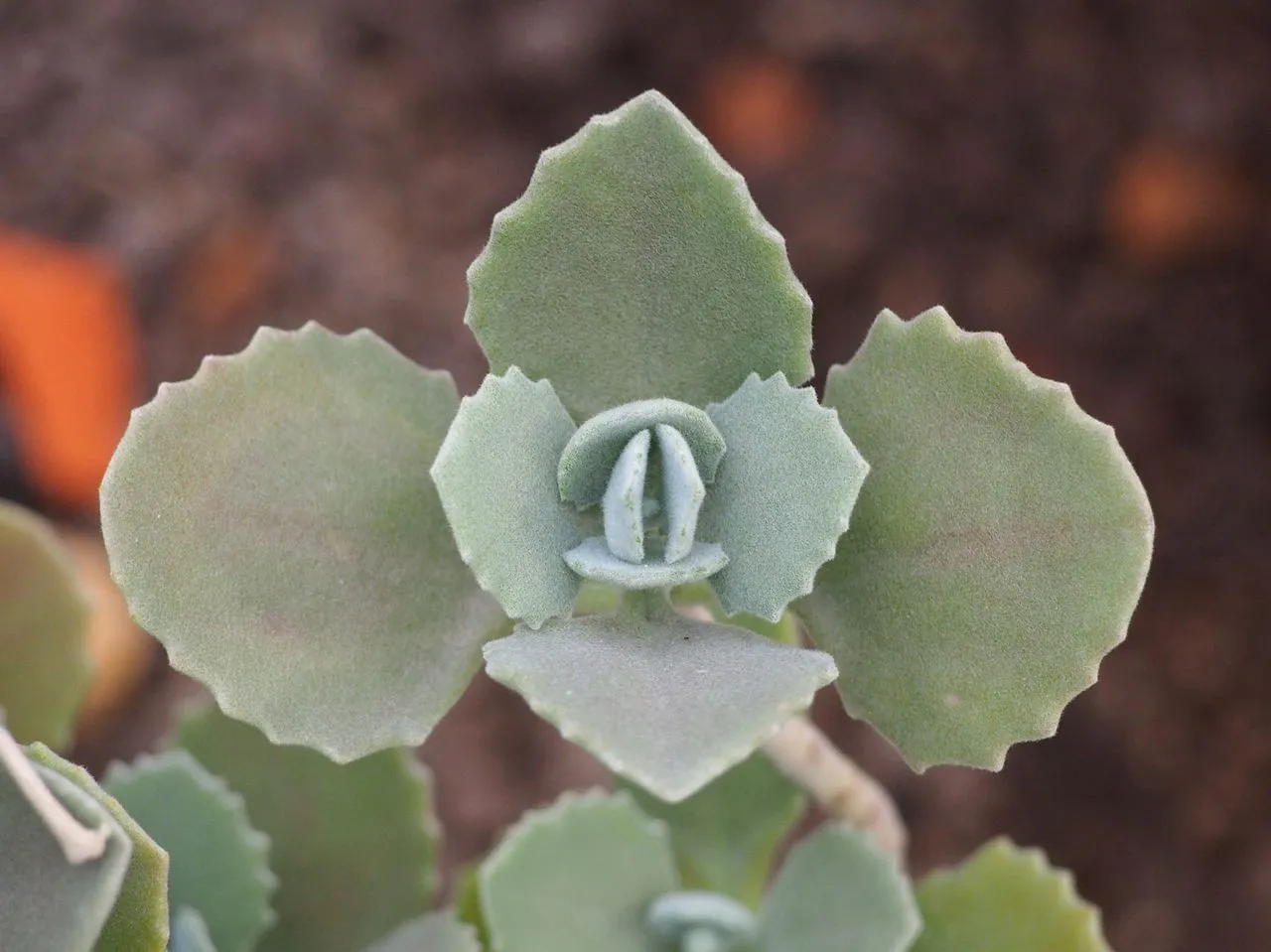
The leaves are the main identification character. They are opposite, broadly oval to rounded, usually 2 to 4 cm long, and covered on both surfaces with a fine grey-green felt. The margin is shallowly serrated, with small rounded teeth rather than sharp saw-like points. Under strong light the foliage can look almost silver grey; in lower light it shifts greener and the internodes lengthen.
Winter flowers are greenish yellow, tubular, and carried above the leaves in small clusters. They are useful for confirming the plant as a kalanchoe, but most collections identify this species by foliage long before it blooms. Indoors, flowering is inconsistent unless the plant receives bright light, a warm summer, and shorter winter days.
The two common lookalikes need separating carefully. K. millotii is less popular in shops than Kalanchoe tomentosa, the panda plant, and labels are often casual. K. tomentosa has longer, thicker leaves with mostly entire margins and dark brown spots or patches along the leaf edge and tip. K. millotii lacks those dark margin spots and has a softer grey cast with small serrations all around the edge. If the leaf edge is smooth and the tip has chocolate-brown markings, you are probably looking at K. tomentosa or one of its forms.
It is also much smaller and finer textured than Kalanchoe beharensis. K. beharensis becomes a large shrub in warm gardens, often well over 1 m, with broad triangular to peltate leaves and a coarse brown-grey felt. The leaves of K. beharensis can look like folded felt paddles. K. millotii stays in the 30 to 50 cm range, has oval 2 to 4 cm leaves, and keeps a lighter grey-green surface. A plant with huge triangular leaves is not K. millotii, even if the nursery tag says so.
Cultivation
Give K. millotii the brightest position you can offer without cooking the leaves behind glass. Indoors, a south or west window suits it in temperate climates if the plant is acclimated over 10 to 14 days. An east window works for maintenance growth, but the plant may stretch and lose the tight grey finish. Outdoors, morning sun plus light afternoon shade is ideal in hot Mediterranean summers. In cooler coastal climates, it can take more direct sun.
Heat is welcome. This species grows best when days sit around 22 to 32 °C and nights remain above 12 °C. It is frost-intolerant. Below about 4 °C, K. millotii may drop leaves, especially if the substrate is damp or the plant has been growing softly indoors. Treat 5 °C as the practical lower limit for a dry, established plant, and keep it warmer if you want it to remain leafy through winter.
Water by substrate dryness and leaf firmness rather than by the calendar alone. In active growth, soak the pot thoroughly, then wait until the top 3 to 4 cm of mix is dry and the pot feels light. In a 9 cm terracotta pot under warm light, that may mean every 7 to 12 days in summer. In a 12 cm plastic pot indoors, the same plant may need 2 to 3 weeks between waterings. If you use a moisture probe, wait for the upper 3 cm to read below 15 percent before watering again.
Winter water should be modest. When light drops and temperatures are below 15 °C, water enough to prevent severe shrivelling, often once every 4 to 6 weeks in a mineral mix. Do not keep the substrate evenly damp in winter to force growth. Cold wet roots are the usual route to stem-base rot in this species.
Use a fast, mineral-leaning substrate. A practical mix is 60 to 70 percent mineral material and 30 to 40 percent low-peat or peat-free organic matter. Pumice, fine lava rock, coarse grit, and a little loam-based compost suit the root system well. If your home is humid or cool, move closer to 70 percent mineral. If you grow in a hot dry greenhouse, 60 percent mineral with a little more organic matter keeps the leaves from collapsing between waterings.
Pot size matters because K. millotii has a modest root system. A young plant is happier in a 7 to 9 cm pot than in a broad decorative bowl. Move up only when roots hold the mix together, usually one pot size at a time. Terracotta is useful in humid rooms because it dries the root zone faster. Plastic is workable in hot dry homes, but it lengthens the interval between waterings.
Feeding should be light. During active growth, apply a balanced low-nitrogen succulent fertiliser at one-quarter to one-half label strength every 4 to 6 weeks after a normal watering. Stop feeding in autumn. Soft, heavily fertilised shoots are more prone to leaf drop after a cold night and more attractive to mealybugs.
For a broader baseline on succulent watering and light, the Beginner's Guide to Succulents is a useful companion, but keep the species-specific frost limit in mind. K. millotii is less tolerant of cold than many growers expect from a fuzzy-leaved succulent.
Propagation
Stem cuttings are the reliable method. Take a firm, non-flowering shoot 5 to 8 cm long in late spring or summer, when warmth is steady and the parent plant is actively growing. Remove the lowest pair of leaves and leave the cutting in bright shade for 2 to 4 days, until the cut surface is dry and sealed.
Set the cutting upright in dry pumice, or in a very mineral mix with at least 70 percent pumice or grit. Do not water immediately. In warm conditions around 22 to 28 °C, stem cuttings usually root in 2 to 3 weeks on dry pumice. You can test gently by nudging the stem; resistance means new roots have anchored. Give the first light watering only after that point, then return gradually to the normal soak-and-dry rhythm.
Leaf cuttings are less dependable than with many echeverias and some other kalanchoes. A detached leaf may callus and root, but it often dries before forming a strong shoot. If you try leaves, choose mature but not old leaves, let the base dry for 2 days, and place them on barely damp mineral substrate in warm shade. Expect uneven results rather than a tray of uniform plantlets.
Seed is rarely used in ordinary cultivation. The flowers are small, hand-pollination is fiddly, and seedlings take longer to produce the grey felted shrub character than cuttings do. For maintaining a named or well-formed plant, cuttings are cleaner and faster.
Notes
The main trade confusion is with panda plant types. K. millotii is sometimes sold as a softer, greyer K. tomentosa, or tucked into mixed succulent trays with no species label at all. Before buying, look at three characters together: small 2 to 4 cm oval leaves, shallow serrations, and no dark brown margin spots. One character alone is not enough, because light level and plant age change leaf size and colour.
Leaf drop after a cold night is common and should be read as stress, not as normal dormancy. If a plant has shed several lower leaves, check the recent minimum temperature, then check whether the substrate stayed wet during that cold period. A dry plant that briefly touched 4 °C may recover with only cosmetic loss. A wet plant at the same temperature can lose branches to rot.
Mealybugs hide well in the felt and at the leaf bases. Inspect the stem joints every few weeks, especially in winter when air circulation is poor. A small infestation can be removed with a cotton bud dipped in 70 percent isopropyl alcohol, followed by isolation and repeat checks for 3 to 4 weeks. Avoid spraying oily products in strong sun; the hairy leaves can hold residue and scorch.
Like many kalanchoes, K. millotii should be treated as unsafe for chewing pets. Keep fallen leaves out of reach of cats, dogs, and rabbits. The plant is not difficult to place safely because it stays compact, but it does shed leaves when chilled or overwatered, so the floor beneath the shelf matters too.
See also
- Complete Kalanchoe Guide
- Beginner's Guide to Succulents
- Kalanchoe tomentosa, the panda plant lookalike with entire leaf margins and dark edge spots.
- Kalanchoe beharensis, the much larger felted shrub with brown-grey triangular leaves.
- Kalanchoe eriophylla — the snow white panda plant, a close Madagascan ally with pure-white trichomes and entire leaf margins rather than grey serrated ones.
Frequently Asked Questions
How do you identify Kalanchoe millotii?
Look for small 2–4 cm oval grey-green felted leaves with shallow serrations and no dark brown margin spots. That separates it from K. tomentosa.
How cold can Kalanchoe millotii get?
Treat 5 °C as the practical lower limit for a dry established plant. Below about 4 °C it may drop leaves, especially if damp.
How should Kalanchoe millotii be propagated?
Stem cuttings are the reliable method. Take 5–8 cm shoots in warm growth, callus for 2–4 days, and root on dry pumice at 22–28 °C.
Why is Kalanchoe millotii dropping leaves?
Recent cold exposure is a common cause, especially if the substrate stayed wet. A dry plant briefly at 4 °C may recover; a wet one can rot.