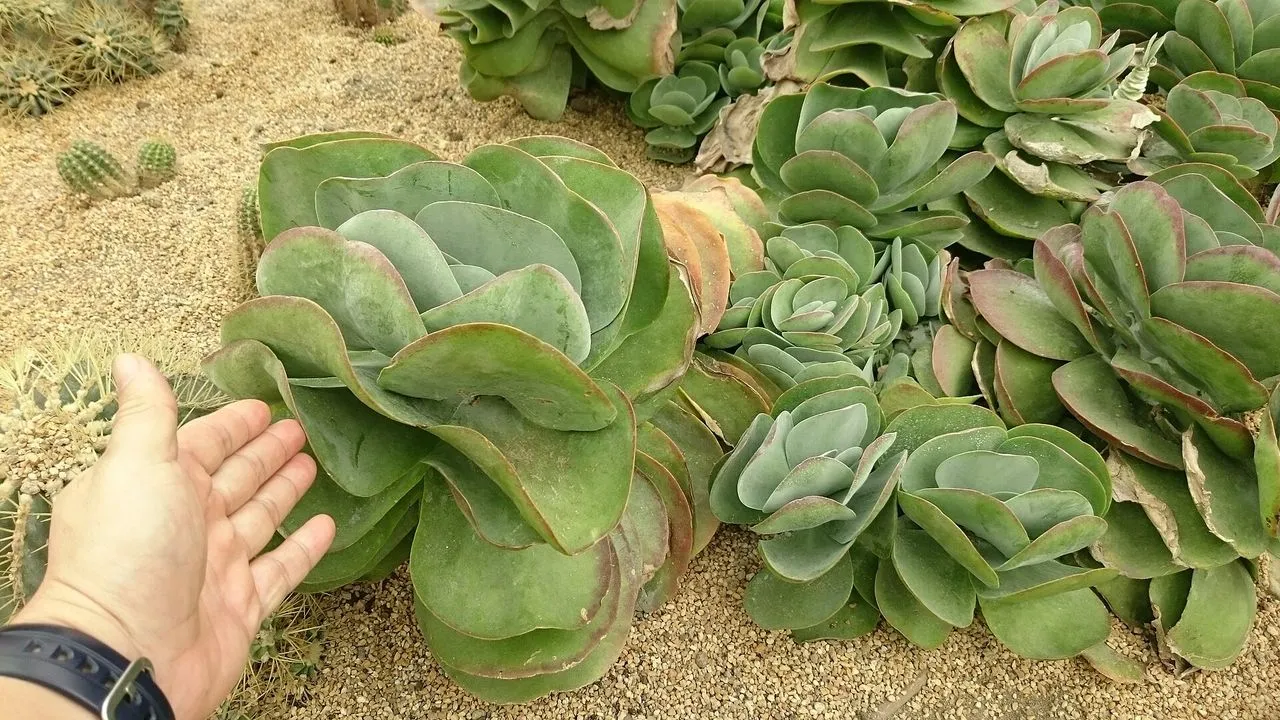
Leaf curling in Kalanchoe is a symptom, not a disease, and the direction and texture of the curl carry most of the diagnostic information. Inward lengthwise curling in a firm leaf is a water-conservation response — the plant is folding its leaf to reduce transpiration. Downward cupping in a soft leaf is the opposite problem — excess water has disrupted normal turgor. Irregular curling with surface damage is a pest sign. Three different problems, three different responses, one shared symptom.
Part of the Complete Kalanchoe Guide.
Drought and under-watering
The most common cause of kalanchoe leaf curling is insufficient water in the root zone. Kalanchoe is a CAM plant — it opens stomata at night and has a degree of drought tolerance — but it cannot indefinitely withstand dry conditions without visible stress. When the root zone dries past the plant's tolerance threshold, the leaves reduce their surface area by curling or rolling inward lengthwise. The mechanism is a reduction in turgor: as water content in the mesophyll cells falls, the differential pressure between upper and lower leaf surfaces changes, pulling the leaf edges upward.
Drought-curled leaves are firm, not mushy. They feel flexible but not wet. The substrate is dry through the full pot depth, and the pot is noticeably light when lifted. Outer and lower leaves are usually affected first — the plant prioritises new growth at stem tips.
One thorough watering until water exits the drainage hole, followed by full drainage, reverses this within 24–48 hours for most plants. Leaves that have been drought-curled for several weeks may not fully flatten, but new growth from the stem tips will be normal. Return to a schedule of watering when the top 3–4 cm of substrate is dry — typically every 7–10 days indoors during active growth, less in winter.
Heat stress
At temperatures above 30–33 °C, particularly combined with direct sun, Kalanchoe can show leaf curling as a heat-stress response even when the substrate is moist. The mechanism is the same as drought-induced curling — the plant limits transpiration — but the driver is thermal stress rather than water deficit. Leaves may also show bleaching or reddening alongside the curl in high-heat conditions.
Heat-stress curling typically resolves within hours of moving the plant to a cooler, shadier position. Water if the substrate is dry, but do not overwater a heat-stressed plant that otherwise has normal soil moisture — root tissue is more vulnerable to rot at high temperatures. Ensure good airflow around the plant; air movement helps reduce leaf surface temperature more effectively than shade alone.
Spider mite infestation
Spider mites (Tetranychus urticae and related species) are the most significant pest cause of leaf curling in Kalanchoe. They feed by piercing individual epidermal cells and extracting contents, leaving pale stipple marks (tiny white or yellow dots) on the upper leaf surface. As feeding damage accumulates, the affected areas lose turgor and the leaf curls, particularly at the edges. Fine, barely visible webbing between leaf veins and in the axils confirms active mites.
Spider mites thrive in hot, dry conditions — above 25 °C with low humidity. They are more common on plants near heating vents, in south-facing summer windows, and on plants that have not been inspected regularly. The mites themselves are only 0.3–0.5 mm long — visible as tiny moving dots on a white paper held under a shaken leaf.
Treatment requires reaching the undersides of all leaves where mites congregate. Options:
- Insecticidal soap spray: 5 ml liquid soap per litre of water. Spray thoroughly, covering all leaf surfaces including undersides. Repeat every 5–7 days for 3–4 applications.
- Neem oil: 5 ml per litre with an emulsifier. Disrupts mite reproduction and feeding. Repeat weekly for 4 applications.
- Miticides: If populations are severe, a miticide labelled for houseplant use (containing abamectin, spiromesifen, or bifenazate) provides faster knockdown. Rotate active ingredients if a second treatment round is needed, as spider mites develop resistance quickly.
Spider mites spread rapidly to adjacent plants. Isolate the infested plant immediately and inspect all neighbouring plants for early signs. See the spider mite identification guide for confirmation before treating.
Overwatering and root damage
Overwatered kalanchoe leaves may curl downward or cup rather than curl inward lengthwise. The mechanism is excess turgor — cells over-inflated with water — which changes the mechanical tension across the leaf surface. The leaf feels soft, not firm, and may be slightly glassy or translucent as well as curled.
This presentation often accompanies early root rot, where roots are beginning to fail and water regulation in the leaves is disrupted. Check the substrate: if it is wet or heavy, and the leaves are soft and curled or cupping downward, stop watering and inspect the root zone. Mild overwatering where roots are still largely intact corrects with a drying period of 10–14 days without watering. Root rot requires unpotting, trimming dead roots, drying, and repotting as described in kalanchoe root rot.
Cold temperature and draught
Cold air below 10 °C, or a direct draught from an open window or air conditioning vent, can cause Kalanchoe leaves to curl or cup slightly. The mechanism is differential contraction — cells on one side of the leaf contracting faster than the other as they cool. Cold-curled leaves typically firm up when the plant is moved to a warmer position, without any watering change.
The risk with cold-induced curling is misdiagnosis: a grower sees curled leaves and waters, which — in cold conditions — creates root rot risk. Always assess temperature history before acting on a curling symptom.
How to identify the cause
| Curl pattern | Leaf texture | Substrate | Other signs | Most likely cause |
|---|---|---|---|---|
| Inward lengthwise roll | Firm, flexible | Dry, light pot | Older leaves affected first | Drought |
| Inward curl, reddening | Firm | Moist or dry | Hot conditions, direct sun | Heat stress |
| Edge curling, stippling, webbing | Firm to papery | Any | Visible dots on underside | Spider mites |
| Downward cupping | Soft, slightly wet | Heavy wet pot | May be translucent | Overwatering |
| Slight curling, plant near vent | Firm | Normal | Recent cold or draught exposure | Cold/temperature |
Risk and severity
Drought curling is low-risk and self-correcting with watering. Heat stress is moderate risk if sustained — prolonged heat above 33 °C can cause lasting leaf damage. Spider mites are moderate risk individually but high risk if undetected and allowed to spread through a collection. Overwatering-caused curling with root rot is high risk and requires same-day intervention to prevent progression to stem rot.
Prevention
Water on demand rather than on a schedule — let the substrate dry before watering again. Maintain temperatures of 15–25 °C and avoid positioning plants near heating vents or air conditioning outlets. Inspect leaf undersides monthly for early mite signs, especially in summer. Ensure good airflow around the plant. Bottom watering — filling a tray and allowing the pot to absorb water for 20–30 minutes — keeps leaves dry and is the safest method in hot conditions where spider mite pressure is high.
See also
- Spider mite identification — confirming and distinguishing spider mites from other small leaf pests.
- Kalanchoe root rot — the full rescue procedure when downward-curling soft leaves point to root damage.
- Kalanchoe tomentosa — the panda plant, whose felted leaves obscure early spider mite signs and require careful inspection.
Frequently Asked Questions
Why are my Kalanchoe leaves curling up at the edges?
Upward or inward curling along the leaf length is the classic drought response — the plant is reducing leaf surface area to slow water loss. Check the substrate: if dry, water thoroughly. If the substrate is moist and leaves still curl, inspect roots for damage.
Why are my Kalanchoe leaves curling downward?
Downward cupping, especially in soft or translucent leaves, usually indicates overwatering — excess water in the cells disrupts normal turgor. Check that the pot is draining and the substrate can dry between waterings.
How do I check for spider mites on Kalanchoe?
Hold a white sheet of paper under a leaf and tap the leaf firmly. Tiny moving dots on the paper confirm spider mites. Also check the leaf undersides with a magnifying glass for fine webbing between leaf veins and small pale stipple marks on the upper surface.
Can curled Kalanchoe leaves recover their shape?
Drought-curled leaves usually recover their normal flat shape within 24–48 hours of thorough watering. Leaves curled from overwatering or pest damage may not fully flatten, but new growth from the stem tips will be normal once the cause is corrected.