| Question | Short Answer |
|---|---|
| How large does Kalanchoe beharensis get? | In habitat it reaches 2–3 m as a small tree. |
| How should Kalanchoe beharensis be watered? | Water the substrate surface only when the top 4–5 cm reads dry. |
| What is the best way to propagate Kalanchoe beharensis? | Stem cuttings are preferred. |
| How is Kalanchoe beharensis different from Kalanchoe orgyalis? | K. |
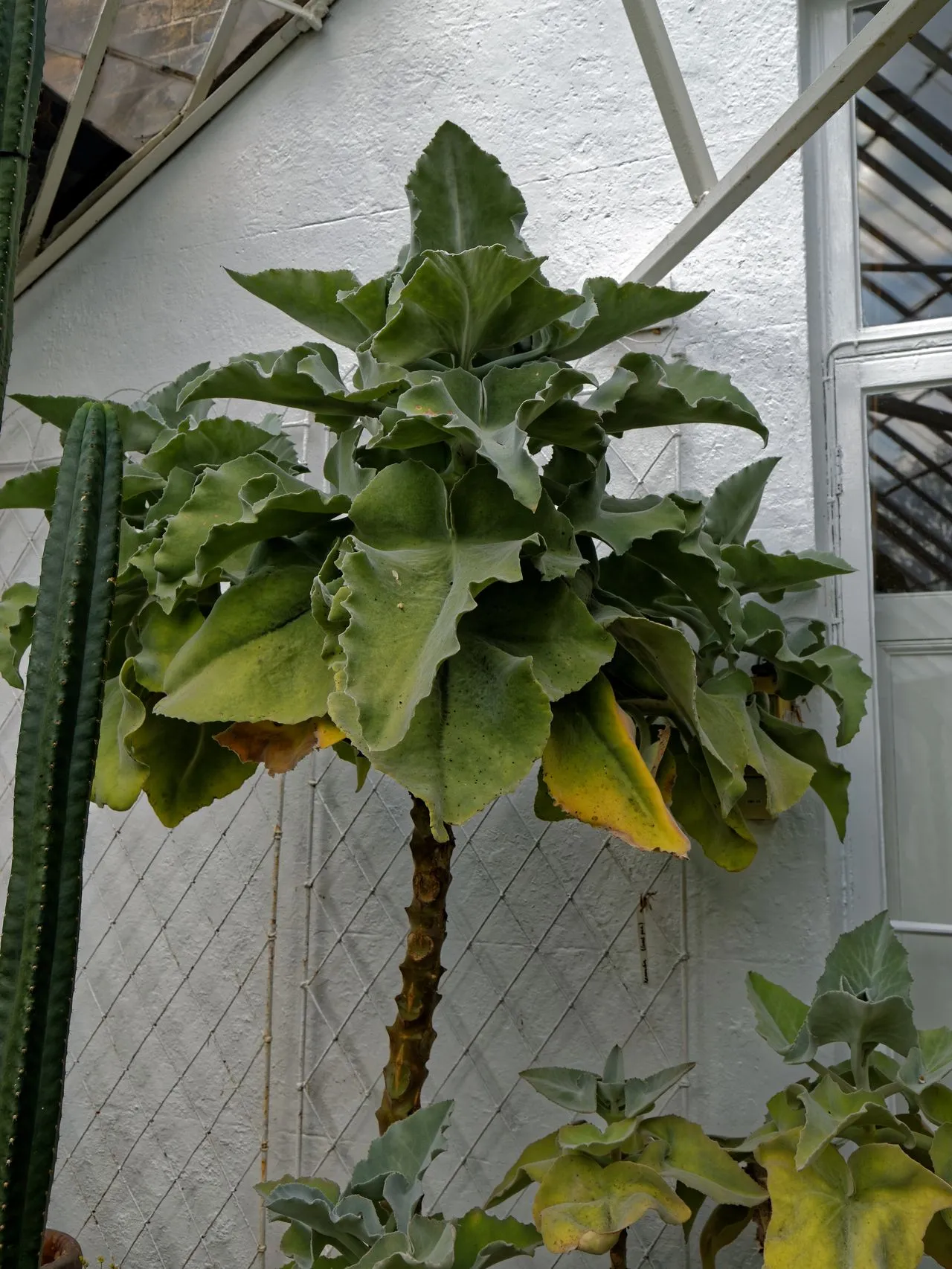
Kalanchoe beharensis Drake (felt plant, velvet leaf) was described by the French botanist Emmanuel Drake del Castillo in 1903 from material collected in the Behara district of southern Madagascar. The specific epithet references Behara directly. Among the Crassulaceae grown in cultivation, K. beharensis is in a structural category of its own: a genuine small tree reaching 2–3 m in habitat, with a woody trunk, large felted leaves, and a silhouette that reads more like a small Ficus than a conventional succulent.
The Behara district sits within the Anosy region, centred on the Mandrare River basin in southern Madagascar. The habitat is semi-arid spiny thicket on thin, fast-draining soils, lateritic or sandy, subject to a pronounced dry season lasting 5–7 months between roughly April and October. Rainfall is concentrated in the wet season (November to March); the plant's entire physiology, from its low water demand to its thick, water-shedding indumentum, reflects this cycle. The IUCN Red List assesses K. beharensis as Vulnerable (VU; taxon ID 128093556), with restricted native range and habitat clearance in southern Madagascar cited as the primary drivers.
Part of the Complete Kalanchoe Guide.
Identification
The trunk is the character that sets this species apart from any other Kalanchoe in cultivation. Mature plants develop a stout, woody stem with ridged bark and prominent crescent-shaped leaf scars marking where old leaves detached. A well-grown garden specimen after 10 years in the ground in a frost-free climate reads as a small tree, branched at the upper portion, not a rosette plant. Container specimens develop the same trunk on a slower schedule; a 10-litre pot plant several years old will already show the beginning of bark formation at the stem base.
Leaves are large, triangular-ovate, typically 20–35 cm long on vigorous mature specimens, with a shallowly undulate to weakly lobed margin. Both surfaces carry a dense, matted layer of stellate trichomes. The indumentum is loosely attached: a light touch leaves a faint dusty residue on the fingers. Water droplets bead and roll off rather than wetting the surface, which has practical consequences for irrigation (see Cultivation, below). Colouration varies with light intensity, from silver-grey in shaded conditions to warm bronze-green under direct sun. The new growth emerging from the growing tip is always noticeably paler than the mature leaves beneath it.
Flowers appear on terminal panicles held above the leaf canopy, produced only by mature multi-branched specimens. They are pale yellow to greenish-yellow, tubular, four-merous, approximately 1.5 cm long. Flowering in temperate cultivation is uncommon and not a reliable feature to expect.
Two cultivars circulate widely enough to be worth knowing. 'Fang' (sometimes listed as 'Fángs') has elongated, tooth-like protrusions along the main veins on the underside of mature leaves. These pale nubs are unique to this selection and are immediately apparent when you flip a leaf. 'Oak Leaf' has strongly sinuate, deeply lobed margins that give each leaf a distinctly different outline from the broadly triangular type. Both cultivars propagate true only from vegetative cuttings; plants grown from seed will not reliably reproduce these characters.
The most frequently confused species in trade is Kalanchoe orgyalis (copper spoons). It also carries a dense indumentum, but the felt on the upper leaf surface is orange-cinnamon rather than bronze-grey, leaves are considerably narrower (typically under 10 cm), and the plant remains a compact subshrub rather than developing a tree-like form. In any side-by-side comparison, the leaf size difference in a mature specimen is diagnostic on its own.
Cultivation
Light. K. beharensis is not an indoor plant by preference, though it tolerates it. A south-facing window with 4–5 hours of direct winter sun is a workable indoor minimum, but growth is slow, internodes lengthen, and the leaf felt thins. Outdoors, 5–6 hours of direct sun per day produces compact growth, denser indumentum, and better bronze colouration. Moving a plant accustomed to indoor conditions directly into full summer sun bleaches the trichome layer; harden off over 2–3 weeks with progressively longer sun exposure.
Water. Apply water to the substrate surface only, never overhead. The indumentum holds moisture efficiently, and water pooling at the crown where leaf bases meet the stem creates conditions for fungal axil rot within a few days during warm weather. Water thoroughly when the top 4–5 cm of substrate reads dry, typically every 10–14 days in active summer outdoor conditions. From October to March, reduce to once every 4–6 weeks. The plant is dormant through winter and cold wet roots are the most consistent cause of loss in container cultivation. A fully dry winter is preferable to a slightly moist one.
Substrate. A very free-draining mineral mix is not negotiable for long-term health. A reliable recipe: 35% coarse pumice (3–5 mm fraction), 30% horticultural grit, 20% loam-based compost (John Innes No. 2 or equivalent), 15% coarse perlite. Commercial peat-based cactus mixes retain too much moisture and compact around the roots over time. Unglazed terracotta pots allow lateral evaporation and reduce the duration of wet substrate after each watering, which is particularly relevant through autumn and winter.
Temperature. Keep K. beharensis above 5°C at all times. In practice, above 8°C through the winter dormancy period is safer; cold combined with any moisture at root or stem level is reliably fatal. A single night at 3°C causes marginal trichome damage at leaf tips; repeated sub-5°C nights cause stem collapse. In Mediterranean climates and frost-free subtropical gardens, this species grows outdoors year-round and reaches 1 m in 4–5 years planted directly into the ground.
Pot sizing. Start young plants in 12–15 cm containers. Move up by one increment (approximately 2–3 cm additional internal diameter) every 18–24 months. An oversized pot for the current root mass holds excess moisture in the outer substrate long after watering, increasing rot risk.
Propagation
Stem cuttings are the preferred and more reliable method. Take a 10–15 cm tip cutting with 2–3 pairs of leaves using a sterile blade. Strip the lower leaf pair cleanly. Callus the cut end in a warm (20–25°C), dry, shaded position for 5–7 days. The large leaves and thick stem hold considerably more moisture than a typical smaller Kalanchoe cutting, and a shortened callus period is the main cause of basal rot in this species. Pot into pure pumice or a 1:1 pumice-perlite mix and water sparingly around the pot perimeter only. Rooting occurs in 4–6 weeks in summer conditions. Expect a 75–85% success rate with properly callused cuttings taken in summer; autumn cuttings root more slowly and are more prone to basal rot at cool glasshouse temperatures.
Leaf wedge cuttings are slower but useful when stem material is not available. Detach a mature leaf and cut it into wedge-shaped sections, each retaining a portion of the midrib. Dust the cut surfaces with powdered sulfur to reduce fungal ingress. Press each wedge upright into dry gritty substrate with the midrib base in contact with the surface. A new plantlet forms at the base of the midrib, typically visible after 8–14 weeks. Viability is approximately 40–60%; not every wedge produces a plantlet. Note that a simple detached leaf laid flat without a midrib section will not regenerate for this species, unlike the reliable single-leaf propagation that works well for Kalanchoe tomentosa. The midrib section is required.
Notes
Trade name confusion. "Elephant ears" is attached to several entirely unrelated garden plants, most often tropical aroids (Alocasia and Colocasia spp.) that require moist shade and frequent watering. K. beharensis carries the same vernacular on unlabelled nursery stock. A plant purchased expecting an aroid and treated with regular overhead watering in a shaded position will deteriorate rapidly. Always confirm the Latin binomial at point of sale.
Conservation note. The IUCN Vulnerable assessment reflects the species' restricted native distribution in southern Madagascar and ongoing pressure from habitat clearance. Whether K. beharensis falls under a specific CITES appendix is not stated here with confidence; collectors or importers sourcing non-cultivated material should verify current trade regulations with their national CITES management authority before purchase or import.
Toxicity. As with other Kalanchoe, bufadienolide cardiac glycosides are present throughout the plant tissue. The ASPCA lists the genus as toxic to dogs, cats, and horses. Suspected ingestion warrants immediate veterinary contact rather than a wait-and-see approach.
See also
- The Complete Kalanchoe Guide
- Kalanchoe tomentosa
- Kalanchoe luciae
- Kalanchoe orgyalis — the compact copper-spoons shrub, the closest small relative of K. beharensis within the dryland Madagascan felted group.
Frequently Asked Questions
How large does Kalanchoe beharensis get?
In habitat it reaches 2–3 m as a small tree. In frost-free ground it can reach 1 m in 4–5 years, while containers slow the trunk-forming habit.
How should Kalanchoe beharensis be watered?
Water the substrate surface only when the top 4–5 cm reads dry. From October to March, reduce to once every 4–6 weeks.
What is the best way to propagate Kalanchoe beharensis?
Stem cuttings are preferred. Take 10–15 cm tips, callus for 5–7 days, and root in pure pumice or a 1:1 pumice-perlite mix.
How is Kalanchoe beharensis different from Kalanchoe orgyalis?
K. beharensis becomes a tree-like plant with broad triangular 20–35 cm leaves. K. orgyalis remains a compact shrub with narrower copper upper leaf surfaces.