| Question | Short Answer |
|---|---|
| Why is Kalanchoe orgyalis called copper spoons? | Young upper leaf surfaces carry dense copper, bronze, or cinnamon-brown hairs, while older leaves and undersides fade silvery white-grey. |
| How much water does Kalanchoe orgyalis need? | In active growth, soak the mix and wait until the top 3–4 cm dries. |
| How cold can Kalanchoe orgyalis tolerate? | Treat 5 °C as the practical lower limit for a dry established plant. |
| How do you propagate Kalanchoe orgyalis? | Use 6–10 cm non-flowering stem cuttings in late spring or summer. |
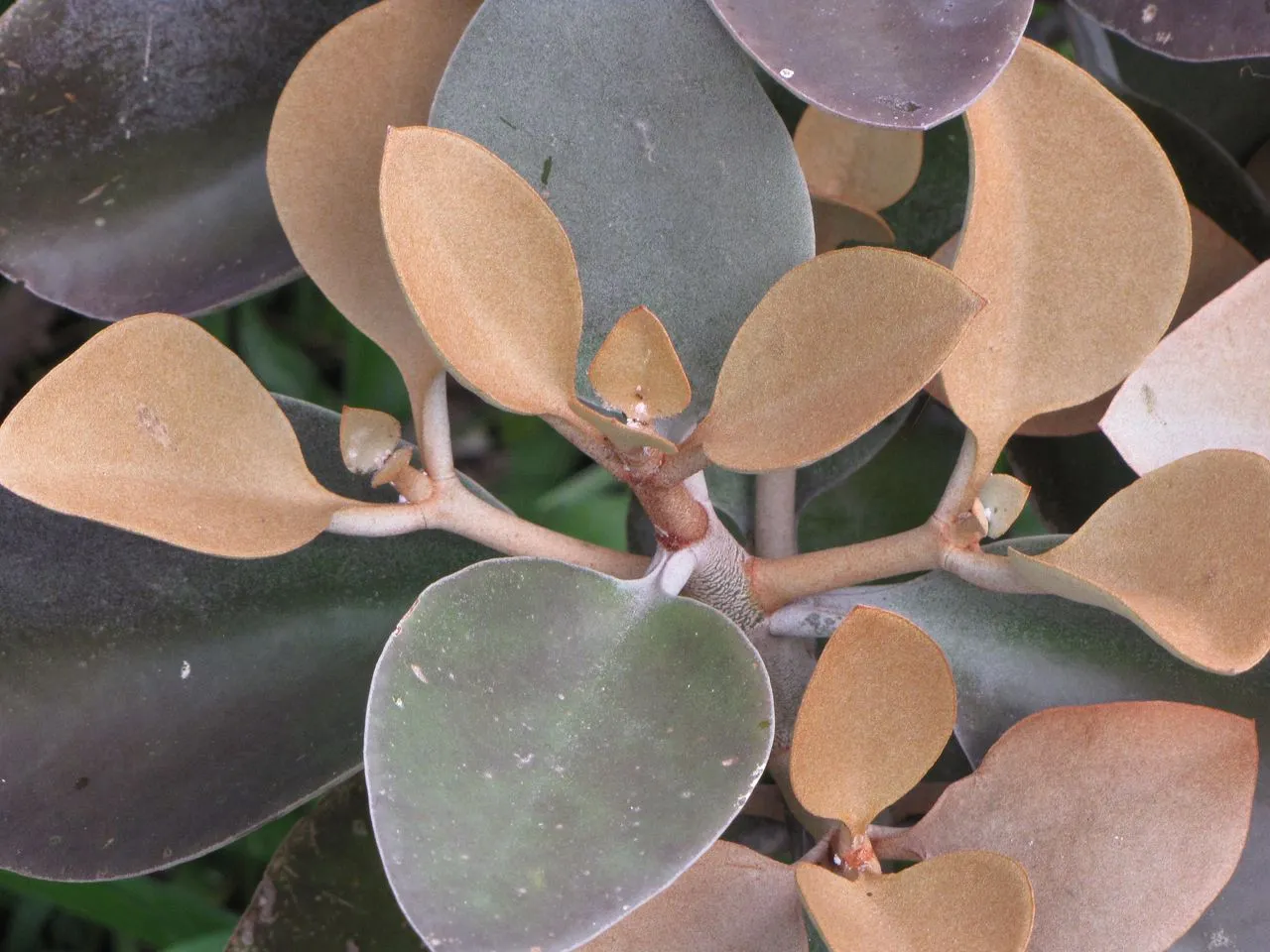
Kalanchoe orgyalis Baker, copper spoons, is a slow-growing shrubby kalanchoe described by Henry Hamet Baker in 1882. It is native to southern and southwestern Madagascar, especially the old Toliara province, where it grows on calcareous and granite outcrops at about 200 to 1,200 m. Its defining feature is the spoon-shaped leaf: young upper surfaces carry copper to bronze trichomes, while older leaves and undersides turn silvery white grey.
In habitat, K. orgyalis belongs to dry, rocky Madagascar vegetation rather than forest understory. The roots work into mineral pockets on exposed stone, and the woody lower stems keep the plant upright through long dry spells. Wild plants can reach 60 to 180 cm, although potted plants usually settle at 40 to 60 cm unless grown for many years in a warm conservatory or frost-free garden. The felted leaf surface is part of that dryland strategy. It reflects light, slows air movement across the leaf, and protects the young bronze tissue from sudden heat.
Part of the Complete Kalanchoe Guide.
Identification
K. orgyalis grows as an erect, branching shrub, not as a flat rosette. Young stems are upright and softly hairy; older stems become brown, woody, and bare near the base. A mature container plant often looks like a small bonsai shrub with leaves clustered toward the branch tips. This woody base is normal and should not be mistaken for decline unless the stem is soft or blackened.
The leaves are opposite, thick, spoon-shaped to obovate, and usually 5 to 9 cm long. The petiole is short, so the blade appears to sit close to the stem. Young leaves are the reason for the common name copper spoons: the upper surface has a dense coating of copper, bronze, or cinnamon-brown hairs. As leaves age, the colour fades toward grey, and the undersides are usually silvery white grey from the start. The contrast between bronze young growth and pale older surfaces is the quickest field mark.
Flowers are yellow, tubular, and carried in branched clusters above the foliage, usually from late winter into spring. Indoors, flowering is less reliable than leaf colour because the plant needs strong light, seasonal day length, and a period of cooler, drier winter growth. A non-flowering plant can still be identified confidently from the leaves and habit.
The bronze colour is the key separator from the common lookalikes. Kalanchoe tomentosa has a more uniform grey-white felt and usually shows darker brown markings at the leaf tips or margins; it does not make broad copper upper surfaces on new leaves. Kalanchoe marmorata has much larger, flatter leaves with distinct dark spots, so the pattern is mottled rather than bronzed. Kalanchoe beharensis is a much larger plant with broad triangular to peltate leaves and brown felt; even a young one has a coarser, more paddle-like outline than K. orgyalis. If the new leaves read copper in neutral light, K. orgyalis is the first name to test.
Cultivation
Give K. orgyalis strong light, but acclimate it carefully if it has been grown under shade cloth or on a shop bench. Indoors, a south or west window suits it in temperate climates, provided the glass does not overheat the leaves during a heatwave. An east window will keep the plant alive, but growth is looser and the copper finish often dulls. Outdoors, morning sun with light afternoon shade is safer in hot Mediterranean summers. In cooler coastal climates, it can take longer direct sun once hardened.
The plant responds visibly to light level. In bright conditions, internodes stay short, new leaves are smaller and richer copper, and the stem becomes woody without collapsing. In low light, leaves widen, the copper hairs thin, and the branches lean toward the window. Rotate the pot every week or two during active growth if you want a balanced shrub, but do not move it repeatedly between shade and full sun. The felted surface does not repair once scorched.
Water on a dry-cycle rhythm. In active spring and summer growth, soak the mix thoroughly, then wait until the top 3 to 4 cm is dry and the pot feels light. In a 10 cm terracotta pot under warm light, that may be every 10 to 14 days. In a 13 cm plastic pot indoors, the interval may stretch to 2 to 3 weeks. If you use a moisture probe, water when the upper 3 cm reads below 15 percent and the lower stem remains firm.
Winter watering should be much lighter. When nights are below 12 °C and days are short, give enough water to prevent deep wrinkling, often once every 4 to 6 weeks in a mineral mix. Do not try to keep the plant in summer growth through a cool winter windowsill. Damp substrate plus low temperature is the usual cause of stem-base rot.
Use a mineral-leaning substrate with fast drainage. A good working range is 60 to 75 percent mineral material, such as pumice, fine lava rock, coarse grit, or expanded shale, with the rest made up of low-peat or peat-free organic matter. Plants in humid rooms should be closer to 75 percent mineral. Plants in hot dry greenhouses can tolerate a little more organic matter because the root zone dries quickly.
Temperature is the main hard limit. K. orgyalis is frost-intolerant, and damage may begin below about 4 °C, especially if the plant is damp. Treat 5 °C as the practical lower limit for a dry, established specimen, and keep young plants warmer. A brief cold night may only mark or drop leaves; a wet cold spell can kill the woody base. If you grow many succulents together, do not use cold-tolerant echeverias or sedums as the standard for this species.
Pot size should follow the root ball rather than the height of the stems. A young plant is usually better in a 9 to 10 cm pot than in a wide decorative container. Move up one size when roots hold the mix together and watering becomes too frequent. Terracotta is helpful in humid homes because it dries the upper root zone. Plastic works in hot rooms, but it should be paired with a more mineral substrate.
Feed lightly. During active growth, apply a balanced low-nitrogen succulent fertiliser at one-quarter to one-half label strength every 4 to 6 weeks after a normal watering. Too much nitrogen makes longer, greener shoots and weakens the compact copper growth that makes the species identifiable. For broader watering and light principles that apply across mixed collections, the Beginner's Guide to Succulents is useful, but keep the K. orgyalis frost limit separate in your notes.
Propagation
Stem cuttings are the reliable method. Take a firm, non-flowering shoot 6 to 10 cm long in late spring or summer, when warmth is steady. Remove the lowest leaves, leave the cutting in bright shade for 3 to 5 days, and let the cut surface dry fully. Kalanchoe stems rot easily if they are pushed into damp mix while still wet at the base.
Set the cutting upright in dry pumice, or in a mix that is at least 70 percent pumice or grit. Do not water at once. At 22 to 28 °C, stem cuttings usually root in 2 to 3 weeks on dry pumice. Test by nudging the stem gently; resistance means new roots have started. Give the first light watering after that point, then return gradually to a normal soak-and-dry rhythm.
Leaf cuttings are possible but less reliable. Choose a mature, healthy leaf, detach it cleanly with the base intact, and let it dry for 2 to 3 days. Place it on barely damp mineral substrate in warm shade. Roots or a small shoot may appear in 6 to 10 weeks, but many leaves dry or root without producing a plantlet. For preserving a good copper clone, stem cuttings are faster and safer.
Seed is rarely used in ordinary cultivation. The flowers are small, seedlings are slow, and leaf colour varies with both genetics and growing conditions. If you want a plant that matches the parent, use vegetative material.
Notes
Trade labels are often loose around felted kalanchoes. K. orgyalis may be sold as copper spoons, copper spoon plant, or as an unnamed fuzzy kalanchoe in mixed trays. Look at new growth before buying. Older lower leaves can be mostly grey, so a plant with no visible bronze may be an older K. orgyalis, but it may also be K. tomentosa or a hybrid. Fresh branch tips under good light should show the copper surface.
Mealybugs hide where the leaf bases meet the stem and can be difficult to see against the trichomes. Inspect with a hand lens every few weeks in winter. Remove small colonies with a cotton bud dipped in 70 percent isopropyl alcohol, then keep the plant out of direct sun until the treated spots dry. Avoid oily sprays on hot bright days, because residue held by the felt can scorch the leaves.
Like many kalanchoes, K. orgyalis should be treated as unsafe for chewing pets. Keep fallen leaves and pruned stems away from cats, dogs, rabbits, and children who may handle houseplants. The plant is slow enough that it rarely drops much material, but cold stress or rough handling can shed older leaves.
Pruning is acceptable if the shrub becomes leggy. Cut back to a firm node in warm weather, keep the plant dry for several days, and give bright shade until new buds start. Do not prune hard in winter, when callusing is slow and rot risk is higher.
See also
- Complete Kalanchoe Guide
- Beginner's Guide to Succulents
- Kalanchoe tomentosa, the grey-white panda plant lookalike without copper upper leaf surfaces.
- Kalanchoe marmorata, the larger-leaved species with dark spotting rather than bronze young growth.
- Kalanchoe beharensis — the tree-forming felt plant from southern Madagascar, the largest of the dryland indumentum kalanchoes and a useful scale reference for K. orgyalis.
Frequently Asked Questions
Why is Kalanchoe orgyalis called copper spoons?
Young upper leaf surfaces carry dense copper, bronze, or cinnamon-brown hairs, while older leaves and undersides fade silvery white-grey.
How much water does Kalanchoe orgyalis need?
In active growth, soak the mix and wait until the top 3–4 cm dries. In cool short days, water only every 4–6 weeks to prevent deep wrinkling.
How cold can Kalanchoe orgyalis tolerate?
Treat 5 °C as the practical lower limit for a dry established plant. Damage may begin below about 4 °C, especially when damp.
How do you propagate Kalanchoe orgyalis?
Use 6–10 cm non-flowering stem cuttings in late spring or summer. Callus for 3–5 days, set in dry pumice, and expect roots in 2–3 weeks at 22–28 °C.