| Question | Short Answer |
|---|---|
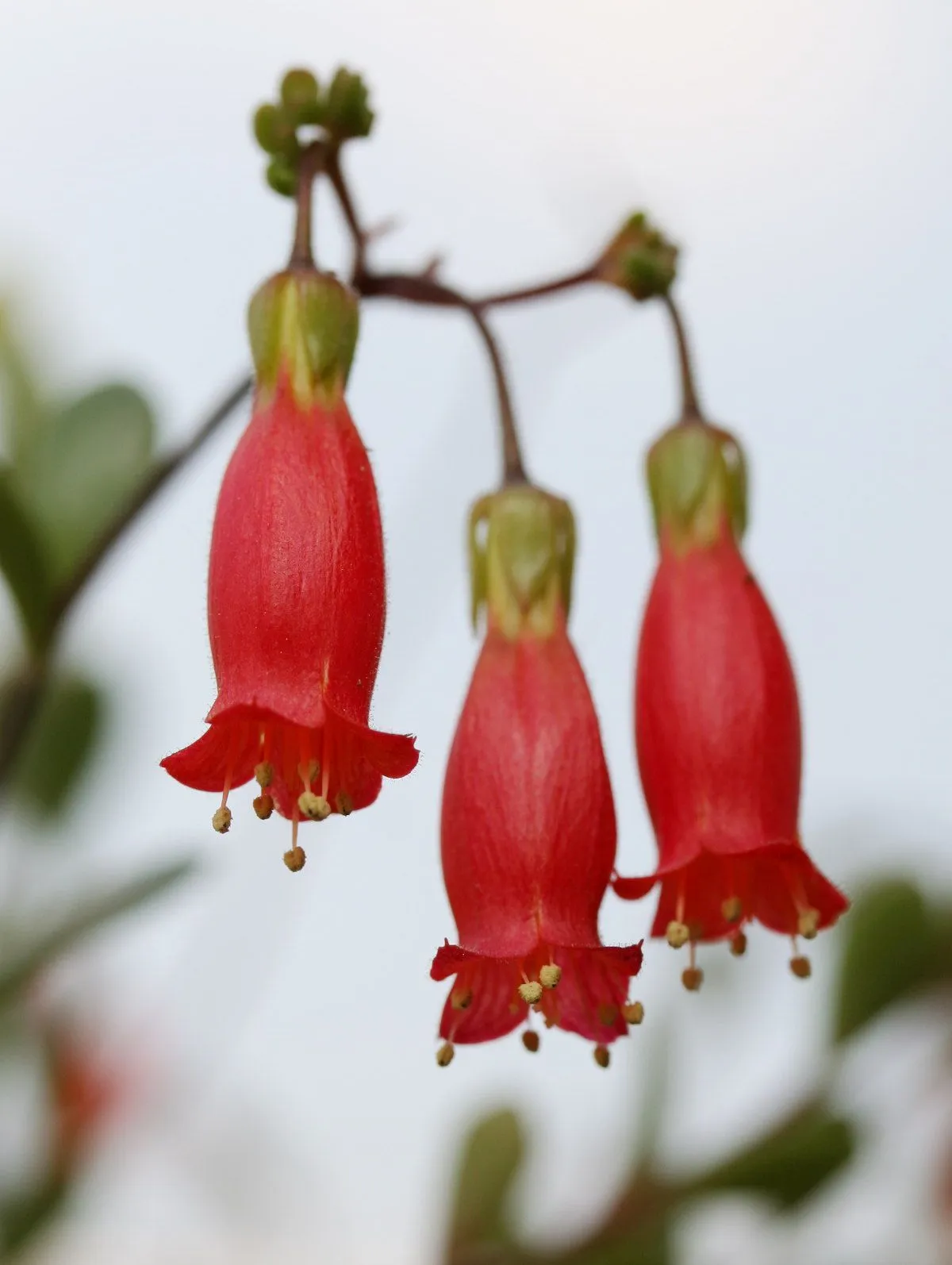
| How do you identify Kalanchoe manginii? | It is a pendulous shrub with small bright green leaves and scapes carrying two to four orange-red bell-shaped flowers. |
| How is Kalanchoe manginii different from Kalanchoe uniflora? | K. |
| How should Kalanchoe manginii be watered? | Soak the basket in active growth and let the upper 2–3 cm dry before watering again. |
| What is the best propagation method for Kalanchoe manginii? | Stem cuttings root in 10–18 days at 22–26 °C, and basket-layering roots nodes in 3–4 weeks. |
Kalanchoe manginii Hamet & Perrier, the chandelier plant, was described by Raymond Hamet and Henri Perrier de la Bâthie in 1908 and originally placed in the segregate genus Kitchingia (as Kitchingia manginii) before transfer to Kalanchoe. It is endemic to southwestern Madagascar, with most recorded populations sitting on rocky slopes around the Toliara region at roughly 500 to 1,500 m. The defining feature is the inflorescence: orange-red bell-shaped flowers carried in pendant clusters of two to four per stem, the trait that separates true K. manginii from the very similar Kalanchoe uniflora and the source of the chandelier trade name.
In habitat, K. manginii grows as a scrambling pendulous shrub on exposed quartzite and granite slopes, where stems trail over rock faces and roots wedge into thin mineral pockets. Conditions are bright but rarely shaded by canopy: rainfall is concentrated in a short austral summer, soils are shallow and gritty, and night temperatures fall sharply at the upper end of the elevation range. The natural rooting habit, with stems layering wherever they touch a damp pocket, produces the cascading mats that growers know from hanging baskets in cultivation. Conservation status is not currently flagged as threatened on the IUCN Red List, although the dry south of Madagascar has lost extensive habitat to charcoal harvesting and grazing.
Part of the Complete Kalanchoe Guide.
Identification
K. manginii is a small pendulous trailing to scrambling shrub of 30 to 50 cm. Stems are thin, flexible, and freely branched; mature shoots arch and hang well clear of a basket rim, often rooting where lower nodes meet damp substrate. The leaves are opposite, fleshy, ovate to broadly ovate, 1 to 2 cm long, glabrous (not felted), and bright mid-green with smooth entire margins. Stems exposed to brighter light may flush a faint red along the petiole and lower leaf edge, but the leaf tissue itself stays green; there is no glaucous bloom and no marginal serration.
The flowers are the diagnostic character. Each scape carries a small cluster of two to four bell-shaped, urn-tubular blooms in deep orange-red, each about 2 cm long, hanging like tiny lanterns at the stem tip. Flowering runs from late winter through spring. A mature basket can throw dozens of these scapes at once, and the cluster habit is what gives the chandelier trade name. The cluster count is the cleanest field separator within the pendulous Madagascan group.
Three confusions run through the trade. Kalanchoe uniflora is the closest match: also pendulous, also Madagascan, with similar small fleshy leaves. The clean separator is the inflorescence count: K. uniflora carries one bell-shaped coral pink to magenta flower per scape, K. manginii carries two to four orange-red bells per scape. Plants sold in nurseries as K. manginii are very often K. uniflora or hybrids between the two; check an open scape and count the buds before committing to either name. Coral bells, the trade vernacular for K. uniflora, is sometimes applied to K. manginii too, so the common name does not resolve the question. Kalanchoe miniata is a terrestrial upright subshrub rather than a pendulous trailer, with more saturated orange-red flowers held above the foliage on stiff stems; habit alone usually settles that one. Kalanchoe pumila is also small, but carries glaucous pale pink to lilac toothed leaves and pink flowers, a colour combination that K. manginii's bright green leaves and orange-red bells never produce.
Cultivation
Light should be bright but filtered through the warmest hours. K. manginii grows naturally on open rocky slopes, so it tolerates more direct sun than its epiphytic sibling K. uniflora, but indoor glass concentrates UV and the small green leaves bleach within a couple of warm afternoons against unshaded south-facing windows. A working position is an east window with a few hours of soft morning sun, a sheer-curtained south or west window, or steady bright LED supplementation. Outdoors in summer, give morning sun with light afternoon shade in hot Mediterranean conditions. Two to three hours of soft direct light noticeably improves flower set and tightens the internodes.
Water on substrate dryness rather than a fixed schedule. In active spring and summer growth, soak the basket thoroughly and let the upper 2 to 3 cm dry before the next pour. In a 14 to 16 cm hanging basket under bright indirect light, that often means watering every 7 to 10 days. With a moisture probe, pour when the upper 3 cm reads below about 18 percent. Ambient humidity in the 40 to 60 percent range suits the plant; it is more tolerant of dry indoor air than K. uniflora, which evolved in moist canopy litter, and slightly less tolerant of stagnant humid bathrooms.
Winter watering should ease back. When nights drop below 12 °C and growth slows, give only enough water to prevent leaf shrivel, often once every 3 to 4 weeks. The combination of damp substrate and cool roots is the usual route to stem-base rot in this species. Keep baskets out of cold draughts; the thin trailing stems mark quickly under cold-wet conditions and brown rapidly under hot dry blasts from radiators.
Substrate should drain freely with a small organic component for moisture buffering. A working mix is 60 to 70 percent mineral material (pumice, fine lava rock, perlite, or expanded shale) with the rest a low-peat or peat-free organic component. This is grittier than the substrate appropriate for K. uniflora, because K. manginii roots in mineral pockets on rock, not in moss on bark.
Temperature is the firm boundary. The practical lower limit is around 5 °C for a dry, established plant; below that, leaves drop and stems collapse. Keep flowering or recently watered specimens above 10 °C through winter. Indoor temperatures of 16 to 24 °C suit the species year-round, and brief summer warmth into the high 20s is fine if airflow is good.
Pot choice favours hanging baskets. The pendulous habit only displays well when stems can fall clear of the rim, so a shallow hanging basket 14 to 18 cm wide with side drainage is ideal. Plastic baskets work in dry rooms; coir-lined wire baskets dry faster and need more frequent watering. Wall-mounted half-pots are workable for a single specimen against a bright wall. Feed lightly in active growth: a balanced low-nitrogen succulent fertiliser at one-quarter to one-half label strength every 4 to 6 weeks, then stop by mid-autumn. The Beginner's Guide to Succulents covers the general principles, but treat K. manginii as a bright-light pendulous species rather than a sun-baked dryland default.
Propagation
Stem cuttings are reliable. Take a firm non-flowering shoot 5 to 8 cm long in late spring or summer, strip the lowest pair of leaves, and let the cut surface dry in bright shade for 2 to 3 days. Set the cutting upright in a 60/40 pumice and milled bark mix. At 22 to 26 °C, roots usually anchor in 10 to 18 days. Test by gentle tug; resistance signals new root contact. Begin light watering after that point and return to a normal soak-and-dry rhythm over the following few weeks. Strike rates above 80 percent are typical from healthy growing material in warm weather.
The species also self-roots at internodes that touch damp substrate, which makes basket-layering very effective. Pin a healthy node to damp moss or a fine bark mix with a hairpin or a short wire loop, hold light moisture for 3 to 4 weeks, and a small rooted plant will form that can be cut free and potted on. This is the fastest route to multiply a known clone, and it bypasses the callus phase entirely.
Leaf cuttings are unreliable for this species. The small ovate leaves rarely produce viable plantlets even under warm humid conditions, so do not rely on them. Seed is uncommon in domestic cultivation; flowers usually need cross-pollination between two unrelated clones, capsules are small, and seedlings are slow to develop a recognisable pendulous habit.
Notes
Trade-name confusion is the persistent issue with this species, and it runs in both directions. A large share of plants sold as K. manginii in supermarkets, garden centres, and online listings are in fact K. uniflora or K. uniflora × manginii hybrids; equally, plants labelled K. uniflora sometimes turn out to be true K. manginii misidentified at point of import. The only reliable test in the pot is a flowering scape: solitary flowers per scape mean K. uniflora, clusters of two to four mean true K. manginii, and intermediate or inconsistent counts on the same plant suggest a hybrid origin. Cultivar circulation is limited compared to K. blossfeldiana, but a small number of selections such as the orange-red 'Tessa' (a hybrid involving K. manginii) move through the European pot trade in late winter as compact flowering hanging baskets.
Like all Kalanchoe, K. manginii contains bufadienolide cardiac glycosides and should be treated as unsafe for cats, dogs, rabbits, and small children. Hanging basket placement helps here: a basket suspended above 1.8 m keeps trailing stems out of pet reach, but check that fallen leaves and pruned cuttings do not land where animals can sample them. Symptoms of ingestion include drooling, vomiting, and in larger doses cardiac arrhythmia; consult a vet promptly if a pet has chewed the foliage.
Mealybugs hide easily at leaf joints and under stem nodes, especially on long pendulous shoots that are slow to inspect from above. Lift the basket every two to three weeks and check both leaf surfaces with a hand lens. Treat small colonies with a cotton bud dipped in 70 percent isopropyl alcohol. Pruning to control basket length is best done in late spring; cut back to a firm node, hold water for 4 to 5 days, and the plant will branch out within a few weeks. Avoid hard pruning in mid-winter, when callus formation is slow and rot risk at the cut sits at its highest.
See also
- Complete Kalanchoe Guide
- Beginner's Guide to Succulents
- Kalanchoe uniflora, the close pendulous Madagascan sibling whose solitary coral-pink flowers per scape distinguish it from K. manginii's clusters of two to four.
- Kalanchoe blossfeldiana, the felted upright florist kalanchoe with dense panicles of small flowers, the genus's commercial mainstay.
- Kalanchoe fedtschenkoi — an upright Madagascan subshrub with lavender-scalloped leaves, useful context for the range of the genus beyond its pendulous basket forms.
Frequently Asked Questions
How do you identify Kalanchoe manginii?
It is a pendulous shrub with small bright green leaves and scapes carrying two to four orange-red bell-shaped flowers. The clustered flowers are the cleanest field character.
How is Kalanchoe manginii different from Kalanchoe uniflora?
K. manginii carries clusters of two to four orange-red flowers per scape. K. uniflora carries one coral-pink to magenta flower per scape.
How should Kalanchoe manginii be watered?
Soak the basket in active growth and let the upper 2–3 cm dry before watering again. In winter, water every 3–4 weeks only to prevent leaf shrivel.
What is the best propagation method for Kalanchoe manginii?
Stem cuttings root in 10–18 days at 22–26 °C, and basket-layering roots nodes in 3–4 weeks. Leaf cuttings are unreliable.