| Question | Short Answer |
|---|---|
| What is the first step for north-window succulents: what actually tolerates it? | Start by matching the symptom to the plant, substrate, light, and season before changing watering or treatment. |
| What should be avoided? | Avoid changing several variables at once; correct the limiting factor and observe the plant before escalating. |
| Which care factor matters most? | Match the plant to its light, substrate, pot size, and season. |
| When should the plant be checked again? | Recheck after one to two weeks unless tissue is actively collapsing. |
Quick Answer
The short answer: North windows give only diffuse light (100-300 µmol/m²/s in summer, less in winter). Only Haworthiopsis, Haworthia, Gasteria, and Sansevieria thrive there. Everything else etiolates.
Best first step: Use a PPFD meter - if under 100 µmol/m²/s, stick to shade-tolerant genera or add LED supplement.
Avoid: Putting Echeveria, cacti, or Agave on a north window - they'll stretch within weeks.
A north window in the Northern Hemisphere receives zero direct sun all year. It collects diffuse skylight, the soft glow that rebounds off the atmosphere and the building opposite, and that is the entire light budget. For most succulents, that is not enough to keep the rosette tight, the spines firm, or the colours saturated. A small group of genera, however, evolved in conditions close to the bright shade a north window provides, and those plants do well there without help. Everything else either etiolates within weeks, or needs an LED bar to make the position viable. Here is the rest of the picture.
Part of the Beginner's Guide to Succulents.
Why north windows are difficult
A north-facing window in the Northern Hemisphere never receives direct sunlight. The sun's path arcs through the southern half of the sky from sunrise to sunset, so the only light reaching a north sill is diffuse skylight: photons scattered by the atmosphere, reflected from clouds, or bounced off neighbouring buildings. Reverse the geometry for the Southern Hemisphere, where south is the equivalent dim direction; growers in Sydney, Cape Town, and Buenos Aires face the same problem in mirror image.
Diffuse light is gentler in colour and direction than direct sun, but it carries far fewer photons per square metre. The most cited threshold for compact, healthy growth in succulents is roughly 200 µmol/m²/s of photosynthetic photon flux density (PPFD) sustained for at least 6 hours a day. Below that band, most rosette species begin to stretch within four to six weeks: the central leaves push upward, internodes elongate, and any anthocyanin colour in the foliage washes out toward dull green. The plant is doing what evolution selected for in low-light conditions, reaching toward a brighter spot that does not exist on your sill.
The problem is not light quality; the spectrum at a north window is fine. The problem is light quantity. PAR meters do not lie, and at a north sill they read numbers most succulents cannot live on.
PPFD reality at a north window
Numbers below assume a clean single-glazed window in a temperate Northern Hemisphere city, no obstructions, no balcony overhang, mid-latitudes around 40 to 50° N.
| Season | Time of day | PPFD on sill |
|---|---|---|
| Summer (June solstice) | Midday | 100-300 µmol/m²/s |
| Summer | 4 hours either side of noon | 60-200 µmol/m²/s |
| Winter (December solstice) | Midday | 30-100 µmol/m²/s |
| Winter | Two hours either side of noon | 20-60 µmol/m²/s |
Compare those to the rough thresholds where most succulents stop etiolating: 200 µmol/m²/s for the soft Echeveria and Sedum group, 400 µmol/m²/s for Mammillaria and most globular cacti, 600 µmol/m²/s for Agave and the ribbed columnar cacti to keep tight spination. A summer north sill clears the first threshold for half a day; a winter north sill does not clear it at any hour.
Reflective surroundings can lift those numbers. A white painted neighbouring wall can add 30 to 50% on the sill side that faces it, and a snow-covered surface in front of the window during winter can raise the PPFD by another 50 to 100 µmol/m²/s in the brightest hours. Conversely, a tall building 20 m away, a balcony above the window, or a tree in leaf can drop the readings by half. Always read the actual sill before deciding what to grow there.
Genera that actually work
The species that tolerate a north window are the ones whose habitats are themselves shaded for most of the day. Many South African Asphodelaceae grow under bushes, beneath rock overhangs, or on south-facing slopes where the sun barely reaches them. These plants have evolved to harvest diffuse light efficiently, and the same biology that lets them survive in a Western Cape thicket lets them survive on a sill in Berlin.
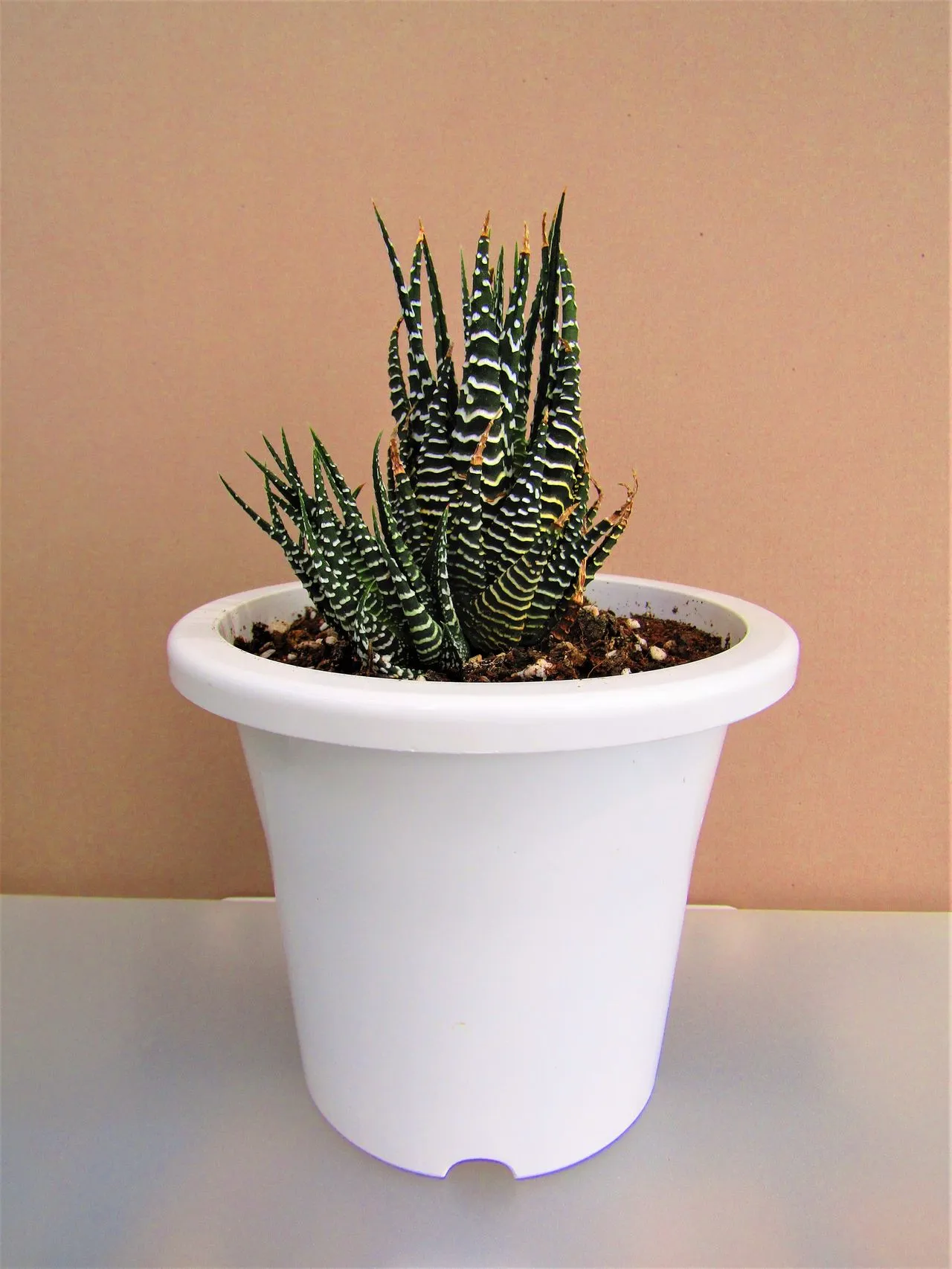
- Haworthiopsis attenuata, H. coarctata, H. tessellata: the zebra-plant group, with hard waxy leaves and white tubercular markings. They tolerate 100 to 200 µmol/m²/s indefinitely without etiolation. The leaf rosette stays tight and offsets reliably even in winter dim. H. attenuata is the workhorse, the species you will see in supermarket trays, and the one that asks the least of a north window.
- True Haworthia (H. cooperi, H. retusa, H. truncata, H. mirabilis): the soft window-leaved species. Their translucent leaf tips evolved to harvest light filtered through soil and shade, and direct sun behind glass usually scorches them. A north sill at 100 to 250 µmol/m²/s is closer to their ideal than a south sill at 1200.
- Gasteria (G. batesiana, G. carinata, G. bicolor, G. brachyphylla): a sister genus to Haworthia with the same shade tolerance. The leaves stay glossy and dark green, and the coral-pink flowers appear even on a north sill provided the plant is at least 4 years old.
- Soft "Aloe" (now mostly transferred to other genera): Aristaloe aristata (the lace aloe, formerly Aloe aristata) and Gonialoe variegata (partridge-breast aloe, formerly Aloe variegata) both grow naturally on shaded south-facing Karoo slopes and tolerate north-window light without stretching. G. variegata in particular flowers reliably indoors at PPFD as low as 150 µmol/m²/s.
- Dracaena trifasciata and its kin (formerly Sansevieria trifasciata, S. cylindrica, S. masoniana): not strictly Crassulaceae, but commonly bought as succulents and frequently asked about. These thrive on a north sill and will photosynthesise meaningfully even in deeper interior shade.
The common thread is leaf morphology. All of these plants run CAM photosynthesis (so they fix carbon at night, decoupled from peak light intensity) and most have either thick waxy cuticles or translucent leaf windows that gather low-angle diffuse light efficiently. They are not aspirational sun plants; they are species that genuinely prefer the shadier end of the gradient, and a north window puts them where they want to be. For the PPFD levels at other indoor window orientations, south vs east vs west window sets out the full indoor gradient.
Genera that fail
The longer list is the failure list. These are plants you will see suggested for north windows by retailers and hopeful blogs, and which will visibly suffer within two months at a north sill.
- Echeveria (every species, hybrid, and cultivar): the most reliable failures. Tight-rosette species like E. agavoides and E. elegans etiolate inside 6 to 8 weeks, with the central leaves elongating and the rosette opening into a flat spiral. Pruinose species like E. cante and E. laui lose the bloom that makes them desirable, and the new leaves come in flat green rather than blue-white. Echeveria is a south-or-east window genus; on a north sill it is a slow-motion disappointment.
- Most cacti (Mammillaria, Echinocactus, Ferocactus, Cereus, Trichocereus, Opuntia): etiolation appears as a paler, narrower zone of new growth at the apex, sometimes called a "pencil neck". Spines come in shorter and weaker; flowering stops entirely. Schlumbergera (the Christmas cactus) is the one cactus genus that genuinely tolerates north light, since it is epiphytic and forest-floor-adapted, but the desert genera that most growers want are universal failures.
- Agave (A. americana, A. parryi, A. victoriae-reginae, A. attenuata): even the comparatively shade-tolerant A. attenuata will lose the tight pineapple-cone shape on a north window and lengthen its leaves visibly within 3 months. Colours fade from blue-grey to pale jade.
- Crassula ovata (jade plant) and other tree-form Crassula: hold on longer than Echeveria, but a year on a north sill produces softer, larger, paler leaves, dropped lower foliage, and stems that bend toward the window. The plant survives. It does not look like the compact sculptural specimen the buyer expected.
- Most Sedum (S. morganianum, S. nussbaumerianum, S. rubrotinctum, S. clavatum): the colour-changing Sedum are bred for sun. On a north sill they revert to flat green, the strings of S. morganianum elongate with widely spaced leaves, and the trailing display loses its density.
- Kalanchoe (K. tomentosa, K. luciae, K. thyrsiflora, K. blossfeldiana): every commercially traded Kalanchoe needs more than 400 µmol/m²/s sustained to colour up and stay compact. K. blossfeldiana will refuse to flower on a north sill, since flowering is photoperiod-driven but bud-set requires a higher daily light integral than the position provides.
If one of these has been on a north window less than a month, you have time to act. Past three months, the rosette has usually committed to a stretched form that will not retract, and the only fix is propagation from cuttings on better light.
Supplementing with LED
A north window is not a hopeless position, only a constrained one. Adding a small horticultural LED bar transforms the budget. A 30 W full-spectrum LED bar mounted 30 cm above the sill delivers roughly 200 to 400 µmol/m²/s of useful PPFD at the substrate level, which moves the position from "shade tolerant only" up to "moderate-light succulents thrive". A 60 W bar at the same height reaches 500 to 800 µmol/m²/s, comfortable for most Echeveria, Sedum, and the smaller cacti.
Spectrum matters less than horticultural marketing suggests. Any 3500 to 6000 K full-spectrum white LED with a CRI above 90 covers what succulents need; the magenta blurple bars are no better and look unpleasant in a living room. The non-negotiable parameter is photoperiod. Run the lamp 12 to 14 hours daily on a mechanical timer, off-cycle aligned to your local night. A sustained daily light integral of 12 to 18 mol/m²/day is the working target, and a 30 W bar over a 60 cm sill on a 14-hour photoperiod meets that for plants in the front row.
Place the lamp close. PPFD falls off with the square of distance: doubling the height drops the photon flux to a quarter. A bar 15 cm above the leaves delivers roughly four times what the same bar at 30 cm delivers. Bring the lamp down until the leaves run 3 to 5 °C above ambient at midday, then back off 5 cm.
Heat is the only common LED problem worth designing around. A bar that warms the leaf above 35 °C in a closed room will dehydrate the plant faster than a south window would. Add a small clip-on fan and leave the window cracked when the lamp runs in summer.
When to admit it isn't working
Some windows are not salvageable, and recognising one early saves months of disappointment.
If your meter reads under 80 µmol/m²/s at midday in summer (heavy obstruction, deep overhang, north-facing balcony, or a wall 5 m from the glass), the position is below the floor for even the Haworthia group. Accept it as a foliage-houseplant slot, where pothos and Sansevieria relatives belong, or commit to LED supplementation as the primary light source.
If you bought a tight rosette specimen and watched it stretch over 8 weeks, the rosette is not coming back without propagating from the apex. A beheaded Echeveria roots in two to three weeks, and the new rosette tightens at full speed under proper light. Trying to "rescue" the original by moving it to a brighter window only relocates the stretched form.
If you find yourself rotating a plant 180° every few days to chase symmetry, that is a sign the light gradient across the rosette is steeper than the plant can balance with normal phototropism. Either commit to overhead LED that flattens the gradient, or move the plant.
A north window is not a sunlight problem to solve. It is a constraint to work with. Pick the genera that actually evolved into low diffuse light, or supplement the position with LED that lifts it into the moderate-light band. The plants that tell you the position is impossible by stretching toward the glass are not failing the window; the window is failing them.
See also
- A Beginner's Guide to Succulents, for the broader framework on light, water, and seasonal change.
- South vs east vs west window comparison, for sun-bearing positions and how to pick between them.
- LED grow light spectrum, for what colour and intensity actually matter when supplementing window light.
- LED Grow Lights Spectrum — fixture selection and photoperiod for supplementing north-window positions.
- Indoor Succulent Care — general indoor positioning and seasonal light management.
FAQ
Can Echeveria survive on a north window?
No. They'll etiolate (stretch) within 6-8 weeks. The rosette opens and leaves elongate. Only Haworthia, Gasteria, and Sansevieria tolerate north windows.
What's the minimum light for Haworthia?
100-200 µmol/m²/s sustained. North windows in summer provide this; winter drops below.
Do I need LED for a north window?
For shade-tolerant plants like Haworthia, no. For anything else, yes - a 30W LED bar 30cm above the plants adds 200-400 µmol/m²/s and makes the position viable.
Why do some plants work on north windows?
These plants evolved in South African shade under bushes or rock overhangs. They have efficient diffuse-light collection - translucent leaf windows (Haworthia) or waxy cuticles.
Frequently Asked Questions
What is the first step for north-window succulents: what actually tolerates it?
Start by matching the symptom to the plant, substrate, light, and season before changing watering or treatment.
What should be avoided?
Avoid changing several variables at once; correct the limiting factor and observe the plant before escalating.
Which care factor matters most?
Match the plant to its light, substrate, pot size, and season. Most succulent failures trace to a mismatch between drying speed and the plant's current growth rate.
When should the plant be checked again?
Recheck after one to two weeks unless tissue is actively collapsing. Stable firmness and new growth are better signs than a fixed calendar interval.