| Question | Short Answer |
|---|---|
| How far should LED grow lights be from my succulents? | 15-30cm for most full-spectrum LEDs. |
| What's the best light schedule for succulents? | 14 hours on, 10 hours off. |
| Can I use regular LED bulbs instead of grow lights? | Regular white LEDs can help but lack the red light peak that drives growth. |
| What is the first step for led grow lights for succulents: spectrum, ppfd, distance? | Position LED lights 15-30cm above plants. |
A succulent grown indoors below roughly 250 µmol/m²/s of PAR will etiolate. Stems lengthen, internodes stretch, leaf colour fades to a pale green, and the rosette leans toward the brightest window. A modest LED grow light fixes that for a fraction of the cost of moving house. Here is the rest of the picture.
Quick Answer
- Succulents need 200-400 µmol/m²/s (PAR) to thrive indoors - about 10,000-20,000 lux.
- Position LED lights 15-30cm above plants. Too close causes light burn; too far is ineffective.
- Use full spectrum (4000K-6500K) LEDs. Red/blue "blurple" lights work but look unnatural.
Part of the Beginner's Guide to Succulents.
When supplemental light makes sense
A north-facing window in winter delivers 100 to 250 µmol/m²/s at the sill on a clear day, less behind sheers. Most rosette succulents need 250 to 500 µmol/m²/s for 12 to 14 hours to keep their compact form. The arithmetic does not work without help. You either move the plant to a south or west window, or you add light.
The signs that a plant is light-starved are visible long before the plant dies. The first is a slow loss of pigment in the upper leaves, especially the violet, copper, and bronze tones that anthocyanin produces under stress. The second is internode elongation: the gap between successive leaves on the stem grows beyond what the species normally shows. The third is leaning, since the meristem orients toward the brightest available source. By the time you see all three, the plant has been short on photons for several weeks.
Supplemental light is also the cleanest fix when household geometry is fixed. A renter with one north window and a tall building blocking the south face cannot acclimate a Haworthia into a south position that does not exist. Adding 50 to 100 W of LED to that window is cheaper and faster than any structural workaround. For placements with usable south, east, or west windows, south vs east vs west window covers which window suits which genus before reaching for supplemental light.
Spectrum: full-spectrum vs blurple vs white
Photosynthetically active radiation runs from 400 to 700 nm. Plants do not use it evenly. Two bands carry most of the work. Blue, between 400 and 500 nm, drives compact growth: short internodes, thick cuticle, and photoreceptor signalling through cryptochrome and phototropin. Red, between 600 and 700 nm, drives stem elongation and flowering through the phytochrome system. Green is not wasted, since it penetrates deeper into a leaf, but the blue and red peaks do the most visible work.
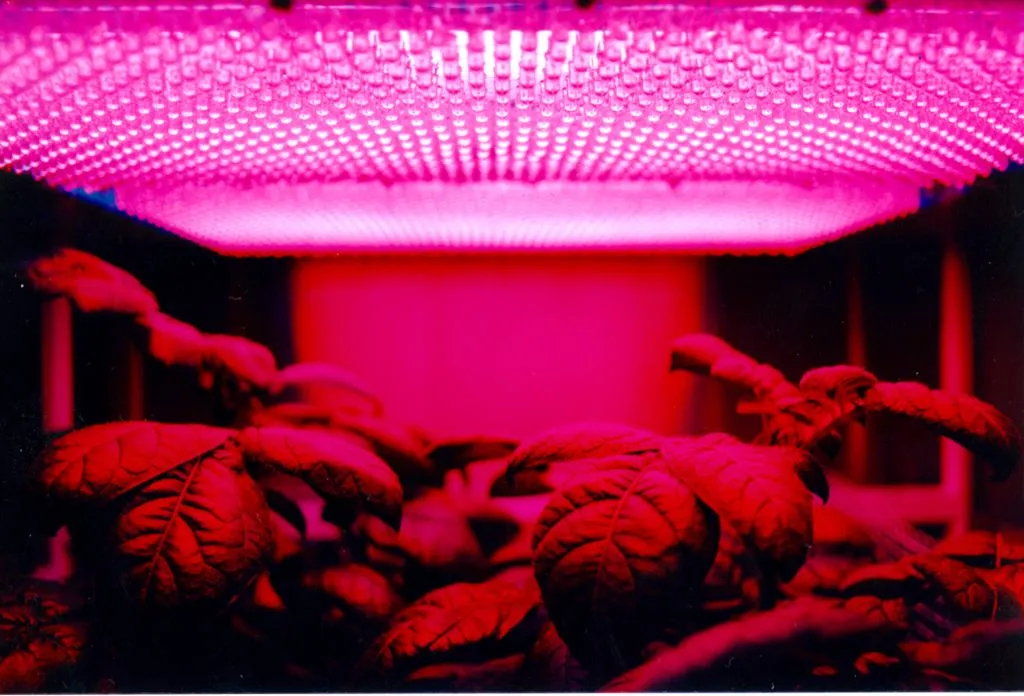
Three classes of fixture sit on the market. The oldest, often called blurple, mixes red and blue diodes (commonly around a 5:1 red-to-blue ratio) and produces the violet wash you see in older grow tents. Blurple is slightly more electrically efficient than white because it skips the wavelengths plants use least. The downside is practical: under blurple light you cannot see leaf colour, mealybug damage, or fungal lesions. The plant is healthy and you cannot tell.
Modern white-LED grow lights pair high-CRI 3000K to 5000K diodes with a red-band boost in the 660 nm range. They look like cool daylight, render plant colour faithfully, and produce PAR efficacy within a few percent of dedicated red and blue arrays. For indoor display growing, this is the format that wins. The fixtures from Mars Hydro (TS series), Spider Farmer (SF-1000), ViparSpectra (P1000), and AC Infinity (Ionboard S22) all sit in this format and run between roughly 80 and 150 € for ~100 to 150 W of board.
UV-A and far-red supplements are sold as add-ons. They have small documented effects on stress colouration and flowering, and are not necessary for healthy succulent vegetative growth.
PPFD targets by genus
The same fixture is too dim for a Trichocereus and too bright for a Haworthiopsis. Aim by genus and intended outcome.
| Group | Target PPFD (µmol/m²/s) | Notes |
|---|---|---|
| Soft Haworthia, Haworthiopsis, Gasteria | 150-300 | Above this, leaf tips burn and translucent windows scorch |
| Echeveria, Aloe, soft Crassula rosettes | 250-500 | Lower end keeps green form, upper end pulls anthocyanin |
| Columnar cacti, Mammillaria, Echinopsis | 400-700 | Tighter spination and slower stretch in the upper band |
| Lithops, Conophytum, hard mesembs | 600+ | Below this they elongate, lose window pattern, and split poorly |
These are sustained midday readings, not peaks. A peak of 800 µmol/m²/s is fine on a Lithops if the daily integrated total stays in the right band. The point is not the maximum that the fixture can deliver but the steady value at canopy height during the photoperiod.
A €50 to €150 quantum meter (Apogee MQ series, Photone Pro, LightScout) reads PPFD directly. The free Photone smartphone app, used with the front-facing camera and a diffuser, is accurate enough for placement decisions if you cannot justify a meter. Generic lux apps overestimate PPFD under white LEDs and underestimate it under blurple, so do not trust raw lux when the spectrum is unusual.
Distance from canopy
Most consumer LED grow lights are designed and rated at 30 to 45 cm above the canopy. That distance hits target PPFD for the rosette band when the fixture is run at full power. Closer than 25 cm and a 100 W board can push past 1000 µmol/m²/s on the central plants while edge plants sit at 200, producing a burned crown and a stretched ring. Further than 50 cm and the same fixture drops to 200 to 300 µmol/m²/s at the canopy, which is below the etiolation threshold for Echeveria and Aloe.
The inverse-square fall-off is steep at first and softens with distance. Doubling the gap from 25 cm to 50 cm cuts PPFD by roughly four. Going from 50 cm to 100 cm cuts it by another four. Adjust by gap, not by dimmer setting, when you can: many cheap dimmers cut current rather than driving the panel at lower duty, and the spectrum can drift slightly at low dim levels.
Photoperiod
The default vegetative schedule for succulents is 14 hours light, 10 hours dark. That mimics a long temperate spring day and matches the active growth window for most Crassulaceae, Asphodelaceae, and Cactaceae. A simple analogue or smart-plug timer is enough. Do not run a panel 24/7. CAM plants rely on the night cycle for stomatal opening and CO₂ uptake, and continuous light disrupts the rhythm without any gain in growth rate.
To induce flowering in dormancy-cued species (winter-blooming Mammillaria, several Echeveria, many Kalanchoe), invert the schedule for 6 to 10 weeks: 10 hours light, 14 hours dark, with the dark period uninterrupted by room lighting. Even a brief exposure to a ceiling lamp during the dark window resets the phytochrome clock and undoes the cue. A timer-controlled grow light makes this easy to enforce; a manually switched one does not.
Cost vs window-only growing
Run a 100 W LED panel 14 hours a day for a year and it draws roughly 510 kWh. At an indicative residential price of 0.30 €/kWh, that is about 153 € a year, plus 80 to 150 € for the fixture. A south window costs nothing to run.
The window wins on cost wherever it exists. Supplemental light wins where it does not, or where the available window is not enough for the species mix you keep. A north-window grower of Haworthia, Gasteria, and soft Echeveria can keep most of the collection under one 100 W board across about 0.4 m². A Lithops grower in any indoor situation almost always needs supplementation, since the genus rarely gets enough total daily PAR through household glass, even on a south sill in summer.
A useful middle path is a panel timed to fill in the morning and evening shoulder, with the window doing midday. Two extra hours of LED on either side of solar noon often closes the gap for plants that would etiolate on the window alone, at a fraction of the running cost of all-day supplementation.
What the marketing won't tell you
Wattage claims on the box are usually nonsense. A panel labelled "1500 W equivalent" frequently draws 100 W from the wall and produces 150 to 200 µmol/m²/s at 30 cm. The "equivalent" figure refers to a fictional comparison with old high-pressure sodium fixtures and has no defined standard. Read the actual draw at the wall, the rated PPF (µmol/s, output across the whole panel), and the PPFD-at-distance chart published by reputable manufacturers. If those numbers are missing from the listing, treat the wattage claim as marketing and assume real output sits in the lower third of what a similar published panel achieves.
PAR efficacy (µmol per joule) is the cleanest spec to compare. Modern white-LED panels from named brands sit at 2.3 to 2.7 µmol/J. Cheap unbranded boards from generic marketplaces commonly measure 1.3 to 1.7 µmol/J once tested independently. The cheap board is not a bargain when its photons cost roughly twice as much to produce.
The other unstated truth is that no fixture is plug-and-play. The same panel, hung at the wrong height over the wrong genus, can stretch a Haworthia and burn a Lithops in the same week. Measure the canopy, place the plant according to its target band, and verify the reading once or twice a season. The hardware is fine; the placement is the variable.
See also
- A Beginner's Guide to Succulents, for the broader framework on light, water, and seasonal change.
- Light acclimation protocol, for moving a plant between supplemental and natural light without sunburn.
- North window succulent options, for species that thrive on the lower PPFD bands without supplementation.
- South vs east vs west window: which natural window suits which genus before reaching for supplemental light
- Indoor succulent care: the broader light, watering, and seasonal framework that grow lights slot into
FAQ
How far should LED grow lights be from my succulents?15-30cm for most full-spectrum LEDs. Check the specific fixture's PPFD chart - too close causes burn, too far wastes light.
What's the best light schedule for succulents?14 hours on, 10 hours off. Use a timer to maintain consistency. Succulents need the dark period for CAM photosynthesis.
Can I use regular LED bulbs instead of grow lights?Regular white LEDs can help but lack the red light peak that drives growth. Full-spectrum grow LEDs are more effective.
Frequently Asked Questions
How far should LED grow lights be from my succulents?
15-30cm for most full-spectrum LEDs. Check the specific fixture's PPFD chart - too close causes burn, too far wastes light.
What's the best light schedule for succulents?
14 hours on, 10 hours off. Use a timer to maintain consistency. Succulents need the dark period for CAM photosynthesis.
Can I use regular LED bulbs instead of grow lights?
Regular white LEDs can help but lack the red light peak that drives growth. Full-spectrum grow LEDs are more effective.
What is the first step for led grow lights for succulents: spectrum, ppfd, distance?
Position LED lights 15-30cm above plants. Too close causes light burn; too far is ineffective.