Quick Answer
The short answer: Pumice is heavy, durable, and lasts 5-10+ years in a pot. Perlite is light, cheap, and breaks down in 2-3 years. For long-term succulents, pumice wins every time.
Best first step: Use pumice (3-8mm) as the structural backbone of your succulent mix. Save perlite for short-term uses like cutting trays or seedling flats.
Avoid: Using perlite as the main mineral in long-term pots - it compacts and slumps, suffocating roots.
Pumice and perlite are both volcanic-derived mineral aggregates sold for the same job, opening up substrate to air and drainage. They are not interchangeable. Pumice is heavy, durable, and stable for years; perlite is light, cheap, and breaks down within two or three pot cycles. For most succulents that will sit in the same pot for half a decade or more, the difference is structural. Here is the rest of the picture.
I'm Dr. Elena Martín, a Certified Advanced Cactus & Succulent Horticulturist and former curator of the succulent collection at the Jardín Botánico de Córdoba. Over twelve years of repotting, the bags I keep buying are pumice and lava grit. The perlite bags came and went, almost always for short-term work like cutting trays or quick germination flats.
Part of the Beginner's Guide to Succulents.
At a glance
| Property | Pumice | Perlite |
|---|---|---|
| Source | Mined and crushed volcanic glass | Heated and popped volcanic glass |
| Particle size (typical) | 1 to 15 mm | 1 to 5 mm |
| Bulk density | 0.5 to 1.0 g/cm³ | 0.05 to 0.15 g/cm³ |
| Porosity | 70 to 80% | 80 to 90% |
| Water retention by pot volume | ~30% | ~30% |
| Compaction over time | Negligible | Crushes under pot weight in 2 to 3 years |
| Working life in a pot | 5 to 10+ years | 2 to 3 years |
| Colour | Grey, tan, or buff | Bright white |
| Price (20 L bag, EU retail) | 15 to 25 EUR | 8 to 15 EUR |
Both materials hold a similar volume of water, around 30%, but they hold it in very different physical structures. That difference is what makes one of them age well and the other break down.
Pumice
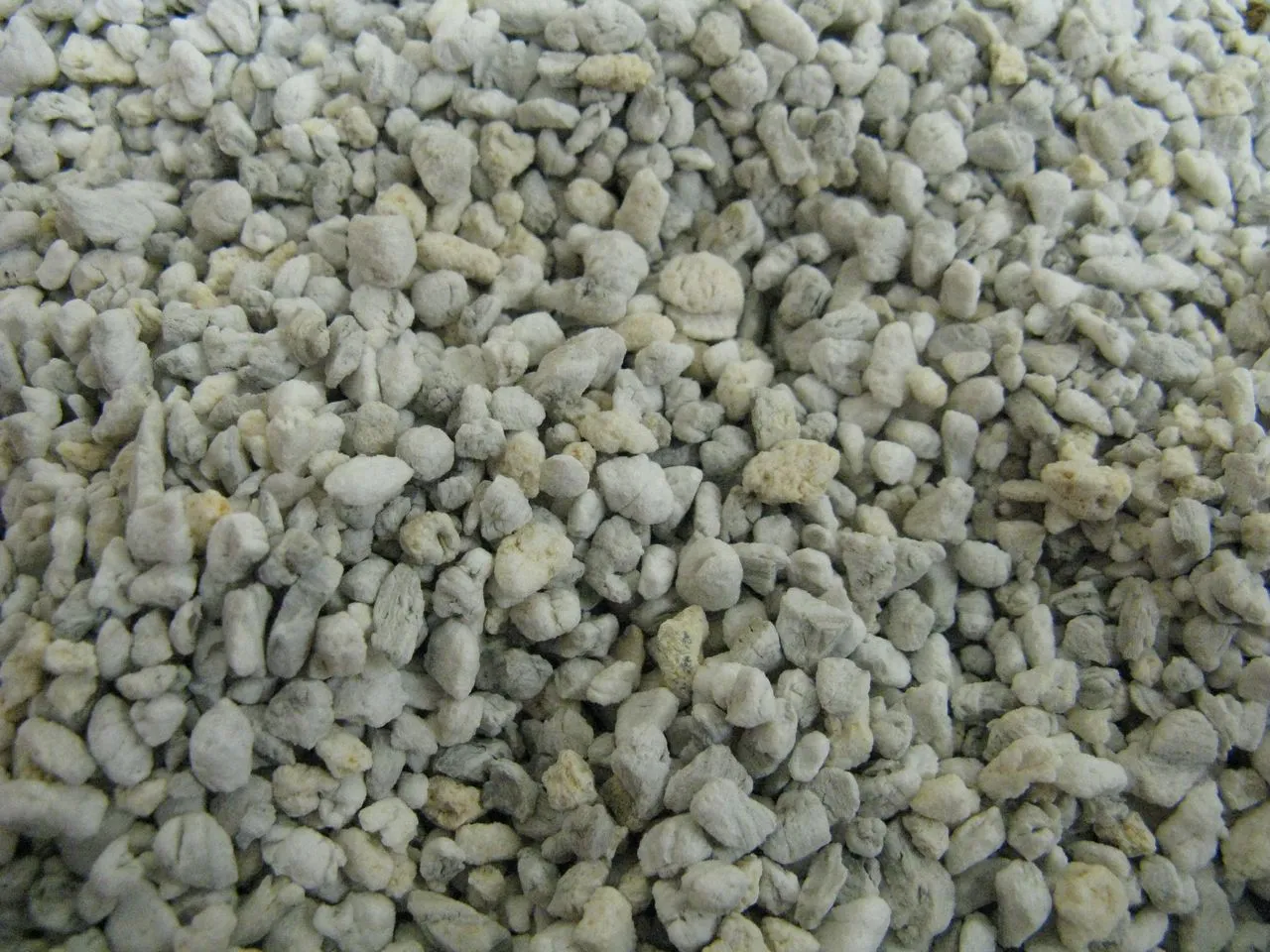
Pumice is solidified volcanic glass with a frothy, vesicular structure. When magma rich in dissolved gas erupts and cools quickly, the gas is trapped as bubbles in a glassy matrix. The resulting rock is so light it sometimes floats on water. For horticulture it is mined, dried, and crushed to a defined particle range, then screened to remove dust.
Typical bulk density runs from 0.5 to 1.0 g/cm³, depending on grade and moisture. A 20 L bag of horticultural pumice weighs roughly 10 to 20 kg. Each particle has thousands of internal pores that hold water by capillarity, and a rough exterior surface that grips fine roots. Total porosity sits around 70 to 80%, with about 30% of pot volume taken up by water at field capacity and the rest available as air.
The trait that matters most for long-lived succulents is mechanical durability. Pumice particles do not crush under the weight of substrate, the pressure of a fattening Echeveria root mat, or the lever of a top-heavy Aloe. A pot of pumice repotted after seven years still looks and behaves like the day it went in. The grade may have a slightly higher fines fraction from handling, but the air-filled pore structure remains.
Top-dressing with pumice has a quiet aesthetic advantage too. Grey or tan grit reads as habitat. It does not pull the eye away from the plant the way bright white does.
Perlite
Perlite begins as the same kind of volcanic glass, but it goes through a manufacturing step that transforms it. Crude perlite ore contains 2 to 5% chemically bound water. When it is crushed and heated to about 850 to 900 °C, that water flashes to steam and the softened glass puffs out, sometimes to twenty times its original volume. The result is a bright white, popcorn-like particle riddled with closed and open cells.
Bulk density drops accordingly, to roughly 0.05 to 0.15 g/cm³. A 20 L bag of perlite weighs only 1 to 3 kg. Particle sizes are typically 1 to 5 mm, with a much narrower size distribution than pumice. Porosity is very high, around 80 to 90%, but most of those cells are sealed inside the particle. Capillary water retention by pot volume still lands near 30%, comparable to pumice.
The structural drawback is that perlite particles are friable. The cell walls are thin, brittle glass. Under the weight of a packed pot, the pull of repeated wet-dry expansion, the grind of root growth, and the small mechanical shocks of moves and repottings, the particles fracture. Over two to three years a perlite-heavy mix loses its open structure. Fines collect at the bottom of the pot, perched water lingers, and aeration falls below the threshold succulent roots need.
Perlite also generates dust during handling. Inhaling it is irritating; rinsing the bag in a colander before mixing reduces the cloud. Even pre-rinsed, expect a film of white powder on the bench.
When pumice wins
The first scenario is any succulent that will live five years or more in the same pot. Slow growers, established cacti, mature Crassula ovata, large Agave in display containers, all of these reward a substrate that holds its structure for the long haul. Pumice does that; perlite does not.
The second scenario is heavy, top-loaded plants. A 30 cm Agave in a 25 cm pot can lever the rim around when wind catches it, and a tall columnar cactus can rock the pot when handled. Pumice's weight stabilises the pot on the bench, on the windowsill, and on the bottom shelf of a sales bench. Perlite is so light that a fully potted, fully watered hanging Senecio in pure perlite still feels almost empty in the hand.
Third, pumice is the practical choice when you want larger particle sizes. Cactus mixes built for breathability often run 3 to 8 mm grit; coarse top-dressing for display work runs 8 to 15 mm. Perlite does not come in those grades at retail. The largest commonly available perlite is "coarse" grade in the 3 to 6 mm range, and it is fragile at the upper end.
Fourth, pumice top-dressing finishes the pot rather than fighting it. The grey or buff colour reads as habitat, and pumice particles stay where they are placed. Perlite top-dressing tends to drift and pop loose during watering, leaving a halo of white pieces around the pot foot.
When perlite wins
Cost matters and perlite is half to two-thirds the price of pumice. For commercial propagation flats, seedling trays, or cutting boxes that will be torn down inside a single season, the durability advantage of pumice is wasted. A 30 L bag of perlite at 10 to 12 EUR will mix into many trays of cuttings.
Weight matters in some pots. Tall plastic columns, hanging baskets full of Sedum morganianum, mounted vertical planters, and shipping setups all benefit from low-density substrate. A perlite-rich mix can save several kilograms across a full shelf and reduces the chance that a hook or bracket pulls out under load.
Particle uniformity is sometimes useful. Seed sowing for tiny taxa, including most Lithops, Aloinopsis, or Conophytum, works better in finer, more uniform substrate than coarse pumice provides. A 50/50 blend of fine perlite (1 to 2 mm) and a sieved mineral fraction gives the smooth bed those seedlings need without the bulk of larger grit.
Perlite is also fine when you mean to repot every one or two years anyway. Production growers selling annuals out of nursery pots, or hobbyists who repot like clockwork in spring, never see the long-term breakdown problem because the substrate is replaced before it fails.
Sourcing and grading
In Europe, the cleanest way to find pumice is to search for "horticultural pumice" plus a particle range, for example "horticultural pumice 2 to 6 mm" or "pumice grit 3 to 8 mm". Bonsai and cactus suppliers usually carry pre-screened bags. Expect 15 to 25 EUR for a 20 L sack, with bonsai-grade material at the higher end. Bulk landscape pumice can be cheaper but often arrives with high fines and needs sieving.
Useful pumice grades for succulents:
- 1 to 3 mm: seedling and cutting mixes, top-dressing for very small pots.
- 3 to 8 mm: the standard cactus and succulent grit, suitable for most adult plants and for the bulk of any mineral mix.
- 8 to 15 mm: large pot drainage layers, sculptural top-dressing for display Agave and columnar cacti.
Perlite is sold by horticultural and DIY suppliers across Europe at 8 to 15 EUR per 20 L. Most consumer perlite is "medium" grade, around 1 to 4 mm. "Fine" (sub-1 mm) is sold for seed-starting and is too small for general succulent use. Coarse perlite (3 to 6 mm) is the most useful grade if you intend to mix it into adult plant substrate; finer grades collapse and clog faster.
Always rinse perlite before mixing. The dust is silicate fines and is more annoying than dangerous, but it irritates lungs and clogs sieves. A coarse colander and a gentle stream of water removes the worst of it within a minute.
Common mistakes
The most expensive mistake is using fine perlite (under 1 mm) as the mineral fraction in an adult succulent mix. Those particles are below the size where they keep pores open. Combined with even a small organic component, they slump into a paste within months. The pot looks well drained on day one and rots roots by month four.
Mixing perlite with peat shortens its life on both sides. Peat acidifies as it decomposes and the breakdown produces mild acids that attack the perlite glass surface. The combination ages faster than perlite alone in a mineral mix. If your base is peat-based, perlite is not a long-term aerator; it is a temporary one.
Top-dressing with perlite is mostly an aesthetic mistake. The bright white reads as packing material, drifts during watering, and floats off the pot under heavier irrigation. Anything you want to look like a finished arrangement should be top-dressed with pumice, lava grit, decomposed granite, or a similar mineral that sits and stays.
A subtler mistake is buying "pumice" that turns out to be lava rock or scoria. Both are useful and similarly durable, but lava is denser and less porous than true pumice, so the same volume holds less water and weighs more. Read the bag, and if you can, run a particle through your fingers; pumice rasps the skin and floats briefly when dropped in water, while lava rock sinks and feels harder. For the properties and sourcing of lava rock specifically, lava rock substrate covers how it differs from pumice in pot weight, colour, and water-holding.
The final mistake is replacing pumice with perlite to save money on plants you intend to keep for a decade. The substrate fails inside the third year, the plant declines through year four with roots in slumped fines, and the repot you finally do is a damage-control operation rather than maintenance. The perlite saved 15 EUR; the lost root mass cost a season of growth.
See also
- A Beginner's Guide to Succulents: how mineral fractions, pot sizes, and watering rhythm fit together
- Akadama for succulents: the Japanese fired-clay alternative and where it overlaps with pumice
- DIY substrate mixing: ratios for combining pumice, perlite, lava, and a small organic fraction
- John Innes and Succulents — the organic component that pairs with pumice in Aeonium and Crassula mixes.
- Top Dressing Materials — how pumice grit finishes a pot compared to perlite and other surface options.
FAQ
Is perlite ever better than pumice?
Yes - for propagation (cuttings, seedlings) that you'll repot within 1-2 years, perlite is cheaper and fine. Also useful for hanging baskets where weight matters.
Why does my perlite mix go compact?
Perlite particles are fragile glass - they crush under pot weight and wet-dry cycles. Within 2-3 years, the structure collapses and fines block drainage.
Can I mix pumice and perlite?
Yes, but it's usually unnecessary. Use pumice as your main mineral for long-term pots; add perlite only for specific short-term situations.
What's wrong with perlite top-dressing?
Perlite is bright white and looks like packing material. It drifts during watering and floats away. Use pumice or lava grit for top-dressing.
Frequently Asked Questions
What is the first step for pumice vs perlite: which one, when, and why?
Start by matching the symptom to the plant, substrate, light, and season before changing watering or treatment.
What should be avoided?
Avoid changing several variables at once; correct the limiting factor and observe the plant before escalating.
Which care factor matters most?
Match the plant to its light, substrate, pot size, and season. Most succulent failures trace to a mismatch between drying speed and the plant's current growth rate.
When should the plant be checked again?
Recheck after one to two weeks unless tissue is actively collapsing. Stable firmness and new growth are better signs than a fixed calendar interval.